

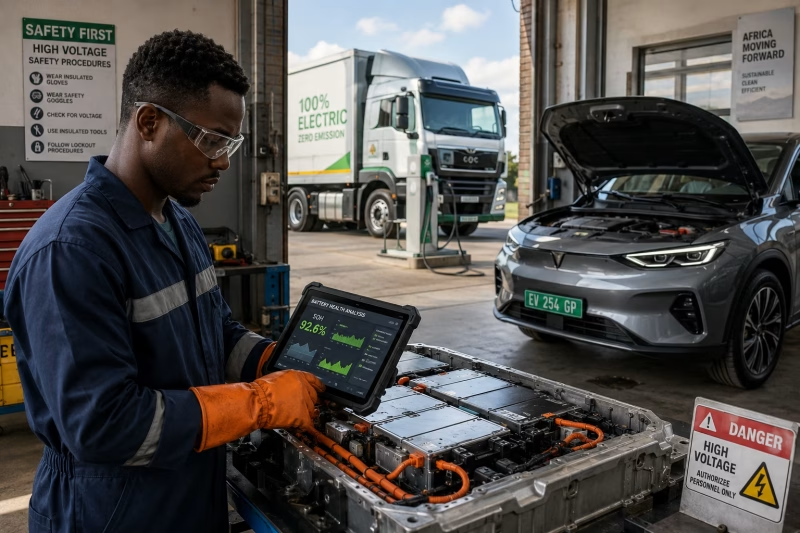
For decades, the automotive industry in Africa viewed the battery as a relatively simple component. It started the engine, powered lighting and supported basic electrical systems. Today, that role is changing rapidly.
Modern vehicles depend on batteries for far more than starting the engine. Advanced driver-assistance systems, electronic control units, infotainment, telematics and start-stop systems all depend on reliable electrical power, while hybrid and electric vehicles rely on much larger battery systems for propulsion and energy management.
For you as a vehicle owner, fleet operator, workshop professional or parts distributor, this shift has important consequences. Battery technology is becoming a core part of vehicle performance, maintenance and profitability.
The Battery Is Becoming More Important
Modern vehicles contain an expanding network of electronic systems. Even conventional internal-combustion vehicles now rely heavily on sensors, computers and electronically controlled components. That means a weak battery can create problems that appear unrelated to the battery itself. A vehicle may struggle to start, produce warning lights, experience electronic faults or behave unpredictably when voltage becomes unstable. In fleets, repeated battery failures can also translate directly into downtime, missed deliveries and higher maintenance costs.
The challenge becomes even greater as Africa adopts more hybrid and electric vehicles. The International Energy Agency (IEA) reported that global battery demand for electric vehicles exceeded 950 GWh in 2024, rising 25% from 2023. Demand from electric trucks alone grew by more than 75%.
These global numbers matter for Africa because vehicles, technologies and components increasingly cross international markets. The skills, tools and battery-management practices developing in mature EV markets will increasingly influence African workshops and fleets.
Africa faces a different battery challenge
Battery technology does not operate in isolation. African operating conditions can make battery management more demanding. High ambient temperatures can accelerate battery degradation, making thermal management especially important in many African markets. Long-distance driving can increase energy demands. Poor road conditions can expose components to vibration and physical stress. Unreliable electricity supplies can complicate charging infrastructure and workshop operations.
Fleet operators must therefore look beyond battery capacity. They need to understand battery health, charging behaviour, thermal management, state of charge and state of health. These factors can influence vehicle reliability and the cost of ownership. For workshops, this creates another challenge: technicians need new diagnostic capabilities. Experience with conventional 12-volt systems does not automatically qualify a technician to diagnose or work safely on high-voltage EV battery systems.
Falling Battery Prices are Changing the Equation
There is also good news. Battery technology is becoming more affordable. BloombergNEF reported that average lithium-ion battery pack prices fell to $108 per kWh in 2025, an 8% decline from 2024 and a new record low. Battery-electric vehicle packs averaged $99 per kWh. The IEA also reports that LFP batteries have become significantly cheaper than NMC alternatives, helping accelerate their adoption in electric vehicles. Lower battery costs can make electric mobility increasingly attractive.
But do not assume that cheaper batteries automatically mean cheaper vehicles or simpler ownership. Import costs, taxes, financing, charging infrastructure, replacement parts, technician availability and local supply chains can still significantly affect the final cost in African markets. The opportunity lies in building the ecosystem around the technology.
Battery Health will Become a Maintenance Priority
One of the biggest changes for the aftermarket will be the growing importance of battery-health management alongside battery replacement. Traditional maintenance often focuses on whether a battery starts the vehicle. Modern battery management requires a more detailed approach.
Workshops will increasingly need diagnostic equipment capable of identifying battery condition and electronic faults. Fleet managers will need data to track battery degradation patterns. Technicians will need to interpret battery-management-system information rather than relying only on visual inspection or basic voltage testing.
This creates an opportunity for the aftermarket. Workshops that invest early in battery diagnostics, technician training and high-voltage safety can position themselves ahead of competitors. Parts distributors can also expand beyond conventional starter batteries into battery-management components, charging equipment, diagnostic tools and EV-related service products.
Training Cannot Be an Afterthought
The skills gap may become one of the biggest barriers to battery adoption. Electric and hybrid vehicles require technicians who understand electrical systems, battery architecture, high-voltage safety and electronic diagnostics. Workshops also need appropriate protective equipment, insulated tools and procedures for isolating high-voltage systems. This does not mean every technician needs to become a battery engineer. It does mean the aftermarket must create practical training pathways.
Technical colleges, vehicle manufacturers, component suppliers, workshops and industry associations can work together to develop training that reflects African operating conditions. Training should cover both technology and safety. A technician must know not only how a battery works but also when a system should not be touched without the correct isolation procedure and equipment.
Fleets Should Start Preparing Now
Fleet operators have perhaps the strongest reason to take battery technology seriously. Whether a fleet remains largely diesel- and petrol-powered or gradually introduces hybrids and EVs, reliable battery performance already affects operational reliability. Telematics can help operators monitor vehicle behaviour, charging patterns and energy consumption. Preventive maintenance can identify weak batteries before they cause roadside failures.
For electric fleets, the business case becomes even more data-driven. Operators need to understand charging schedules, battery degradation, route requirements and vehicle utilisation. The cheapest vehicle to purchase may not necessarily be the cheapest vehicle to operate. The right question is increasingly: How efficiently can the vehicle store, manage and use energy throughout its working life?
Africa Should Build More than an EV Market
Africa should not approach battery technology simply as a vehicle-import story. The continent has an opportunity to develop capabilities around battery servicing, diagnostics, recycling, second-life applications, energy storage and component supply. Battery demand is expanding beyond vehicles. The IEA says total battery demand across the energy sector reached 1 TWh in 2024, with EVs accounting for the largest share. That creates potential links between automotive, renewable energy and energy-storage industries.
A battery removed from a vehicle may eventually have applications in stationary energy storage, depending on its remaining capacity, condition and economics. Responsible recycling will also become increasingly important as more batteries reach the end of their useful automotive life.
What Should the Automotive Aftermarket Do?
The transition does not require African businesses to abandon conventional vehicle technology overnight. Instead, the aftermarket should prepare progressively.
- Workshops should invest in training and diagnostic equipment.
- Fleet operators should monitor battery health and energy performance.
- Parts distributors should understand emerging battery technologies.
- Technical institutions should expand EV and battery curricula.
- Policymakers should support standards, skills development, charging infrastructure and responsible battery recycling.
Most importantly, the industry should treat battery technology as a mainstream automotive issue rather than a niche EV subject.
The Battery is Becoming Part of the Vehicle’s Intelligence
The modern vehicle is increasingly a software-controlled machine whose performance depends on stable, intelligent energy management. Africa’s transition will not happen at exactly the same speed everywhere. Markets differ in income, infrastructure, vehicle fleets and policy. Yet the direction is clear. Battery technology is moving closer to the center of automotive maintenance.
For the African aftermarket, the question is no longer whether batteries will become more important. The real question is whether workshops, fleets, suppliers and technicians will be ready as battery technology becomes impossible to ignore.
Read More:
Sustainability in the Aftermarket: From Compliance to Advantage
How Smart Garages Are Changing African Automotive Service
Counterfeit vs Genuine: Can Workshops Really Tell the Difference?
Why Vehicle Cybersecurity Is Becoming a New Safety Priority
Cox Automotive Acquires Dickinson Fleet Services
AAPEX 2023

