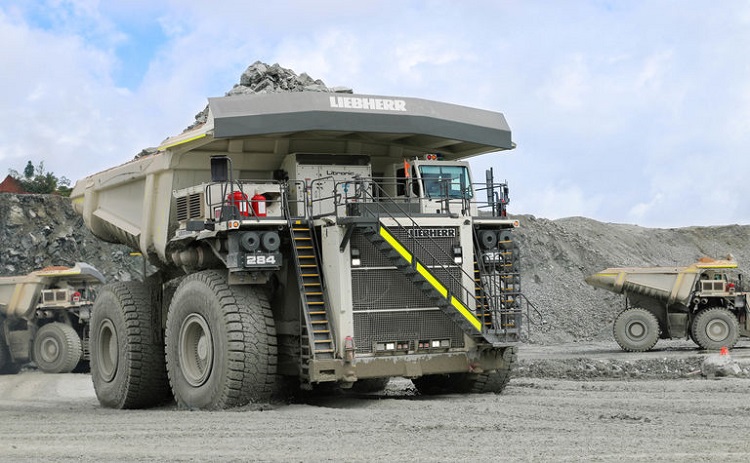
Liebherr has increased the payload capacity of its T 264 ultra-class mining trucks to 240 tonnes following the implementation of several upgrades. The changes include a front wheel design and braking system that improve torque and operational safety, particularly during downhill operations. Upgraded wheel motors and rear gear ratio can ensure similar cycle times while boosting payloads by 10 per cent.
Liebherr stated the T 264 would be best matched with the company’s four-pass R 996 B and three-pass R 9800 mining excavators. Additionally, its T 282 C and older T 284 models can be retrofitted to increase payloads and capacity up to a total of 375 tonnes.
Engine power ratings for the T 264 are also available up to 2013 kilowatts, supporting increased payloads. Tier 4 engines, which can help reduce emissions when compared with alternative engine models, are available for the T 264 and T 284 models.
Liebherr’s online portal Liebherr Mining Data (LMD), which delivers real-time performance data related to the company’s mining trucks, is now standard with all new Liebherr ultra-class mining trucks, and can also be retrofitted for older T 282 C trucks.
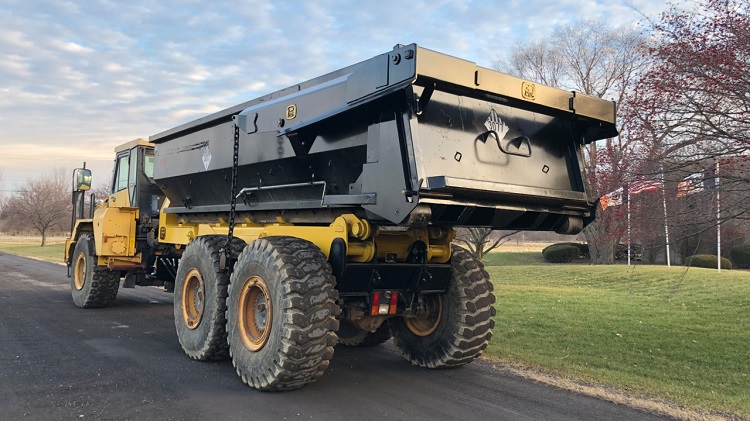
Illinois-based Philippi-Hagenbuch has announced the launching of a new version of its Autogate Tailgate specifically designed for off-highway trucks and roll-off containers that require a 100% positive seal.
In a press release, the truck customization company said that the new machine can be paired with its fluidic seal material to create a water-tight seal that contains liquid materials within an off-highway truck body or roll-off container. In the firm’s view, this is particularly important when environmental regulations or local laws make even slight spillage undesirable.
Philippi-Hagenbuch explained that the way the Autogate Tailgate works is that it builds up the rearmost portion of the truck body or container to create a cohesive flange from which the tailgate compresses. Two hooks on either side of the base of the flange intercept a corresponding tag on the tailgate, allowing the tailgate to pivot inward as the sidearm and over-center locking mechanism compressively lock the rear tailgate into place.
“The new Positive Seal Autogate Tailgate can be designed for practically any size off-highway truck or roll-off container,” the media brief reads. “Paired with PHIL’s simple yet robust outrigger, its traditional scissors-style mechanism provides an industry-leading maximum opening clearance at full dump. In the closed position, the new design positively locks into place and will not open under normal conditions without the body or container entering the ‘dump’ mode.”
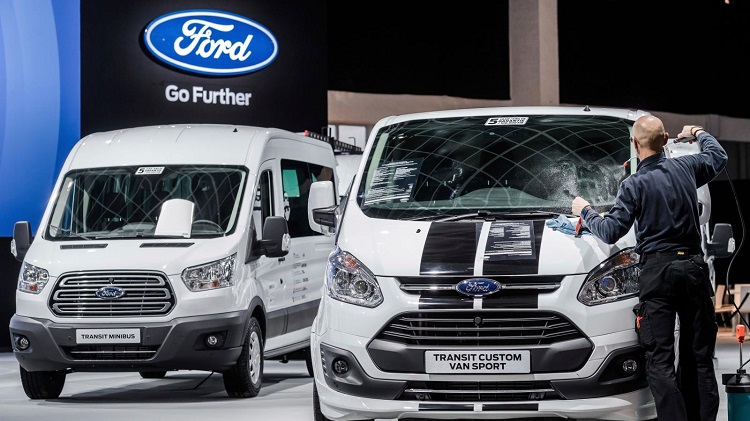
Ford and Volkswagen plan to build commercial vans and medium-sized pickup trucks together as early as 2022 as part of the new found partnership. The partnership is expected to boost annual pre-tax operating results for both companies starting in 2023, the two companies said in announcing the agreement on the second day of the North American International Auto Show in Detroit.
They also signed a “memorandum of understanding” to work together on autonomous vehicle research and will consider new vehicle programs in the future, Ford CEO Jim Hackett said.
It is the first formal agreement in a broad alliance between the American and German automakers. The Ford-Volkswagen partnership will be governed by a joint committee led by Hackettand Volkswagen CEO Herbert Diess.
“I want to emphasize simplicity and speed here,” said Hackett on the call. He added the firms have spent a considerable amount of time focusing on how they can collaborate effectively.
However, the two firms will not take ownership stakes in each other, French carmaker Renault did with Japan’s Nissan in the late 1990s. While the Renault deal seemed to work seamlessly for years, it appears to be crumbling following the arrest of Nissan’s former Chairman Carlos Ghosn, which some industry executives say is politically motivated to wrest control away from Renault.
“Ford and Volkswagen will continue operating as two separate and competitive entities,” Hackett said.
Both firms already have commercial vehicle businesses. Ford currently produces the Transit line of commercial vans and the Ranger mid-size pickup, while Volkswagen currently makes the Transporter and Caddy vans and Amarok pickup truck.
Ford is going to make medium-size pickups and commercial vans for the partnership while Volkswagen will develop a city van, Hackett said on the call.
The medium-sized pickup will be made for markets in Africa, South America and Europe only so far.
The news follows Volkswagen’s Monday announcement that it will invest $800 million to beginning manufacturing electric vehicle technology in Chattanooga, Tennessee.
“This underlies our strong commitment to the United States,” Diess said.
Last week, Ford said it plans to cut thousands of jobs across Europe in an effort to turn around its business in the region, where it has struggled to maintain profitability.
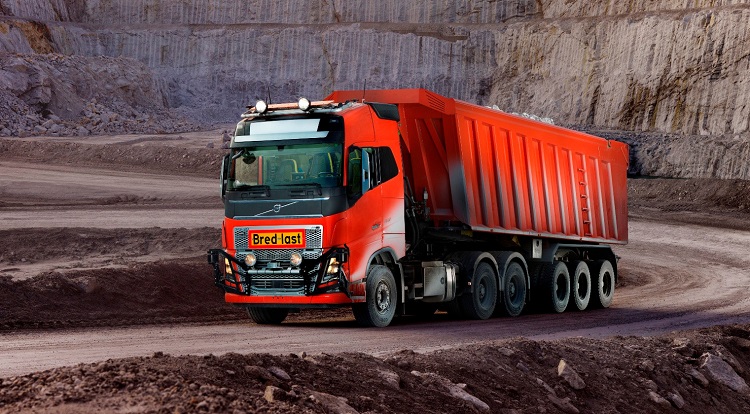
Volvo has announced a commercial first for its autonomous trucking endeavors. The Swedish automotive company has signed a deal with Norwegian mine Brønnøy Kalk to transport limestone along five kilometers of roads and tunnels from the mine to a nearby port using self-driving trucks.
Volvo has engaged in a number of pilots in recent years to get its autonomous trucks ready for commercial projects. In Brazil, Volvo trialed self-steering trucksto help sugarcane farmers improve crop yield, and it has also tested an autonomous garbage collection truck. As early as 2016, Volvo was testing autonomous trucks in an underground mine in Sweden, part of an initiative to demonstrate the technology as a means of improving both efficiency and safety in hazardous conditions.
Going commercial
Inking its first commercial deal, however, is a notable development not only for Volvo’s self-driving trucks, but for the broader autonomous vehicle push. Indeed, self-driving vehicles won’t just land on public roads overnight — they will likely seep into society gradually, with niche cases that use preset routes serving as the foundation for a bigger expansion.
“It is exciting to reach this point where we introduce autonomous solutions,” said Volvo Trucks’ director of autonomous solutions, Sasko Cuklev. “By working in a confined area on a predetermined route, we can find out how to get the best out of the solution and tailor it according to specific customer needs. This is all about collaborating to develop new solutions, providing greater flexibility and efficiency, as well as increased productivity.”
Above: Volvo autonomous truck offloading limestone into a crusher at a nearby port
It’s also worth noting here that Volvo isn’t selling trucks to the mine; it’s selling a transport service. Volvo owns the trucks, and Brønnøy Kalk pays per tonne of limestone delivered. Using this business model, it is much easier for Volvo to convince companies to jump on board, as it requires minimal up-front investment.
“This is an important step for us,” said Brønnøy Kalk mine managing director Raymond Langfjord. “The competition in the industry is tough. We are continuously looking to increase our efficiency and productivity long-term, and we have a clear vision of taking advantage of new opportunities in technology and digital solutions. Going autonomous will greatly increase our competitiveness in a tough global market.”
The Brønnøy Kalk mine will utilize six autonomous Volvo trucks. And while initial tests did use safety drivers, when the vehicles are put into full official operation by the end of next year, they will be entirely self-sufficient.
Above: Volvo self-driving trucks: Where’s the driver?
Truck on
A number of other autonomous trucking companies are already entering the early stages of commercial operations, including Sweden’s Einride, which recently signed a deal with logistics giant DB Schenker, who will use Einride’s all-electric autonomous T-pod to transport goods on-site to and from a warehouse. This is expected to set the foundation for an eventual expansion into road freight transportation.
A number of companies have raised significant investment for various trucking technologies, many of which leverage automation, while Volvo itself recently debuted a new concept electric autonomous truck it calls Vera.
“The global transport needs are continuously changing at a very high pace, and the industry is demanding new and advanced solutions to stay ahead,” added Volvo Trucks president Claes Nilsson. “Our aim is to be the leader of the development of products and services to respond to these demands.”
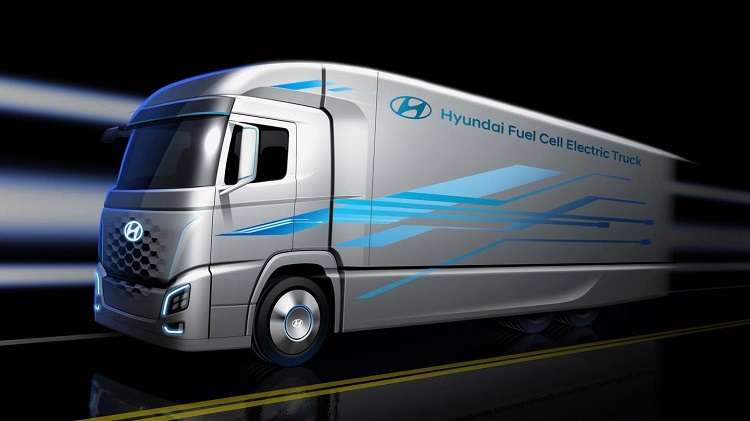
Hyundai Motor says it will sell 1,000 hydrogen-powered trucks in Switzerland over the next five years through a new tie-up, betting the vehicles could beat battery-powered models sold by the likes of Tesla Inc.
South Korea’s Hyundai and Japan’s Toyota are among a handful of car makers doubling down on hydrogen vehicles amid an intensifying global race to develop greener technologies to replace combustion engines, as regulators around the world crack down on emissions.
The deal, which will double Hyundai’s hydrogen vehicle sales, marks its latest push into a technology that has lagged battery electric vehicles. Hyundai, whose profits have tumbled due to a heavy reliance on low-demand sedans, hopes to burnish its brand image by taking the lead in hydrogen cars.
In a statement, Hyundai said it will partner with Swiss hydrogen company H2 Energy and fuel cell operators to provide 1,000 hydrogen trucks in the country after launching at the end of 2019 what it says will be the world’s first commercial hydrogen trucks. It did not provide any financial details.
The launch timeline is ahead of battery-powered trucks Tesla and Daimler plan to introduce in 2020 and 2021, respectively.
Hyundai announced a partnership with Audi in June to share each other’s hydrogen car technology and components to bring down production costs and make the technology profitable.
For long-haul, hydrogen trucks have a huge advantage over battery rivals as heavy batteries can reduce cargo capacity and require longer charging times, Mark Freymueller, a commercial vehicle director at Hyundai Motor, told Reuters. Hyundai said its hydrogen trucks are expected to deliver a single-fueling travel range of around 400 kilometers.
“We are not planning just purely 1,000 vehicles and then stop the business… We expect that much more is coming afterwards,” he said, adding Hyundai would look at launching it in the United States, China and other European countries.
Freymueller said expanding into other markets, however, will depend on finding partners such as pump operators and hydrogen suppliers.
The uptake of hydrogen cars, which are propelled by electricity generated by fuel cells, has been held back by a lack of infrastructure, which costs 3 billion won ($2.7 million) each to build in South Korea.
Hyundai Motor launched the industry’s first mass-produced hydrogen car Tucson Fuel Cell in 2013, followed by NEXO this year. It has sold about 1,140 fuel cell vehicles so far, while Toyota sold 6,700 Mirai hydrogen cars since its launch in 2014.
Hyundai and affiliate Kia Motors are hedging their bets on hydrogen cars with a plan to release 14 battery electric vehicles by 2025.
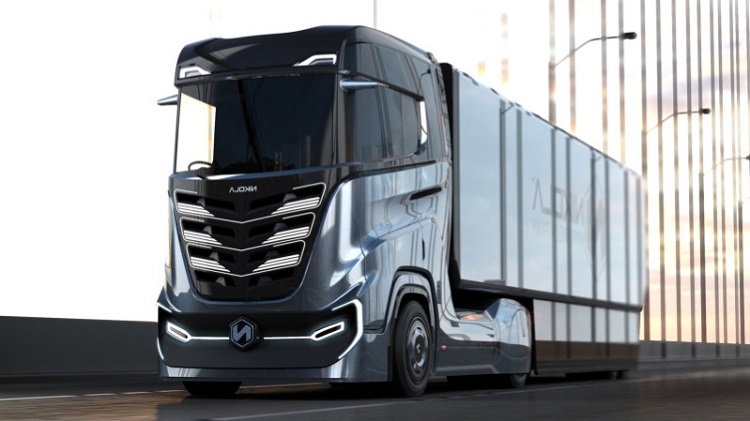
Nikola seems to have cracked the nut on how to build fully electric semi-trucks. It revealed its Nikola Two and Nikola Tre will be available in electric configurations as well as hydrogen.
Additionally, the company does plan to keep working on hydrogen trucks, so it’s not fully switching to electric any time soon. It says hydrogen’s cheaper for long-haul drives, and the startup expects to see 50 times as many orders for hybrids as its electric semi-trucks. However, it claims EVs are particularly useful for “inner cities and non-weight sensitive applications.
Nikola Motor Company is a pioneer in electric heavy duty applications. The company offers both pure electric and also hydrogen electric powertrains to cover class 6-8 in transportation.
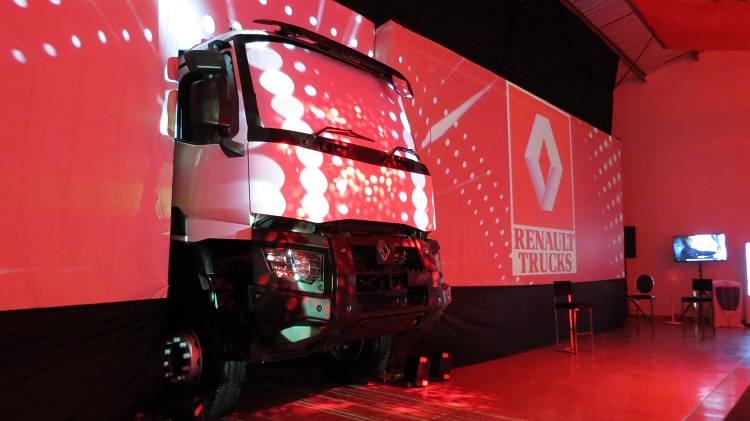
CMC Motors has been appointed the local dealer of Renault Trucks heavy commercial vehicles, entering the lucrative segment currently dominated by Isuzu East Africa, Simba Corp and DT Dobie.
CMC has relied heavily on the passenger car segment led by its Ford dealership, with the Renault Trucks deal also helping the company to rebuild its franchise portfolio.
The company’s past failure to invest in its brands and boardroom wrangles led to the defection of several major automakers including Jaguar Land Rover (JLR) and Volkswagen which transferred their franchises to RMA Kenya (now Inchcape Kenya) and DT Dobie respectively.
This marks a significant franchise acquisition by CMC under the ownership of Dubai-based Al Futtaim Group which took over the company in 2014 at a price of US $74 million.
Unlike cars, most heavy commercial vehicles are bought new from local official dealerships and have higher margins, with demand coming from the trade, transport, construction and mining sectors.
“East African economies continue to grow, creating demand for heavy commercial vehicles. This demand is driven by the end-to-end logistics for industries, retail and agricultural production,” Renault Trucks Africa Vice President Cyril Barille said in a statement. Heavy duty trucks account for 37.6 per cent of all new vehicle sales, making them the largest single vehicle class, according to data from Kenya Motor Industry Association (KMI).
French multinational Renault Trucks is owned by the Volvo Group. The agreement with CMC will give it access to the dealer’s distribution network comprising eight branches across Kenya and a central warehouse in Nairobi.
The Renault trucks will be assembled at Thika’s Kenya Vehicle Manufacturers (KVM) which is partly owned by CMC.
CMC chief executive Noel Mabuma said the Renault Trucks dealership gives the company a presence in the heavy commercial vehicle segment which is also benefiting from the nascent leasing model. “This has created interest from both financial service providers and logistics firms looking to supply the government and other contractors with equipment,” Mabuma said.
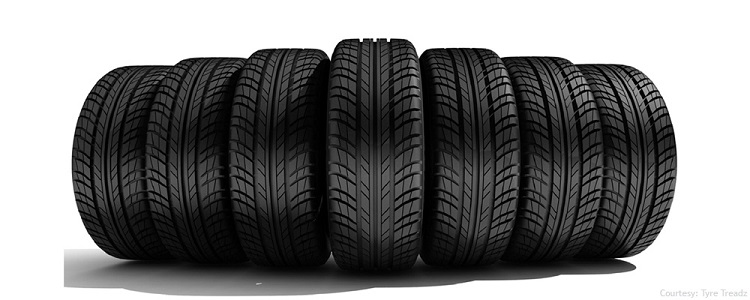
From the early days of the automobile until now, tires have seen many technological advancements. Improvements in raw materials and chemical compounds have led to tires that perform more effectively.
Whether it’s compounds offering better grip in snow and ice or compounds providing improved wet handling, technology continues to enhance tire performance. Innovations in tread patterns, sidewall design and overall tire construction have made today’s higher-performing tires more reliable than ever before. Tire manufacturers work hand in hand with vehicle designers to engineer tires for the future.
One of the most comprehensive technological innovations of the modern tire era is run-flat tire technology. Run-flat technology allows drivers who sustain air loss due to a puncture or cut in their tire to drive approximately 50 miles at 50 m.p.h. so they can reach a safe location to change the tire.
Elements contributing to modern tire technology
Rubber is the main raw material used in manufacturing tires, and both natural and synthetic rubber are used. Natural rubber is found as a milky liquid in the bark of the rubber tree, Hevea Brasiliensis.
The other primary ingredient in tire rubber is carbon black. Carbon black is a fine, soft powder created when crude oil or natural gas is burned with a limited amount of oxygen, causing incomplete combustion and creating a large amount of fine soot. So much carbon black is required for manufacturing tires that rail cars transport it and huge silos store the carbon black at the tire factory until it is needed.
Sulfur and other chemicals are also used in tires. Specific chemicals, when mixed with rubber and then heated, produce specific tire characteristics such as high friction (but low mileage) for a racing tire or high mileage (but lower friction) for a passenger car tire. Some chemicals keep the rubber flexible while it is being shaped into a tire while other chemicals protect the rubber from the ultraviolet radiation in sunshine.
However, constant improvements in rubber chemistry and tire design are creating exciting new tires that offer greater mileage and improved performance in extreme weather conditions. Manufacturers now offer tires estimated to last up to 80,000 miles. Treads, designed and tested by computer, now feature unique asymmetrical bands for improved traction and safety on wet or snowy roads.
Tire design engineers are also experimenting with non-pneumatic tires that can never go flat because they don’t contain air under pressure. One such non-pneumatic tire is simply one slab of thick plastic attached to the wheel rim. The plastic curves out from the rim to a point where a rubber tread is secured to the plastic for contact with the road. Such a tire offers lower rolling resistance for greater fuel economy and superior handling because of a greater area of contact between tread and road.
According to Mallesh Kumar at ZAFCO Low Rolling resistance, higher fuel efficiency, less carbon emission, low cost per kilo meter are among the elements contributing to the modern tire technology.
ZAFCO is one of the leading importers and exporters of automotive tires, batteries, and lubricants and operates internationally to cater the needs of hundreds of customers spread across all six continents.
Tire challenges in the African roads
When it comes to tires, the African continent is one of the fastest growing markets for the global tire industry. The rapid growth of the middle class in many African countries has pushed demand for automobiles to an all-time high – in turn creating a growing market for all kinds of tires: passenger car tires, off-the-road tires, industrial tires, agricultural tires, truck, bus and trailer tires as well as motorcycle and bicycle tires.
Even so, tire industry is faced with one great obstacle called roads. Africa’s roads are notorious and more than half of them are unpaved. This has greatly hinder tire growth in Africa given that manufacturing process improvements have largely been spurred on by environmental concerns. Moreover, growing demand has resulted in the setting up of new manufacturing units that are more capable of handling technology and new equipment. Automation advances have also helped to a significant extent.
“Road conditions, terrain, maintenance practices, lack of surveillance on the health of tires,” says Mallesh Kumar highlighting major challenges in tire industry
Overcoming these challenges
“Government authorities should have a periodic inspection on tires, tires more than five-year-old and with minimum tread depth (1.6mm for PCR) are not to be used, resale of old/used tires should not be encouraged, tires with cuts and injuries (which are not safe) are to be removed,” suggests Kumar.
Auto lubricants play a critical role in the operation of a vehicle and Keeping a vehicle on the road should always be one of its owner’s top priorities. This is why we strive so hard to keep our cars in the best of health that they can possibly be. “Lubricants are very important and use cannot be avoided into engines,” says Anna Maria Vicidomini, of Fulgoil.
Fulgoil is a brand of Columbia Motor Oil, over 80 years quality lubricants for all engine types Columbia s.r.l., leader in the production of lubricants, is located in Genova-Italy.
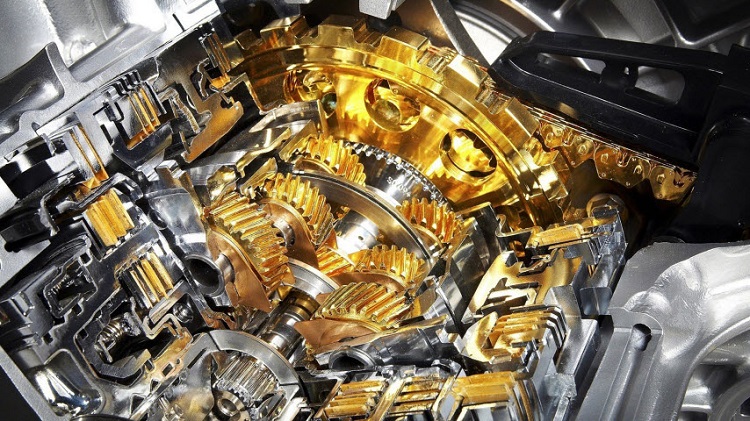
There are numerous different types of auto lubricants used in a car, including engine oil, gear oil, transmission oil, greases, and various fluids. While each of these has a specific purpose in general, they are to reduce friction between moving parts. Therefore, using the highest-quality auto lubricants is important for a number of reasons.
One of the most important elements of lubricating is keeping the engine strong and functioning properly, especially since replacing or repairing an engine can sometimes be more expensive than just purchasing a whole new car.
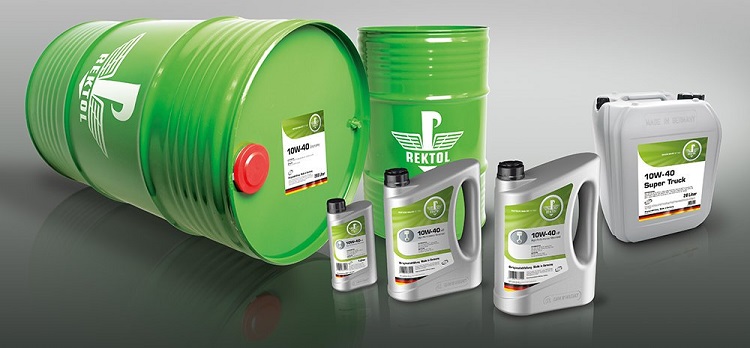
Igor Brandt, Rektol GmbH & Co. KG Global Sales Manager says, “A lubricant is a substance that reduces friction, heat, and wear when introduced as a film between solid surfaces. Using the correct lubricant helps maximize the life of your motor engines, gear boxes and machinery, therefore saving money, time, and manpower, this making operations more efficient and more reliable.”
Rektol GmbH & Co. KG Lubricants
Rektol GmbH & Co. KG produces and develops high-performance lubricants for automotive and industrial sector as well as classic oils for veteran, vintage and classic vehicles.
So how do we keep an engine safe without expending a ton of time and effort? The answer is simple. Engine lubrication is one of the best things that one can do to ensure the engine stays loud and powerful for a long time.
Annalene Coetzee, Afriq LubeKey Accounts and Marketing Manager advice’s potential buyers that to keep your engine safe and running you require the right oil for it. “Without a good quality oil and also the right oil, your machine will get damaged or even break.”
Afriq Lube and Services are suppliers and manufacturers of automotive oils, agricultural oils, industrial lubricants, grease, antifreeze, rust preventatives and cleaning chemicals to both the trade and public.
Importance of Lubricant
What lubrication does
The physics of lubrication is what makes it so important. Typically, an engine is comprised of a large multitude of sliding parts that come together to create life for a vehicle. However, the high speeds that these parts are moving and sliding amongst each other creates an incredible amount of friction, which can generate intense levels of heat. These temperatures can actually get to the point that the metal parts of an engine will begin to mold and fuse together, which will destroy the entire engine, if left unattended. Lubrication is able to prevent this from happening altogether, as it eliminates the friction between the moving pieces.
Here’s a few reasons why engine lubrication is so important…
Prolongs engine life
Moving parts will wear down over time at varying rates. To enable the lowest amount of degradation to the parts and thus extend their lives, using quality auto lubricants is the way to go. Making sure that all of the moving parts of a functioning engine are able to move without glitches or intense heat will keep each part healthy and can make a big difference on critical components in a car, such as the engine and transmission. A vehicle that has been serviced with higher-quality auto lubricants can get anywhere from a few thousand miles to as much as 100,000 miles of extra life.
The problem with an unlubricated engine is that, once one piece begins to have trouble, it will cause systematic problems throughout the rest of the engine. This is because an engine is like a single organism, and every major organ inside of it needs to function for it to stay alive. Engine lubrication will prevent fatigue and wear-and-tear.
Saves money
Not only will having proper engine lubrication keep your car running for longer, it will actually be a generous gift to your wallet. Taking care of a vehicle by using quality auto lubricants will save money in the long run. This is because a vehicle that is well cared for will need fewer repairs. Using low-grade auto lubricants can even cost you dearly, should an engine or transmission need to be replaced.
However, having a healthy engine will mean that you can get a lot more money out of selling the vehicle you currently have. And as we’ve laid out, the best and simplest way to help ensure that is to routinely make sure that your engine is properly lubricated.
Performance
Using quality auto lubricants also allows the vehicle to operate at ultimate efficiency and performance. This can equate to lower fuel costs and more power.
Cooling
The lubricating oil carries heat away from the component which is lubricated. The oil is returned to the oil pan. Some engines incorporate external oil coolers to assist in oil cooling in the oil pan. It is necessary to keep the oil temperature below the flash point of the oil. An engine oil must also have a high heat resistance so that carbon formation due to breakdown is kept to a minimum.
Cleaning or detergence effect
The engine oil has an ability to clean all the engine components, which are in contact with it. Additives in the engine oil help the oil to perform its cleaning operation. Carbon formation is cleaned from the pistons and rings by engine oil. Also, other engine components, such as valve stems, valve lifters, rocker arms, and camshafts, are also cleaned.
Sealing
The engine oil helps the piston rings to form a tight seal between the rings and cylinder walls. Microscopic irregularities in the piston rings or cylinder walls are filled by the oil film, preventing the escape of combustion chamber gases. The engine oil clings to the metal surfaces and resists the tendency of combustion chamber gases to “blow by” the piston rings. The oil film also provides lubrication between the rings and the piston ring grooves, thus allowing the rings to move freely and therefore to have continuous contact between the rings and cylinder walls. Oil between the engine parts cushions the parts from the shock as the combustion charge forces the piston down.
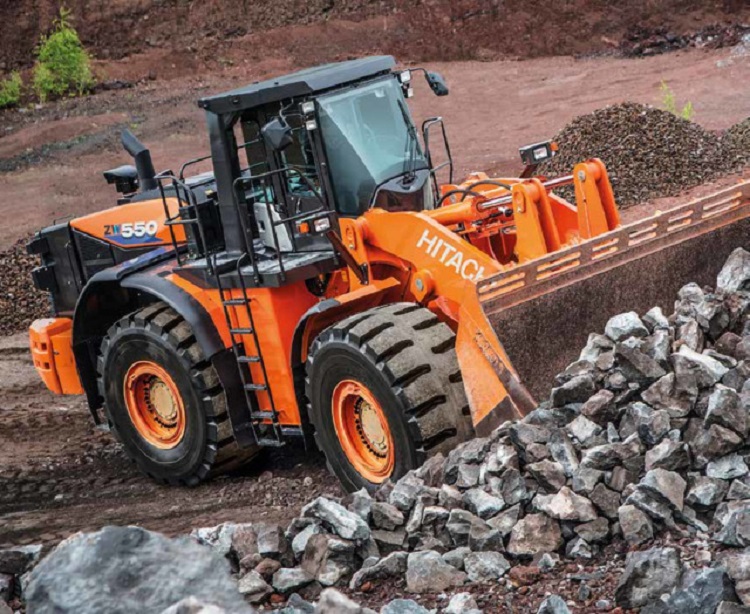
The ZW550-6 leads off the new Dash-6 series of Hitachi wheel loaders. Weighing in at 104,000 lbs. and equipped with an 8.2- or 9-yd. bucket, the robust, 512-hp production machine is built for the heaviest applications. With its standard dual Z-bar linkage, high tipping load and high breakout force (83,460 lbs.), it is well-suited for tough rock handling as well as loading high volumes of soil and fill.
Includes four-wheel drive, full-floating front and rear axles, 24° total oscillation angle and articulated frame steering (37° each direction)
Heavy-duty planetary, mounted outboard final drives
The ZW550-6 incorporates a suite of premium features, including joystick steering as standard along with smart technology such as traction control, ride control, auto power-up and an operator-friendly LCD color monitor. The “Global e-Service” telematics and ConSite reporting provides 24/7 remote monitoring, daily maintenance and operational data plus monthly performance reports. Dash-6 machines also take the lead in Tier 4 Final power, replacing DPF filters with clean SCR technology using a simple DEF system.
The heavy-duty box frame is matched with a low-mount lift arm that minimizes twisting on the front frame, especially with uneven loading. The cooling package is suited for long duty cycles in hot, dusty applications. A standard reversible cooling fan offers automatic or manual activation. Aluminum cooling cores ensure high cooling efficiency as well as longer, corrosion-free service life. A protective rear grille also helps to prevent dust and raw material from entering the radiator compartment.
A new Power Mode feature provides simple access to extra power on demand for higher productivity and efficient duty cycles. The quick power switch, mounted on the steering joystick, lets operators boost power instantly with a 10% higher engine rpm. The power boost means added rimpull and breakout force for digging into heavy piles or for climbing grades with a full load on board. Power Mode also provides faster hydraulic speed for quicker bucket lifts. While Power Mode allows faster acceleration on flat stretches, it does not limit the loader’s top speed, meaning faster duty cycles with more payload each time.
Loading tasks are further simplified with responsive lift/bucket prioritization. Parallel Tilt & Lift movement smooths out digging operations, while the tandem function prioritizes the bucket when dumping. The automatic return-to-dig function resets the bucket for the next load.
Clean lines of sight in all directions ensures enhanced cab visibility. With standard joystick steering, there’s no steering wheel to obstruct the operator’s view of the work zone. The view to the rear is also opened up by relocating the exhaust stack to the far end of the rear cowling. Sight lines are further enhanced by the ROPS design, with frame struts forward and away from the corners of the cab. A rear safety camera is standard equipment. Proximity detection provides audible and visual alerts for stationary and moving objects out to 20 ft. from the loader.