

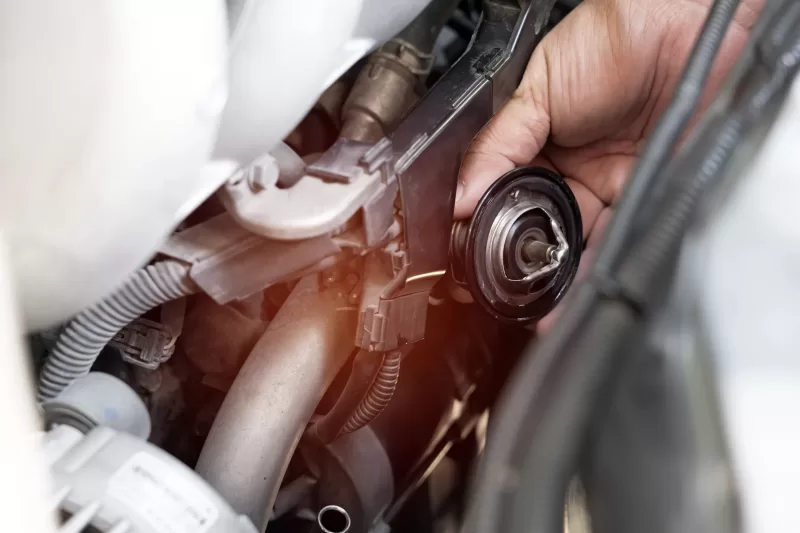
Radiator harmony begins with a thermostat’s touch, a temperature-sensitive valve that acts as a control mechanism within your vehicle’s engine cooling system. I could refer to it as a “small but mighty” component situated between a vehicle’s engine and the radiator.
“The thermostat is an essential component in the cooling system of internal combustion engines. Its primary function is to regulate the flow of coolant, allowing the engine to reach and maintain its optimal operating temperature, generally between 85°C and 105°C. This ensures efficient and safe operation, preventing issues such as overheating or excessive cooling,” says Jurgen Sergooris – CSO – Sales and Marketing Director at FAE – Francisco Albero S.A.U.
Sergooris adds, “In an internal combustion engine, the system converts less than 25% of the generated energy into useful work and dissipates the rest as heat. The thermostat plays a crucial role in managing that heat.”
Similarly, as described by Davide Orlandi – Sales and Marketing Director at I.A.P International Automotive Parts s.r.l, “The thermostat is a device that regulates and controls the temperature and flow of coolant between the engine and the radiator. This specific component opens to allow coolant to circulate inside the engine, enabling the engine to cool down. This is why the thermostat acts as a “guardian” that controls the engine’s temperature by regulating the flow of coolant between the engine and the radiator.”
Types of Thermostats
There are several types of thermostats, each serving a different purpose. Let’s look at the mostly used types of thermostats:
• Mechanical Thermostat:
“This basic design uses a wax element that expands when heated, opening the valve to regulate coolant flow. As the coolant cools, the wax contracts and the spring closes the valve, controlling the flow to the radiator,” highlights Willem van Ham – Marketing Manager AVA.
Sharing his opinion on mechanical thermostats, Orlandi explains, “A wax element controls the thermostat’s operation. When heat causes the wax to expand, it opens a valve that allows coolant to flow back to the radiator for cooling. Manufacturers adjust the thermostat’s opening temperature within specific limits, depending on the vehicle type and engine specifications.”
Additionally, speaking with Stevan Manzan – Mechanic Engineer at MTE-THOMSON, “When the temperature of the liquid rises and reaches the temperature, at which the valve opens (it depends on the vehicle’s design, but is around 90°C), the wax inside the thermo-element begins to expand, presses the spring and the valve begins to release the liquid into the radiator. This way, all the liquid is cooled down on the radiator and goes back to the engine, stabilizing its ideal operating temperature. Depending on the variation in external temperature, altitude conditions, demands in heavy traffic and load, the valve continues working to maintain the correct temperature.”
• Electrically Assisted Thermostat:
The electrically assisted thermostat enhances the mechanical thermostat’s functionality by utilizing an electric actuator, making precise adjustments in real time. As van Ham notes, “This newer version adds electrical assistance, allowing the thermostat to open at more precise temperatures. This results in better fuel efficiency and reduced emissions.”
Emphasizing on this type of thermostat, Orlandi states that, “Modern thermostats function through the use of a sensor that measures the coolant temperature, a control module that receives the signal from the sensor and compares the current temperature to the setpoint and an actuator that opens or closes the thermostat valve based on the instructions from the control module. The opening temperature can be adjusted within certain limits to optimize engine performance”
• Fully Electric Thermostat:
Electric thermostats utilize electronic signals to operate. This shift brings several advantages that can greatly improve your driving experience. “The newest option, this thermostat is controlled by the vehicle’s ECU and operates independently of the coolant temperature. It uses sensors to provide precise control, enhancing performance and fuel economy,” says van Ham.
• Fail-Safe Thermostats:
It’s essential to note that thermostats can fail. Fail-safe thermostats are designed with a built-in safety mechanism such that it defaults to a safe position in the event of a malfunction. In the event of a failure, such as a broken spring, the thermostat will remain open, preventing the engine from overheating. This feature provides an added layer of security, especially for drivers who prioritize engine safety.
• Dual-Stage Thermostat:
Some vehicles utilize a dual-stage thermostat, which has two separate temperature settings. The two stages involve a lower threshold temperature for initial operation and a higher threshold for peak performance. For example, during light driving conditions, the thermostat might open sooner to help reach operating temperature more quickly, which can enhance fuel efficiency. Under heavier loads, the second stage opens for increased coolant flow to absorb excess heat generated by the engine. It can maintain a higher temperature for optimal performance. This flexibility is particularly beneficial for high-performance vehicles.
• Remote Thermostats:
Commonly used in performance vehicles, remote thermostats are designed to be installed away from the engine. This configuration allows for different temperature settings based on specific driving needs. They can be adjusted more easily and provide a level of customization that isn’t possible with standard thermostats.
Also Read: How Often Should I Change Engine Coolant
Thermostat Cover and Housing
The thermostat cover and housing are protective components that encase the thermostat and provide attachment points for associated hoses and connections within the cooling system.
Thermostat Cover:
The cover serves as a protective cap over the thermostat. It is typically made of durable materials, designed to withstand high temperatures and pressures.
“The thermostat cover not only holds the thermostat in place but also facilitates the transfer of coolant between the engine and the radiator,” remarks Albert Fernàndez Mateu – Marketing and SEO manager at FARE Automotive. “Additionally, some thermostat housing are equipped with a pressure release valve,” continues Mateu. “This feature helps prevent excess pressure from building up in the cooling system, which can protect the engine from damage. In summary, the thermostat cover is a key component in regulating engine temperature and ensuring proper coolant circulation between the engine and the radiator,” he emphasized.
Thermostat Housing:
The housing is the larger component that supports the thermostat, seals it in place and integrates with the engine’s cooling system. It allows for the connection of coolant lines that carry coolant to and from the engine and radiator.
“The thermostat housing is located between the engine and the radiator,” says Mateu. “Thermostat housing plays a critical role in the cooling system of internal combustion engines. Their primary function is to regulate the engine’s temperature, ensuring it operates within the optimal range to prevent overheating or excessive cooling,” he adds.
The Role of the Radiator
The radiator functions as a heat exchanger. Its job is to dissipate the heat absorbed by the coolant as it circulates through the engine. When the coolant exits the engine, it carries heat away and the radiator disperses that heat into the air. The efficiency of radiator function is crucial for maintaining an appropriate engine temperature.
Also Read: What Affects Your Engine Temperature While You Drive
The Relationship Between Thermostat and Radiator Function
The relationship between a vehicle’s thermostat and radiator is a cornerstone of effective engine temperature management. While the thermostat controls the flow of coolant, the radiator serves as the cooling agent for that coolant. But how exactly does this process work?
Cooling Cycle:
When you first start your vehicle, the engine is cold and the thermostat remains closed. This closure prevents coolant from flowing to the radiator and allows the engine to reach its optimal operating temperature quickly. “The thermostat is essential for maintaining your engine’s optimal temperature, ensuring top performance and efficiency. When the engine is cold, the thermostat stays closed, allowing coolant to heat up quickly. Once it reaches the optimal temperature, the thermostat opens, letting coolant flow through the radiator to keep the engine running smoothly,” asserts Willem van Ham – Marketing Manager AVA.
“A temperature sensor monitors the coolant and signals the fan when it gets too hot,” continues van Ham. “If the temperature drops, the thermostat begins to close again, reducing flow and keeping the system as close to the ideal temperature as possible – typically between 85°C and 95°C, depending on the type. Modern vehicles often have higher operating temperatures than older models.”
Flow Control:
Apart from opening to allow coolant flow to the radiator, thermostat also regulates how much coolant is circulated. For instance, if the engine temperature rises too high, thermostat opens further to allow more coolant flow and if the engine cools down, thermostat restricts flow to allow the engine to reach its optimal temperature again.
As Manzan cautions, “Never remove or allow the thermostat to be removed from the vehicle!”
System Efficiency:
If the thermostat sticks closed, it causes the engine to overheat and can lead to significant engine damage. If it sticks open, the engine takes too long to reach its optimal operating temperature, which reduces performance and fuel efficiency. Regular maintenance, including checking on the thermostat, can help you avoid these issues.
Also Read: How Can I Tell My Radiator is Leaking
Importance of Choosing the Right Thermostat
Selecting the right thermostat for your vehicle is essential for maintaining proper engine temperature and radiator function. An incorrect thermostat can lead to poor engine performance, increased fuel consumption, and even significant engine damage due to overheating.
“The thermostat, in its perfect functioning, helps to make better use of power and increase the engine’s lifetime, reducing wear on other components, ensuring safe performance of your vehicle,” says Manzan. “Its function is to allow the engine to heat up as quickly as possible and then maintain the ideal working temperature,” he adds.
“A quality thermostat contributes to the durability of the engine by preventing damage that can arise from overheating, such as the premature wear of critical components,” notes Sergooris.
“However, it is important to note that other factors, such as dirty radiators or water pump failures, can also affect the performance of the cooling system,” he enlightens.
What Vehicle Owners Should Watch For
As a vehicle owner, it’s vital to keep an eye on your engine temperature gauge. Knowing how your thermostat is functioning can save you from costly repairs. If you notice fluctuations in temperature or indications of overheating, inspect your thermostat’s condition, along with your radiator’s efficiency. However, before making any changes, it’s advisable to consult a professional mechanic who can assess your current thermostat condition, aid in selecting the right upgrade or replacement and ensure proper installation. Even so, if your vehicle’s thermostat is faulty or you may want an upgrade, to take advantage of the automotive technology advancements, it is worth considering this evolution in automotive design.

