Sunday, May 31, 2026
Home Blog Page 4

Why Africa Must Accelerate Local Vehicle Production


For decades, the continent has relied heavily on imported vehicles to meet mobility needs. Most of these vehicles arrive fully built, new or used. However, most markets in Africa depend on used car inflows from Europe, Asia, and North America. Why Africa must accelerate local vehicle production is now a crucial question as imports, while filling mobility gaps, have also drained foreign exchange, weakened industrial capacity, and delayed technological advancement.

Every imported vehicle represents value created elsewhere. Africa can no longer afford to remain primarily a vehicle consumption market. It must become a production market. And it must accelerate that shift now.

Imports Are Costing More Than We Admit

Vehicle imports appear convenient, because they provide quick access to supply and meet the short-term demand. However, they carry hidden costs. Imported vehicles strain foreign currency reserves. They expose economies to global shipping disruptions, reducing local job creation. They also suppress domestic supplier industries, limiting technology transfer.

Used vehicle imports also create additional challenges. Many of these vehicles arrive with high mileage. Therefore, maintenance costs rise almost immediately. Additionally, emissions standards often lag, hence, road safety suffers when aging vehicles dominate fleets.

On the other hand, local production addresses these structural weaknesses. It keeps value within national economies. It stimulates industrial growth, and builds skills that extend beyond the automotive sector.

The Industry Economic Impact

Few industries generate as much economic spillover as automotive manufacturing. A single assembly plant activates multiple value chains, such as Batteries, Steel, Plastics, Electronics, Glass, Rubber, Textiles, Adhesives, Logistics, Finance, Insurance and Retail just to name a few. In a nutshell, each vehicle contains thousands of components. Localizing even a portion of these components creates industrial depth. Supplier networks emerge, technical expertise expands and export potential grows.

The automotive sector also supports high-quality employment. It demands engineering skills, thus, requiring technical training that encourages automation and innovation. Africa needs exactly this type of industrial multiplier.

Also Read: Africa: The New Hub for Automotive Manufacturing

Demand Is Growing, Production Must Catch Up

Africa’s population is young and its cities are expanding rapidly. Infrastructure projects are increasing, logistics networks are strengthening, ride-hailing and delivery platforms continue to scale. Mobility is therefore, central to productivity and economic growth. Such that, businesses require dependable fleets, logistics operators need durable trucks, digital transport platforms rely on reliable vehicles, and families are actively seeking affordable and efficient mobility solutions.

If Africa does not expand local production, it will continue importing vehicles at scale. The choice is straightforward: either to build for growth domestically or continue to finance it externally, because if Africa continues to import the majority of these vehicles, it exports opportunity along with capital. And therefore, accelerating local production aligns supply with long-term demand.

Regional Integration Changes the Equation

The African Continental Free Trade Area offers a historic opportunity. It reduces tariffs across member states. It opens access to a combined market of more than a billion people. No single African country may generate sufficient scale alone. But collectively, the continent can.

Accelerated local production, supported by regional trade, enables manufacturing hubs to serve multiple markets. Furthermore, scale attracts suppliers. Suppliers reduce costs, and costs improve competitiveness. This cycle creates sustainable growth.

Also Read: Africa’s Future is on the Move and the Aftermarket is Leading the Way

Industrial Policy Must Lead with Clarity

Acceleration demands clear and consistent policy direction. Governments must establish long-term frameworks that provide stability for investors and predictable incentives for manufacturers. Import structures should support local production while safeguarding competitiveness and efficiency. Public procurement policies, where feasible, should prioritise locally assembled vehicles. At the same time, local content requirements must expand progressively and realistically to ensure sustainable industry growth.

Policy inconsistency erodes momentum. Sudden regulatory shifts weaken investor confidence and disrupt planning cycles. In contrast, transparent, enforceable, and well-communicated regulations strengthen trust and encourage long-term commitment. Africa must therefore position automotive manufacturing as a strategic industrial pillar, rather than treating it as a short-term or experimental initiative.

Infrastructure and Energy Matter

Manufacturing performs best in environments where infrastructure is reliable and efficient. Stable power supply is fundamental. Well-functioning ports minimise delays. Integrated road and rail networks reduce logistics costs and improve competitiveness.

Africa’s infrastructure gaps are still a reality, yet measurable progress is underway. Industrial zones are expanding, energy sources are diversifying, and key logistics corridors are being upgraded to support trade and manufacturing.

Accelerating local vehicle production can further catalyze these improvements. Strong industrial demand strengthens the case for sustained investment in energy reform, transport networks, and port efficiency. In turn, enhanced infrastructure lowers production costs and attracts additional manufacturing investment. In this way, production growth and infrastructure development operate as mutually reinforcing drivers of long-term industrial advancement.

Skills Development Is an Opportunity, Not a Barrier

Automobile manufacturing demands precision, discipline, and technical expertise. Historically, Africa has faced a persistent skills gap in this sector. Today, that gap is steadily closing. Technical training institutions are expanding their programs. Original Equipment Manufacturers (OEMs) are investing in apprenticeships and hands-on learning. Young professionals are adapting quickly to automation and digital systems, embracing modern manufacturing practices with agility.

As production accelerates, these skills will deepen further. Every new plant strengthens the technical sector, while each supplier provides additional exposure to advanced engineering processes. Automotive production in Africa should be seen not merely as an economic activity, but as a powerful engine for skills development, innovation, and long-term industrial capability.

Also Read: Revving Up Progress: Bridging the Skills Gap in the African Automotive Service Industry

Electrification Demands Strategic Positioning

The global automotive industry is rapidly shifting toward electric mobility and Africa cannot remain on the sidelines. Local vehicle production offers a direct pathway into the electric vehicle value chain. It enables opportunities in battery assembly, charging infrastructure, power electronics, and software integration.

Given the infrastructure challenges persist, several segments are already demonstrating potential. Electric buses are gaining traction in urban corridors, while two- and three-wheel EVs are emerging for delivery and mobility services. Fleet electrification pilots further highlight the continent’s readiness for innovation. Clearly, by accelerating adoption today, Africa can proactively shape its EV strategy instead of reacting to external developments tomorrow.

Counterfeits Undermine Industrial Growth

Counterfeit parts remain a serious threat in many African markets. Fake components damage vehicles. They compromise safety. They distort pricing structures. However, building a robust local manufacturing base will help mitigate this risk, and make genuine parts more accessible, strengthens regulatory enforcement, and drives higher industry standards.

Additionally, for industrial growth to be sustainable, it must be paired with stricter regulations and increased consumer awareness. Together, these measures protect vehicles and safeguard the integrity of the automotive market. A robust local manufacturing base reduces exposure to counterfeit products, improves access to authentic components, and reinforces compliance. By combining industrial expansion with strong regulation and informed consumers, Africa is capable of creating a safer, more reliable, and more resilient automotive market.

The Consumer Must Trust Local Production

Successful acceleration of local vehicle production depends on consumer trust. Quality must remain uncompromised, warranties should be dependable, and service networks need to be robust and accessible. African-built vehicles must meet global standards, adapt to local road and climate conditions, and deliver clear value without sacrificing safety. Trust develops gradually, but once earned, it spreads rapidly and drives long-term adoption.

The Time for Action Is Now

Africa has the demand, the population, and increasingly supportive policy frameworks. It boasts emerging industrial clusters and growing investor interest. What it now requires is urgency.

Accelerating local vehicle production can strengthen economies, reduce reliance on imports, develop technical skills, and create jobs. This can position Africa as a credible automotive player on the global stage. The time has come to move from aspiration to action. Africa has waited long enough. Its roads deserve vehicles made for its people, by its own industry.

Zonda Tec Ghana Expands the Chery Vehicle Line-Up in Ghana


Zonda Tec Ghana Limited, a Ghana‑based assembly and distribution firm with Chinese ownership, launched an expanded line‑up of Chery vehicles on Wednesday. Automotive enthusiasts and industry leaders attended the event. Organizers unveiled three new sport-utility models, the Chery Tiggo 2, Tiggo 7, and Tiggo 9. They also introduced two electric vehicles, the iCAUR V23 and iCAUR 03.

Commitment to Quality Chinese Vehicles for the Ghanaian Market

During the ceremony, Managing Director Yang Yang emphasized the company’s commitment to delivering high‑quality Chinese automobiles to the Ghanaian market. “Chery is one of China’s leading vehicle exporters, and I want Ghanaian drivers to experience its distinctive features and reliability,” she told Xinhua. Moreover, Yang added that Ghanaian consumers have consistently embraced Chinese‑made cars. This is because they trust Zonda’s ability to bring the best products from China to local roads.

Industry Support and Vision for Local Manufacturing

The launch also received strong endorsement from Seth Twum Akwaboah, Chief Executive Officer of the Association of Ghana Industries (AGI). Akwaboah praised Zonda for injecting new energy into Ghana’s automotive sector and expressed optimism about the company’s future manufacturing ambitions. “We look forward to the day when Zonda moves beyond assembling semi‑knocked‑down kits to producing components locally. That transition is feasible, given the groundwork already in place,” he said. He noted that such local production initiatives would thrive under Ghana’s newly adopted 24‑hour economy policy. This policy encourages round‑the‑clock industrial activity.

Also Read: Silver Star Auto unveils Mercedes-Benz ambulances in Ghana

A Step Forward for Ghana’s Automotive Market

In summary, Zonda Tec Ghana’s introduction of the latest Chery SUVs and electric models marks a significant step forward for the nation’s car market, promising greater choice for consumers and the prospect of deeper domestic manufacturing involvement in the years ahead.

Source: Xinhua

Tesla Enters the African EV Market in Morocco


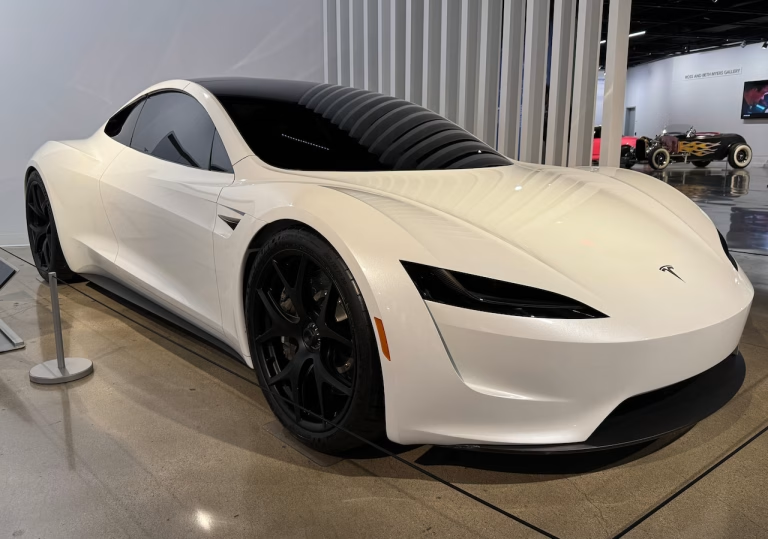
Tesla, Inc. has officially entered the African automotive market with the opening of its first location in Morocco. Tesla enters the African EV Market with first official launch in Morocco, marking a milestone for the company. The launch in Casablanca marks the start of Tesla vehicle sales and services in the country. Importantly, this is supported by an existing Supercharger network and a newly established local subsidiary.

As it often does with major announcements, Tesla revealed the news on social media with a simple greeting: “Bonjour le Marco!”, meaning “Hello Morocco.” Furthermore, the company also confirmed that customers can now configure and order vehicles through its online configurator. At the same time, Tesla is establishing a physical presence in Casablanca. This signals a major milestone in its global expansion and positions Morocco as its first official market in Africa.

Launch Event Showcases Model 3 and Model Y

Tesla officially presented two of its most popular electric vehicles, the Tesla Model 3 and the Tesla Model Y, during an opening ceremony scheduled for February 6. Both models are available to Moroccan customers. However, the Tesla Model S and Tesla Model X will not be part of the initial offering. The decision aligns with a recent announcement by Tesla CEO Elon Musk. He stated that production of those two models will end by the close of the second quarter.

Pricing and Variants Available in Morocco

In Morocco, the Model Y starts at 419,990 Moroccan Dirhams (MAD), equivalent to just under €39,000. This price applies to the rear-wheel-drive “Propulsion” variant. It offers a driving range of approximately 534 kilometers.

The all-wheel-drive “Premium” variant of the Model Y, which provides an extended range of about 600 kilometers, starts at 549,990 MAD (around €50,770). Meanwhile, the Model 3 “Propulsion” and “Premium” variants are priced from 389,990 MAD and 469,990 MAD respectively. This translates to roughly €36,000 and €43,000.

Supercharger Network Already in Place

Although Tesla is only now officially launching in Africa, the company began preparing the Moroccan market several years ago. In 2021, Tesla installed its first Supercharger stations in Casablanca and the northern port city of Tangier.

Since then, Tesla has steadily expanded its fast-charging infrastructure across the country. Morocco now hosts six operational Supercharger locations. As a result, a reliable charging network for Tesla drivers supports the growing adoption of electric vehicles.

Tesla Morocco Subsidiary to Manage Operations

To support its local activities, Tesla established a dedicated subsidiary called Tesla Morocco in May 2025. The company is jointly registered by Tesla International B.V. and Tesla Motors Netherlands B.V. Notably, these are two entities responsible for managing Tesla’s international operations.

The new subsidiary operates from Casablanca’s Marina district and oversees several key functions. These include vehicle imports, retail sales, service operations, and the rollout of Tesla’s energy products. For example, stationary battery storage and solar power solutions are included.

Morocco: A Strategic Entry Point for Electric Mobility in Africa

Tesla’s decision to launch in Morocco reflects the country’s growing importance in the global electric mobility landscape. Morocco has invested heavily in renewable energy, automotive manufacturing, and export infrastructure. Thus, these actions create favorable conditions for electric vehicle adoption.

The country already hosts several major automotive production facilities and continues to expand its renewable energy capacity, making it an attractive gateway for EV manufacturers entering Africa.

Tesla’s Moroccan launch follows the company’s recent expansion into other emerging markets, including Chile and India. As global demand for electric vehicles continues to grow, Morocco could serve as a strategic hub. This would support Tesla’s future growth across the African continent.

Read More:

Kenya’s Automotive Industry at a Turning Point


Kenya’s automotive sector stands at a critical turning point as policymakers, manufacturers, and investors push for stronger reforms to unlock the industry’s full economic potential. With new government initiatives and regional trade opportunities emerging, industry leaders believe the country can significantly expand local vehicle assembly and parts manufacturing while creating thousands of jobs.

Stakeholders across the sector agree that the next phase of growth will depend on bold policy implementation, strategic investment, and stronger collaboration between the public and private sectors.

Industry Leaders Call for Supportive Policy Frameworks

According to Rita Kavashe, Chair of the Board and Managing Director of Isuzu East Africa, Kenya’s automotive manufacturers already have the capacity to expand their influence across the region.

In a recent report, she noted that local vehicle assemblers are “strategically positioned to serve customers in the region and beyond,” provided the government enacts and enforces supportive policies.

Kavashe highlighted two key policy priorities that could accelerate growth in the sector. The first involves prioritizing locally assembled vehicles in government procurement programmes. The second focuses on implementing the proposed Local Content Bill 2025, which requires at least 60 percent local sourcing in major infrastructure projects.

These measures would help stimulate demand for locally manufactured components while strengthening domestic industrial capacity.

Kenya National Automotive Policy Aims to Revive the Sector

The Kenyan government has already introduced the Kenya National Automotive Policy, a comprehensive strategy designed to revitalize the country’s automotive industry. The policy seeks to promote local vehicle assembly while gradually reducing reliance on imported used vehicles, which currently dominate the market.

The strategy includes several incentives aimed at attracting investment and encouraging domestic production. These measures include tax incentives, duty remission schemes, and regulations governing the importation of key automotive components such as batteries, radiators, and brake fluids. By encouraging local manufacturing of these components, policymakers hope to build a stronger automotive supply chain within the country.

Government Plans to Build a Strong Automotive Ecosystem

Lee Kinyanjui, Cabinet Secretary for Investments, Trade and Industry, said the government designed the policy to build a competitive automotive ecosystem that supports job creation and industrial development. According to him, the strategy aims to strengthen both backward and forward linkages within the sector while promoting skills transfer and technological development.

The government also plans to establish a Sh13 billion affordable credit facility to help local automotive companies access financing for expansion and modernization. Such funding could enable assemblers and component manufacturers to scale production and compete more effectively within the region.

Industry Stakeholders Emphasize the Need for Effective Implementation

Although industry players have welcomed the government’s policy initiatives, many stress that consistent enforcement will determine whether the reforms deliver tangible results.

Private sector leaders argue that local assemblers and manufacturers must become fully integrated into government procurement programmes. Without strong implementation, policies intended to support domestic production may fail to generate the expected economic impact.

For Kenya’s automotive sector to thrive, stakeholders say the government must ensure that locally assembled vehicles and locally manufactured components receive genuine preference in public projects.

Local Vehicle Assembly Shows Signs of Growth

Despite longstanding challenges, recent data indicates encouraging progress within the industry. Government incentives and policy interventions have helped revive local vehicle assembly in recent years. During the first half of 2025, Kenya’s vehicle assembly output increased by 16.4 percent year-on-year, reaching approximately 6,723 units after several years of stagnation.

Duty exemptions on imported parts and financing mechanisms such as Samurai bond funding from Japan contributed significantly to the recovery. Local assembly activity has also expanded steadily over the past seven years. Manufacturers increasingly rely on domestic operations rather than importing fully built vehicles.

Government officials report that in some segments, nearly 85 percent of production now takes place locally, supported by initiatives such as the Buy Kenya Build Kenya campaign, which promotes locally manufactured products.

Rising Demand Signals Market Recovery

The broader automotive market in Kenya is also showing signs of recovery as demand gradually improves. Increased consumer confidence, government incentives, and expanding regional trade opportunities continue to support growth.

If policymakers maintain momentum and implement reforms effectively, Kenya could position itself as a leading automotive manufacturing hub in East Africa. Industry experts believe that with the right policies, investment climate, and regional integration, Kenya’s automotive sector can drive industrial growth, create high-quality jobs, and strengthen the country’s position in Africa’s evolving mobility landscape.

Read More:

Counterfeit Auto Parts: A Silent Threat Growing Across Africa


Alongside the positive Africa’s automotive aftermarket growth, lies a dangerous and costly challenge: the surge of counterfeit auto parts infiltrating the market. From brake pads that crumble under heat, oil filters that fail after a few days, to knock-off sensors that misreport engine data, counterfeit auto parts pose a serious threat. Fake parts are an ongoing widespread market and life threat. Their impact is not only financial; instead, they endanger drivers, reduce vehicle lifespan, increase road accidents and undermine trust across the industry. The counterfeit crisis is a reality, an urgent concern and it’s deeply intertwined with Africa’s mobility future.

Why Counterfeit Parts Are Flooding African Markets

To begin with, several factors have paved the way for counterfeiters to thrive:

  1. High Vehicle Import Rates and a Huge Aftermarket Demand

Africa imports more than 80% of its cars. Many of them older used vehicles. These cars require frequent repairs and affordable parts. Counterfeiters exploit this demand by offering cheap alternatives that appear convincing at first glance. Unfortunately, counterfeit auto parts take advantage of such demands.

  1. Price Sensitivity Among Consumers and Small Garages

With the rising living costs and limited consumer awareness, drivers often choose low-priced parts without understanding the risks. Similarly, informal garages also unintentionally (or sometimes intentionally) buy low-cost inventory to increase margins. This behavior inadvertently supports the counterfeit auto parts trade.

  1. Weak Border Enforcement and Regulatory Gaps

Limited inspection capacity, porous borders and inconsistent enforcement give counterfeiters room to operate. More often, once fake parts enter the supply chain, they blend seamlessly with genuine products. Hence, counterfeit auto parts continue to flood the market.

Also Read: Counterfeit Automotive Lubricants: How Innovative Solutions are Crushing Counterfeits and Defend Quality

  1. Sophisticated Counterfeiting Techniques

Today’s counterfeit parts look professional. Branded packaging, holograms, barcodes, making them difficult to distinguish without deep technical knowledge or authenticity techniques. This combination has resulted in counterfeit parts capturing as much as 40% of Africa’s auto parts market, and severity depending on the country.

The Hidden Costs: How Fake Auto Parts Hurt Everyone

Counterfeit parts are cheaper, but the long-term price is far higher.

  1. Rising Road Accidents and Safety Risks

Brakes, suspension components, airbags and tyres are the most commonly counterfeited parts. All these are critical to driver’s and passenger’s safety. Failures are fatal. Road safety experts estimate thousands of avoidable accidents across Africa linked to defective parts as a result of counterfeit auto parts issues.

  1. Higher Repair and Maintenance Costs

Fake parts wear out faster, causing damage to surrounding components and require repeated replacements. In many cases, what seemed like a bargain ends up costing more in repairs, downtime and lost vehicle lifespan.

  1. Massive Financial Losses for Legitimate Businesses

Authorized distributors, OEMs and professional mechanics lose revenue as counterfeiters undercut them with artificially low prices. The presence of fake parts also damages brand reputation, even when the OEM is not at fault.

  1. Economic Drain and Tax Revenue Loss

Governments lose millions in tax revenue when counterfeit products bypass proper import channels. Worse, counterfeit trade often fuels illicit networks and undermines legitimate job creation.

  1. Reduced Reliability for Fleets and Public Transport

Bus operators, logistics companies and ride-hailing fleets suffer breakdowns and operational inefficiencies when fake parts infiltrate their maintenance systems. In effect, the counterfeit crisis is a direct threat to safety, business confidence, and economic development.

Also Read: 10 Clear Steps to Buying Auto Parts Online Without Risk

How Africa Is Fighting Back

Despite the scale of the problem, a powerful wave of reforms and industry initiatives is emerging across the continent.

  1. Stronger Border Inspections and Customs Intelligence

Countries like Kenya, South Africa, Rwanda, and Ghana are strengthening customs checks using digital tracking, advanced scanners and improved supply chain tracing.

  1. OEM-Led Authentication Technologies

Leading aftermarket brands are launching:

  • QR code verification
  • SMS authentication
  • Tamper-proof packaging
  • Track-and-trace QR portals

These tools empower technicians and consumers to confirm authenticity instantly.

  1. Public Awareness Campaigns

Governments and associations are educating drivers about the dangers of counterfeit parts through media campaigns, roadshows and mechanic training programs. Awareness is becoming one of the most powerful weapons.

  1. Certification for Garages and Retailers

Countries are increasingly adopting “approved garage programs” to help consumers identify trusted workshops that source genuine parts.

  1. Crackdowns on Informal Dealers

Market raids, fines and business closures are becoming more common as governments take a harder stance on illicit sellers.

  1. Partnerships Between Industry and Regulators

More importantly, collaboration is growing between OEMs, national standards bodies, automotive associations and law enforcement. This coordinated approach is proving far more effective than isolated efforts.

Also Read: TotalEnergies Lubrifiants and SCRIBOS Partner Against Counterfeiting

How Consumers and Businesses Can Protect Themselves

Whether you’re a driver, fleet operator, or garage owner, vigilance is key:

  • Always buy from authorized distributors.
  • Avoid deals that look “too cheap to be true.”
  • Check packaging, holograms and serial numbers.
  • Ask for receipts and warranties.
  • Train your mechanics to detect counterfeit signs.
  • Confirm authenticity using brand verification apps where available.
  • Besides, a small step today can prevent a major breakdown or accident tomorrow.

Also Read: How to Identify Counterfeit Auto Parts

Quality Parts Are the Foundation of Africa’s Automotive Future

Africa’s automotive sector is rising with a demand for reliability, safety and professionalism. Counterfeit auto parts threaten this progress, however, they are not unbeatable. With stronger regulation, better awareness, digital authentication tools and coordinated industry action, Africa is turning the tide.

In the end, the future belongs to a market built on trust, safety and genuine quality, because in mobility, the right part isn’t just a choice, it’s a lifeline.

How to Avoid Roadside Scams and Unsafe Mechanics


If you drive regularly, one thing is certain: At some point and at unexpected time, you will eventually need mechanical help on the road. A flat tyre, engine overheating or a warning light you don’t understand. It happens. But while most mechanics and roadside technicians are honest professionals, it’s important to avoid roadside scams and unsafe mechanics because roadside repair scam is rising, especially in busy highways, rural routes and urban hotspots.

Why Roadside Scams Are on the Rise

The automotive aftermarket is booming, but so is the opportunity for fraud. According to industry analysts, vehicle owners are experiencing a growing trend of:

  • Inflated repair fees
  • Fake mechanical diagnoses
  • Counterfeit spare parts
  • Unauthorized towing and storage charges
  • Forced repairs while stranded
  • Unqualified “mechanics” posing as professionals

Drivers often fall victim because they’re stressed, stranded, or unsure how to verify repairs on the spot. Scammers exploit moments of panic and that’s why awareness is your strongest defense. These scams often target drivers who are stressed, stranded or unfamiliar with their car’s mechanical components. And because many car owners don’t know what goes on under the hood, scammers take advantage by inflating prices, creating fake problems or using substandard parts.

This article arms you with practical, factual and expert-backed strategies to avoid these traps, and keep your wallet, your car and your safety intact.

  1. Know the Most Common Roadside and Mechanic Scams

Before you can protect yourself, you need to recognize the red flags. Here are some of the most common tactics:

  • The “Fake Breakdown Spotter”

Scammers roam parking lots, petrol stations or highways claiming your brakes, battery or suspension “looks bad.” They pressure you into emergency repairs you never needed.

  • The “Surprise Problem” Scam

A mechanic starts with a small job, then suddenly “discovers” major issues that weren’t there before. These problems often sound complicated to intimidate you.

  • The Overcharging Trap

Some inflate prices on parts and labour, knowing you’re stranded and unlikely to negotiate.

  • The Parts-Swapping Scam

A dishonest mechanic replaces your good part with a worn-out or counterfeit one.

  • The Fake Tow Truck

Scammers appear at breakdown scenes without being called, towing your car to an unknown location and demanding unreasonable fees.

  • The Sabotage Scheme

Rare but serious: some rogue roadside “assistants” damage a component, like unplugging a sensor, so your car appears to have a severe fault.

  1. Always Contact Your Trusted Mechanic First

When something goes wrong, your first reaction should not be panic. It should be a phone call.

Dial your regular mechanic, trusted garage or roadside assistance provider. Explain the symptoms and ask for guidance.

A reputable technician will often tell you:

  • Whether it’s safe to continue driving
  • If the issue is minor or severe
  • What parts are typically affected
  • How much a repair should cost

This simple step filters out 80% of roadside scams.

  1. Never Accept Help from Unexpected Roadside Mechanics

One of the biggest red flags is a mechanic who appears immediately after your breakdown, especially if you never called for help.

Typical scam tactics include:

  • Scammers patrol highways looking for stranded drivers
  • They pressure you into repairs
  • They exaggerate the issue to justify high prices
  • They use low-quality parts that fail shortly after
  • They refuse to let you leave without paying

✔ What to do instead:

  • Stay in your car with the doors locked while you assess the situation.
  • Call your trusted roadside assistance provider or a mechanic you know.
  • If anyone approaches, politely decline and say:

“Thank you, but I’ve already called my mechanic. They’re on the way.”

Professional mechanics do not drive around looking for victims.

  1. Verify Your Mechanic Before You Say Yes to Any Repair

Once you’ve contacted your garage or roadside service, always verify:

  • Name of the mechanic
  • Company they represent
  • Vehicle/number plate
  • Job card or work order

Scammers sometimes impersonate legitimate companies by guessing common provider names like AA, insurance partners, or dealership service centers.

✔ Smart verification hacks:

  • Ask the provider to send the mechanic’s photo via SMS or WhatsApp
  • Request a service ID or badge
  • Confirm the official tow truck plate number
  • Call back the company to reconfirm the identity
  • If anything feels off, decline. Your safety comes first.
  1. Avoid On-the-Spot Diagnoses from Unknown People

Fraudulent mechanics rely on fear and urgency. They know you’re vulnerable on the roadside, so they hit fast with lines like:

  • “Your engine is about to blow!”
  • “This car cannot be driven another meter.”
  • “I’ve already opened it; you must pay for labor.”
  • “This part is completely finished, lucky I have a spare for you.”

✔ Your defense strategy:

A genuine mechanic will never pressure you into immediate repairs. Always insist on a second opinion, even if it means towing the car home.

  1. Be Extremely Cautious with Tow Trucks

Unauthorized towing crews often appear minutes after an accident or breakdown. This scam is common worldwide, especially in big cities. They tow your car to an unknown garage, then hold it “hostage” until you pay huge storage or repair fees.

✔ Protect yourself:

  • Only accept tow services you requested personally
  • Never let anyone tow your car without written consent
  • Ask for the destination address before anything happens
  • Take clear photos of the tow truck and your car before it moves
  • Clarify towing fees upfront

If a tow truck comes without being called: It’s almost always a scam.

  1. Know the Common Repair Scams Mechanics Use

Even in established workshops, fraud can happen. These common tricks trap uninformed car owners:

🔧 Fake Faults

Mechanic claims a part is “dead” when it only needs cleaning or minor adjustment.

🔧 Inflated Part Prices

They charge double or triple the actual market price.

🔧 Switching Parts

They remove working parts and replace them with defective ones.

🔧 Charging for Parts Not Installed

You pay for premium-quality components but get cheap, generic versions.

🔧 Unnecessary Repairs

Repairs you never needed, never asked for and never approved.

✔ How to counter:

  • Request photos or videos of faulty parts
  • Ask for old parts to be returned after replacement
  • Request a detailed written quotation
  • Compare prices with at least two other mechanics. Knowledge = power.
  1. Build a Relationship with a Trustworthy Mechanic

The safest drivers are those who have atleast one reliable mechanic or garage they consistently use.

Look for a mechanic who:

  • Has a registered business
  • Offers written invoices
  • Allows you to inspect the car before and after service
  • Uses transparent pricing
  • Explains repairs in plain language
  • Has positive customer reviews

A mechanic who values long-term relationships will always prioritize your safety and trust.

  1. Keep Emergency Tools and Knowledge with You

Scammers prey on helpless drivers. The more prepared you are, the less likely you’ll be a target.

Essential items to carry:

  • Phone charger / power bank
  • Reflective hazard triangles
  • Tyre pressure gauge
  • Jump starter kit
  • Spare tire + jack
  • Basic tool kit
  • Flashlight
  • Emergency contacts list

When you appear confident and prepared, fraudsters move on.

10. Know Your Rights as a Consumer

You have every right to:

  • Ask questions
  • Refuse service
  • Request a quote before repair
  • Demand original parts
  • See old replaced parts
  • Decline work you did not authorize
  • Get a receipt
  • Seek a second opinion
  • Report fraud to authorities

No mechanic or tow truck operator can force you into repairs you don’t want.

  1. Learn the Basics of Your Car’s Warning Signs

You don’t need to be a technician, but knowing the difference between a check engine light, an oil pressure warning and a temperature warning can save you from panic and scammers.

Key basics every driver should know:

  • Overheating often needs a pause, not a mechanic
  • Battery warnings may be caused by loose terminals
  • Vibrations can come from tyres, not suspension failures
  • Fluid leaks have distinct colors
  • Strange noises usually have simple causes

Knowledge reduces vulnerability.

  1. Don’t Pay in Cash Without Documentation

Cash leaves no trail. Scammers prefer it because it prevents complaints or refunds.

Use:

  • M-Pesa
  • Bank transfer
  • Card
  • Any traceable method

Request a receipt every time.

Stay Alert, Stay Empowered, Stay Safe

Roadside scams thrive on panic, ignorance and desperation. But with the right knowledge and a few simple precautions, you can drive confidently, knowing you’re protected from dishonest mechanics and predatory repair traps. You deserve safe, honest, and professional service every time.

Roadside scams and dishonest mechanics can turn a simple breakdown into a nightmare, financially, emotionally and even physically. But with the right knowledge, you become scam-resistant.

Remember:

  • Never accept unsolicited roadside help
  • Always verify identities
  • Don’t let fear pressure you into quick fixes
  • Build a relationship with a trusted mechanic
  • Stay prepared and informed. Vehicle problems are stressful, but being informed transforms panic into control.

Your safety begins with awareness. Your confidence begins with knowledge. And your protection begins with refusing to be an easy target.

Read More:

How Climate Change Affects the Choice of an Antifreeze: What Drivers Need to Know


Africa’s climate change effects are now influencing everyday decisions, including how drivers protect their engines. Rising temperatures, unpredictable weather patterns and extreme climate swings across Africa and the rest of the world are reshaping the way motorists choose antifreeze. In fact, how climate change affects the choice of an antifreeze is a major concern for drivers today.

Usually, antifreeze is associated mainly with cold climates and preventing water in the radiator from freezing. However, today’s climate realities have changed that perception. Antifreeze does much more than protect against freezing, it regulates engine temperature, prevents overheating, stops corrosion and improves the overall engine efficiency. As Africa’s climate conditions shift, selecting the right antifreeze is more important. Clearly, understanding influences like climate change on the choice of an antifreeze is vital for vehicle owners.

Climate Change and Extreme Temperatures: Why It Matters

Climate change has introduced more intense heat waves, longer dry seasons and erratic temperature variations. In regions where temperatures were once moderate, heat extremes now occur more frequently. For engines, this means greater stress. The choice of an antifreeze is affected by climate change, as engines must withstand higher stress and variable conditions.

Higher temperatures increase the likelihood of:
  • Engine overheating
  • Coolant evaporation
  • Cooling system corrosion
  • Breakdown of low-quality coolant mixtures
  • Greater demand on the thermostat and radiator

Therefore, modern antifreeze formulations must withstand higher boiling points, maintain stable performance under stress, and offer long-lasting protection. For this reason, how climate change affects the choice of an antifreeze has become a technical consideration for coolant makers.

This is why many manufacturers now recommend long-life organic acid technology (OAT) or hybrid OAT coolants designed to perform consistently in hotter climates, reflecting how the changing climate impacts antifreeze selection.

Shifting Weather Patterns Require More Versatile Antifreeze

Climate change doesn’t only bring heat; it also creates unpredictable weather. Some regions may experience unusually cold mornings followed by extremely hot afternoons. Others may shift between drought and heavy rainfall cycles. This unpredictability means drivers need antifreeze that performs well across a wider temperature range. Today’s advanced coolants provide:

  • Freeze protection as low as –34°C (or lower when mixed properly)
  • Boiling protection up to 265°F / 129°C
  • Consistent performance regardless of seasonal shifts
  • This versatility is essential as climate instability becomes the norm. As the climate changes, the choice of an antifreeze must account for both cold and hot extremes.
  • Antifreeze and Corrosion Protection: Increasingly Important

With higher temperatures and more dust in the environment, especially across Africa’s savannah, rift valleys, and semi-arid regions, engines face increased corrosion risks. Sediments, minerals in water and air impurities accelerate internal rust, weakening the radiator, water pump and metal gaskets. The way climate change affects the choice of an antifreeze now includes a greater emphasis on corrosion protection.

Climate-induced heat speeds up corrosion reactions. Therefore, drivers must prioritize corrosion-inhibiting antifreeze formulas, specifically:
  • OAT (Organic Acid Technology)

Best for long-lasting corrosion protection and hot climates, especially where shifts in climate change impact the choice of an antifreeze.

  • HOAT (Hybrid Organic Acid Technology)

Blends modern inhibitors with conventional additives for mixed metals.

  • Si-OAT (Silicated OAT)

Best for newer engines with aluminum components.

Choosing the wrong type or mixing incompatible coolants can accelerate corrosion, reduce vehicle lifespan, and cause expensive repairs. As a result, how climate change affects the choice of an antifreeze can directly impact maintenance costs.

Water Quality Matters More Under Climate Stress

In many African regions, clean distilled water is not always readily available. This leads some drivers to mix antifreeze with borehole, tap or river water. Each containing minerals that react negatively with coolant formulations, especially in hot climates. Hard water can:

  • Cause scale buildup
  • Reduce coolant efficiency
  • Block radiator channels
  • Lower boiling protection
  • Shorten coolant lifespan
  • Under climate change, driven heat, these issues worsen more quickly, which impacts the choice of an antifreeze formulation.
Thus, drivers should always:
  • Use pre-mixed 50/50 coolant, OR
  • Mix concentrate only with distilled or demineralized water

This ensures stable protection even under severe weather fluctuations. Because climate change affects the choice of an antifreeze, water quality becomes even more important.

Why Vehicle Type and Climate Conditions Must Guide Coolant Choice

Engines today are more advanced, with tighter tolerances, lightweight materials and higher operating temperatures. Climate stress demands that drivers match coolant type not only to weather but also to engine requirements. Furthermore, how climate change affects the choice of an antifreeze should be a key consideration for every motorist.

When selecting antifreeze, consider:
  1. Manufacturer specifications
  • Modern engines often require specific coolant chemistry. In addition, climate change influences the choice of an antifreeze and its formulation for different models.
  1. Driving habits
  • Long distances increase heat load
  • Stop-and-go city driving causes temperature fluctuations
  1. Climate and terrain
  • Hot climates: Need high boiling protection
  • Cold regions: Need strong freeze protection
  • Coastal areas: Need extra corrosion resistance due to salt exposure
  1. Vehicle age
  • Older vehicles may need IAT coolants
  • Newer engines require OAT/HOAT formulations

Choosing an antifreeze based on these factors ensures long-term engine health. Of course, how climate change affects the choice of an antifreeze remains central to modern maintenance decisions.

The Importance of Regular Coolant Checks

Climate stress accelerates coolant degradation. Even long-life coolants need periodic evaluation. More frequent checks are now warranted, given how climate change can affect the choice of an antifreeze and its performance.

Drivers should check coolant:
  • Every 3 months
  • Before long trips
  • During heat waves
  • At every service interval
Signs your antifreeze is failing include:
  • Rising engine temperature
  • Coolant discoloration
  • Rust deposits in the reservoir
  • Sweet smell of leaking coolant
  • Overheating during climbs or hot afternoons; these are signs that climate change affects the choice of an antifreeze more than ever.

Regular maintenance is your best defense against climate-induced engine damage. Properly understanding how climate change impacts the choice of an antifreeze will protect your vehicle in the long run.

Climate Change Makes Antifreeze Choice More Critical

Climate change has rewritten the rules of vehicle maintenance. Choosing the right antifreeze is now essential to protect engines from extreme heat, fluctuating temperatures, corrosion and increased mechanical stress. Ultimately, how climate change affects the choice of an antifreeze could decide the durability of your vehicle in harsh conditions.

Read More:

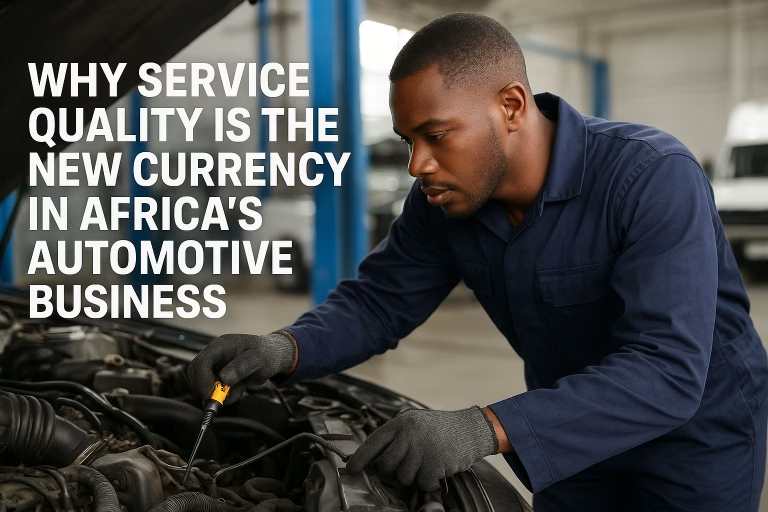
Why Service Quality Is the New Currency in Africa’s Automotive Business


Amid the rising vehicle imports, expanding mobility solutions, stricter regulations and growing customer expectations, one factor is emerging as the most powerful differentiator in Africa’s automotive service quality. Service Quality Is the New Currency in Africa’s Automotive Business, as consumers are no longer loyal simply because a brand is well-known or a car is affordable. They are loyal because of the experience they receive, before, during and especially after the purchase.

Whether it’s more reliable repairs, transparent communication, faster turnaround times or the availability of genuine parts, service quality has become the new currency that determines who leads and who loses in Africa’s rapidly evolving auto landscape.

A Market Where Trust Is Everything

Across the continent, vehicle ownership is rising. This we are all familiar with, from bustling cities like Nairobi and Lagos to emerging towns in Rwanda, Zambia and Côte d’Ivoire. Yet, many consumers remain wary when it comes to auto repair and maintenance. Stories of inflated prices, poor workmanship, substandard parts and long delays are all too common.

Because of this, trust has become the strongest asset in the automotive sector. Businesses that deliver consistent, honest and high-quality service are winning customers faster than those relying only on competitive pricing.

Simply put, in Africa’s automotive ecosystem:

  • Trust = Loyalty
  • Loyalty = Revenue
  • Revenue = Growth

A garage or dealership that prioritizes customer experience doesn’t just fix cars, it builds long-term relationships that drive sustainable business success.

Rising Vehicle Complexity Demands Higher Expertise

Modern vehicles are no longer simple machines. They are advanced systems packed with electronics, sensors, telematics devices, driver-assist features and intricate fuel and engine technologies. Electric vehicles (EVs), hybrids and newer clean-diesel models are adding even more complexity.

This shift means that the old-school trial-and-error approach to repairs is no longer enough.

Today’s customers expect:

  • Accurate diagnostics
  • Skilled technicians
  • Proper tools and equipment
  • Certified repairs
  • Genuine parts
  • Transparent explanations

In many markets, workshops that invest in technician training, computerized diagnostics and quality tools are already outperforming those that rely on outdated methods. The reality is simple: Skill is now a competitive advantage.

The Customer Experience Revolution

Beyond technical skills, Africa’s auto consumers increasingly value how they are treated. They want to feel respected, informed and appreciated. That’s why dealerships and independent garages that embrace customer-centric practices are outperforming competitors.

This includes:

  • Clear pricing and estimates
  • Regular updates on repair progress
  • Shorter waiting times
  • Comfortable service lounges
  • Follow-up calls after service
  • Digital booking and payment options

In markets like Kenya, South Africa, Morocco, and Ghana, workshops that combine professionalism with high convenience are becoming the preferred choice for private car owners, ride-hailing drivers, and corporate fleets.

When quality service is paired with great customer support, the result is loyalty and loyalty is invaluable.

The After-Sales Race: Where Real Competition Lives

Globally, most automotive profits come from after-sales service, not new car sales. The same trend is now clearly visible across Africa.

This is why international manufacturers, local dealers, and independent garages are investing heavily in:

  • Spare parts availability
  • Preventive maintenance programs
  • Extended warranties
  • Remote diagnostics
  • Mobile service units
  • Service subscription models

Consumers no longer choose brands solely on the vehicle’s design or fuel economy. They choose brands that guarantee support, reliability, and peace of mind throughout the ownership journey.

A car is a long-term investment and Africans want long-term service they can count on.

Technology Is Raising the Bar

Digital transformation is reshaping the automotive service landscape across Africa. Tools like telematics, diagnostic software, digital service records, and workshop management systems are improving transparency and efficiency.

These technologies allow workshops to:

  • Diagnose faults faster and more accurately
  • Predict maintenance needs
  • Track performance and repair history
  • Provide clear estimates and receipts
  • Improve customer communication
  • Reduce unnecessary repairs

For consumers, digital integration means convenience, clarity and trust; three pillars that define excellent service quality.

A Competitive Edge for Local Mechanics and SMEs

Independent garages make up the majority of Africa’s automotive service market. With the right investments, they stand to benefit enormously from the rising demand for quality.

Small and medium workshops that modernize their service delivery, even gradually can:

  • Attract new customer segments
  • Charge premium rates for quality w ork
  • Build strong local reputations
  • Compete effectively against larger dealerships

This is especially important in rural and peri-urban areas where demand is rising quickly but supply remains inconsistent.

Why Service Quality Will Define the Future

In an industry where margins can be thin and competition is fierce, service quality is no longer optional, it is the foundation of survival and growth.

Africa’s auto industry is moving toward a future driven by:

  • Transparency
  • Customer empowerment
  • Digital tools
  • Professional expertise
  • Long-term value

Businesses that embrace this shift will enjoy improved profitability, stronger customer loyalty and long-term sustainability. Those that don’t risk being left behind.

Service quality is the new currency of Africa’s automotive business. However, the companies that invest in it today will become the market leaders of tomorrow. Whether you run a dealership, a garage, a parts shop, or a fleet service, there’s no ignoring the truth: Quality is not a cost; it is an investment. And in Africa’s fast-growing automotive landscape, it is the smartest investment you can make.

Read More:

N!Academy Training Program in Partnership with Phinia in Nairobi


The renowned N!Academy made its mark in East Africa’s Nairobi, in partnership with PHINIA, hosting a transformative training program for local automotive technicians at the Emara Hotel – Ole Sereni on September 17, 2025. The full-day event brought together professionals from Kenya’s automotive service market. It offered an immersive experience designed to equip technicians with the latest knowledge, tools, and insights shaping the local automotive aftermarket.

Nonetheless, this initiative, a collaboration between PHINIA and NEXUS Automotive International (N!), underscores a shared commitment to developing Africa’s automotive service and maintenance sector. Besides, this market is expanding rapidly with a growing demand for advanced parts, skilled labor, and reliable services.

Also Read: NEXUS Automotive International Accelerates Growth in Africa

Innovation Grounded in African Realities

The training sessions were powered by Delphi, a PHINIA brand renowned for precision engineering and cutting-edge innovation. Delphi’s product portfolio spans a wide range of vehicle systems—from steering components such as control arms, stabilizer links, and tie rods to comprehensive braking solutions including discs, drums, pads, and shoes. The brand also offers a strong lineup of vehicle electronics, from ignition coils and sensors to EGR valves. With this breadth of expertise, Delphi continues to meet global standards while addressing regional needs.

Through interactive demonstrations and live diagnostic simulations, participants explored how PHINIA’s global technology can adapt seamlessly to Africa’s local realities.

Empowering Technicians: The Heart of the N!Academy

A major highlight of the day was the Delphi Masters of Motion initiative. This program celebrates technicians as the true drivers of automotive progress. Moreover, participants engaged in sessions on system diagnostics, parts calibration, and data-driven maintenance. This prepared Kenya’s technicians for the demands of today’s connected vehicles.

The session also highlighted Hartridge’s specialized test benches for industrial, marine, and agricultural engines. It gave emphasis to their unique role in niche sectors. Ethem Metin, Test Equipment Support Leader at Delphi, emphasized Delphi’s training philosophy. He noted that with proper skills, clean conditions, and the use of Delphi original software, technicians can repair injectors with near-factory precision. Most importantly, the session reminded them that injector reliability depends not only on equipment but also on meticulous cleanliness. Ensuring precision is key, from the fuel tank to the common rail system, to maintaining a lasting engine performance and customer confidence.

N!Academy with Phinia Ongoing Training Sessions
Precision in Practice

The training session offered a deep dive into the precision and care required in diesel injector repair. Metin emphasized that, true accuracy depends on replacing both the controller, “the heart of the injector,” and the nozzle. He further highlighted Delphi’s rigorous approach, combining advanced engineering with practical tools. “Rather than risk microscopic damage during disassembly, our tools prevent it.” Participants also learned about the importance of cleanliness, calibration, and diagnostics. Both ultrasonic cleaning systems and strict torque specifications support these processes. Every step reflected Delphi’s uncompromising standards.

Adding a touch of excitement and engagement, participants took part in a lively question-and-answer trivia session. This tested their attentiveness and takeaways from the day’s training. Winners were rewarded with prizes, while all attendees were awarded certificates of participation. These recognized their enthusiasm and commitment to continuous learning. The interactive activity not only reinforced key lessons but also built a sense of unity. It fostered a shared spirit of professional pride among the attendees.

N!Academy with Phinia Certificate of Participation Awarded to attendees
Ismail Gokce, Sales and Branch Manager (ME, TH’s, SSA Regions) awarding the N!Academy in partnership with Phinia Certificate of Participation to attendees
Building a Culture of Continuous Learning

Attendees were also introduced to Delphi’s comprehensive learning ecosystem. It includes the Delphi Academy e-learning platform, free Masters of Motion tutorial videos, and global face-to-face technical training. With over 300 training modules, more than 20,000 annual learning hours, and advanced tools like the Blue Tech VCI and DS-Cloud connectivity, PHINIA continues to invest heavily in building technical capacity. They focus on long-term career growth in the automotive aftermarket field.

The program also emphasized PHINIA’s deep understanding of real-world challenges faced by African technicians. These include fuel quality inconsistencies and harsh operating environments. By balancing global innovation with local adaptability, PHINIA demonstrated how advanced technologies can deliver both performance and durability, even in the most demanding conditions.

Also Read: Revving Up Progress: Bridging the Skills Gap in the African Automotive Service Industry

Supporting Africa’s Automotive Future

Through its partnership with NEXUS Automotive International and regional distributors, PHINIA is driving a vision of strengthening Africa’s automotive value chain. In particular, this ranges from parts distribution and technical service to innovation and sustainability.

Growth Opportunities Ahead

PHINIA’s ongoing investment in education, technology, and local partnerships positions it among the key enablers of Africa’s automotive evolution. The company combines global innovation with local expertise to help Africa’s workshops and service centers evolve into world-class mobility hubs.

Moreover, Delphi’s aftermarket solutions demonstrate a clear vision. It aims to deliver world-class performance and reliability tailored to every road and driver. This ensures the people behind the tools remain as advanced as the technologies they service.

A Shared Commitment to the Road Ahead

As the day concluded, what began as a training session had transformed into something bigger. In the end, it became a shared commitment to shaping Africa’s automotive aftermarket future. The N!Academy Training Program, in partnership with PHINIA, reflected more than just a technical gathering. It became a symbol of empowerment, equipping local technicians with advanced skills, global knowledge and the confidence to drive Africa’s automotive excellence into the next decade.

As Africa’s automotive aftermarket accelerates toward a new era of growth, initiatives like the N!Academy Training Program stand out as powerful engines of progress. Indeed, by merging PHINIA’s global innovation to empower the local experts, a new generation of professional technicians is rising. They are skilled, confident and ready to meet the continent’s evolving local mobility demands. Sure enough, what began as a single training day now marks the start of a wider movement. It is empowering Africa’s local mechanics to become masters of motion shaping tomorrow’s roads with precision, innovation and purpose!

Bridgestone Launches Potenza Sport EVO with ENLITEN Technology


Bridgestone, a global leader in premium tyres and sustainable mobility solutions, has introduced its newest innovation, the Bridgestone Potenza Sport EVO with ENLITEN Technology. Building on the success of the award-winning Potenza Sport, the new model delivers improved sports performance, better wet control, longer lifespan, and greater fuel and energy efficiency. It also offers an expanded range of sizes.

Superior Control and Stability at High Speeds

Engineered for precision, the Potenza Sport EVO ensures exceptional control during high-speed driving. It maintains vehicle stability on both straight stretches and tight corners. This tyre achieves best-in-class EU label A-grade wet grip, with a five per cent shorter braking distance on wet roads. Additionally, it has a two per cent reduction on dry surfaces compared to its predecessor.

Also Read: Bridgestone EMEA puts spotlight on sustainable investing

Enhanced Durability and Fuel Efficiency

The Potenza Sport EVO delivers 15 per cent more mileage than the previous model, translating to around 6,000 extra kilometers of driving. Its innovative design reduces rolling resistance by up to six per cent, improving fuel economy and extending the driving range of electric vehicles (EVs).

Bridgestone’s Commitment to High-Performance Innovation

“The new Bridgestone Potenza Sport EVO with ENLITEN Technology is built for high-performance vehicles and drivers, whatever the powertrain,” said Stefano Sanchini, Vice President Consumer Replacement at Bridgestone EMEA. “Building on the success of the remarkable Potenza Sport – a tyre chosen as original equipment by many of the world’s most prestigious car brands, like Lamborghini, Maserati, and Porsche – it continues the proud Potenza family legacy.”

Chosen as original equipment by luxury automakers such as Lamborghini, Maserati, and Porsche, the Potenza line continues to set benchmarks in premium tyre engineering and driving excellence.

Also Read: Bridgestone unveils new EMIA headquarters

ENLITEN Technology: The Heart of Sustainable Performance

The integration of ENLITEN Technology represents Bridgestone’s next-generation approach to tyre design, enhancing sustainability while delivering uncompromised performance. ENLITEN allows engineers to create EV-ready tyres that meet the demands of both electric and internal combustion engine (ICE) vehicles.

Advanced Design and Compound Engineering

Bridgestone’s engineers developed a high-stiffness compound for greater stability during cornering and high-speed maneuvers. The tyre’s hybrid crown reinforcement, stiff carcass construction, and asymmetric profile contribute to consistent high-speed control. Its bespoke compound combines optimised fillers and advanced polymer-filler interaction, boosting abrasion resistance, wet grip, and longevity.

Expanded Range for High-Performance and EV Vehicles

Developed and manufactured in Europe, the Potenza Sport EVO will be offered in 139 sizes across 17-23-inch range. 40 more sizes than its predecessor. This expanded range ensures compatibility with a wider array of high-performance vehicles, regardless of powertrain. The rollout will occur in two waves. The first wave will be in January 2026 with 92 sizes, followed by the remaining options in 2027. This expanded lineup ensures broader compatibility with a variety of high-performance and electric vehicles across global markets.

Also Read: Hopium partners with Bridgestone to develop bespoke tyres for Hydrogen-Powered Hopium Machina

Driving Towards a Sustainable Future

With the Potenza Sport EVO, Bridgestone continues its legacy of combining innovation, safety, and sustainability. This launch underscores the brand’s vision to lead in EV-ready tyre technology and to redefine what premium driving performance means in a greener automotive future.

- Advertisement -