

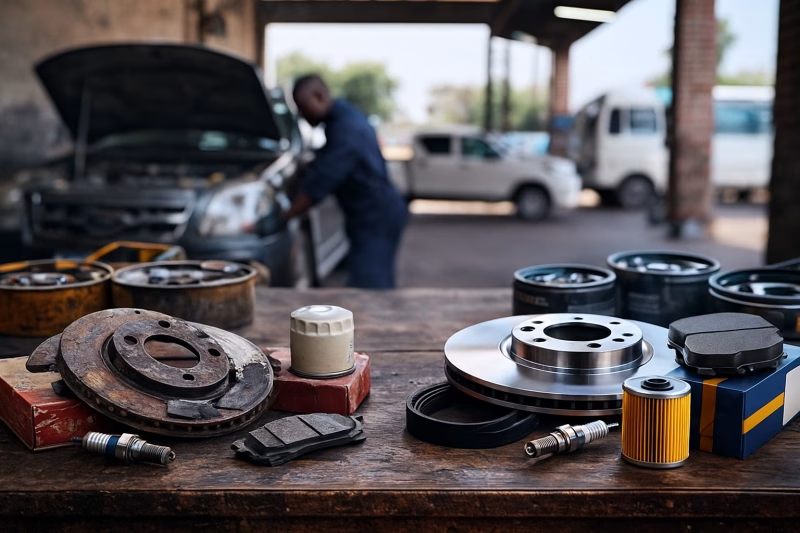
Alongside the positive Africa’s automotive aftermarket growth, lies a dangerous and costly challenge: the surge of counterfeit auto parts infiltrating the market. From brake pads that crumble under heat, oil filters that fail after a few days, to knock-off sensors that misreport engine data, counterfeit auto parts pose a serious threat. Fake parts are an ongoing widespread market and life threat. Their impact is not only financial; instead, they endanger drivers, reduce vehicle lifespan, increase road accidents and undermine trust across the industry. The counterfeit crisis is a reality, an urgent concern and it’s deeply intertwined with Africa’s mobility future.
Why Counterfeit Parts Are Flooding African Markets
To begin with, several factors have paved the way for counterfeiters to thrive:
-
High Vehicle Import Rates and a Huge Aftermarket Demand
Africa imports more than 80% of its cars. Many of them older used vehicles. These cars require frequent repairs and affordable parts. Counterfeiters exploit this demand by offering cheap alternatives that appear convincing at first glance. Unfortunately, counterfeit auto parts take advantage of such demands.
-
Price Sensitivity Among Consumers and Small Garages
With the rising living costs and limited consumer awareness, drivers often choose low-priced parts without understanding the risks. Similarly, informal garages also unintentionally (or sometimes intentionally) buy low-cost inventory to increase margins. This behavior inadvertently supports the counterfeit auto parts trade.
-
Weak Border Enforcement and Regulatory Gaps
Limited inspection capacity, porous borders and inconsistent enforcement give counterfeiters room to operate. More often, once fake parts enter the supply chain, they blend seamlessly with genuine products. Hence, counterfeit auto parts continue to flood the market.
-
Sophisticated Counterfeiting Techniques
Today’s counterfeit parts look professional. Branded packaging, holograms, barcodes, making them difficult to distinguish without deep technical knowledge or authenticity techniques. This combination has resulted in counterfeit parts capturing as much as 40% of Africa’s auto parts market, and severity depending on the country.
The Hidden Costs: How Fake Auto Parts Hurt Everyone
Counterfeit parts are cheaper, but the long-term price is far higher.
-
Rising Road Accidents and Safety Risks
Brakes, suspension components, airbags and tyres are the most commonly counterfeited parts. All these are critical to driver’s and passenger’s safety. Failures are fatal. Road safety experts estimate thousands of avoidable accidents across Africa linked to defective parts as a result of counterfeit auto parts issues.
-
Higher Repair and Maintenance Costs
Fake parts wear out faster, causing damage to surrounding components and require repeated replacements. In many cases, what seemed like a bargain ends up costing more in repairs, downtime and lost vehicle lifespan.
-
Massive Financial Losses for Legitimate Businesses
Authorized distributors, OEMs and professional mechanics lose revenue as counterfeiters undercut them with artificially low prices. The presence of fake parts also damages brand reputation, even when the OEM is not at fault.
-
Economic Drain and Tax Revenue Loss
Governments lose millions in tax revenue when counterfeit products bypass proper import channels. Worse, counterfeit trade often fuels illicit networks and undermines legitimate job creation.
-
Reduced Reliability for Fleets and Public Transport
Bus operators, logistics companies and ride-hailing fleets suffer breakdowns and operational inefficiencies when fake parts infiltrate their maintenance systems. In effect, the counterfeit crisis is a direct threat to safety, business confidence, and economic development.
Also Read: 10 Clear Steps to Buying Auto Parts Online Without Risk
How Africa Is Fighting Back
Despite the scale of the problem, a powerful wave of reforms and industry initiatives is emerging across the continent.
-
Stronger Border Inspections and Customs Intelligence
Countries like Kenya, South Africa, Rwanda, and Ghana are strengthening customs checks using digital tracking, advanced scanners and improved supply chain tracing.
-
OEM-Led Authentication Technologies
Leading aftermarket brands are launching:
- QR code verification
- SMS authentication
- Tamper-proof packaging
- Track-and-trace QR portals
These tools empower technicians and consumers to confirm authenticity instantly.
-
Public Awareness Campaigns
Governments and associations are educating drivers about the dangers of counterfeit parts through media campaigns, roadshows and mechanic training programs. Awareness is becoming one of the most powerful weapons.
-
Certification for Garages and Retailers
Countries are increasingly adopting “approved garage programs” to help consumers identify trusted workshops that source genuine parts.
-
Crackdowns on Informal Dealers
Market raids, fines and business closures are becoming more common as governments take a harder stance on illicit sellers.
-
Partnerships Between Industry and Regulators
More importantly, collaboration is growing between OEMs, national standards bodies, automotive associations and law enforcement. This coordinated approach is proving far more effective than isolated efforts.
Also Read: TotalEnergies Lubrifiants and SCRIBOS Partner Against Counterfeiting
How Consumers and Businesses Can Protect Themselves
Whether you’re a driver, fleet operator, or garage owner, vigilance is key:
- Always buy from authorized distributors.
- Avoid deals that look “too cheap to be true.”
- Check packaging, holograms and serial numbers.
- Ask for receipts and warranties.
- Train your mechanics to detect counterfeit signs.
- Confirm authenticity using brand verification apps where available.
- Besides, a small step today can prevent a major breakdown or accident tomorrow.
Also Read: How to Identify Counterfeit Auto Parts
Quality Parts Are the Foundation of Africa’s Automotive Future
Africa’s automotive sector is rising with a demand for reliability, safety and professionalism. Counterfeit auto parts threaten this progress, however, they are not unbeatable. With stronger regulation, better awareness, digital authentication tools and coordinated industry action, Africa is turning the tide.
In the end, the future belongs to a market built on trust, safety and genuine quality, because in mobility, the right part isn’t just a choice, it’s a lifeline.

