

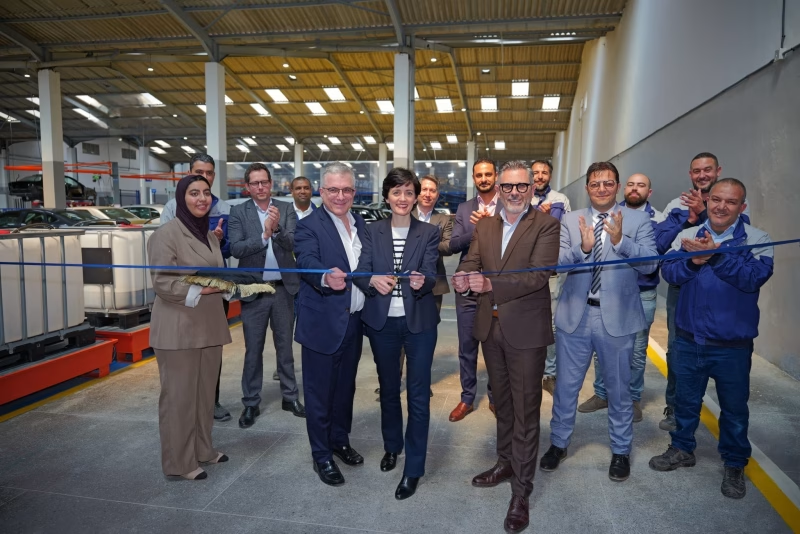
Stellantis has expanded its circular economy footprint by inaugurating its first vehicle dismantling centre in the Middle East and Africa (MEA). The company chose Casablanca, Morocco, as the location for the landmark investment. The new facility is designed to process up to 10,000 end-of-life vehicles annually. This reinforces the company’s commitment to sustainable mobility, resource efficiency, and affordable aftermarket solutions across the region.
The project represents an investment of €1.6 million and is expected to create approximately 150 direct and indirect jobs. These jobs will be created once it reaches full operational capacity. Furthermore, it is the third Stellantis dismantling facility globally. The previous similar centres are located in Turin, Italy, and São Paulo, Brazil.
Supporting a Circular Automotive Economy
The 6,000-square-metre facility will receive vehicles from insurance companies, auctions, and certified end-of-life vehicle channels. After dismantling each vehicle, Stellantis carefully inspects original components that remain in excellent working condition before reintroducing them to the market through its authorised aftersales network and digital sales platforms.
This approach extends the useful life of genuine automotive parts. It also reduces waste. Additionally, it lowers repair costs and minimizes the environmental impact associated with manufacturing new components.
Speaking during the launch, Samir Cherfan, Chief Operating Officer for Stellantis Middle East and Africa and Global Head of Micromobility, emphasized a key point. He stated that circular economy initiatives have become central to the company’s long-term regional strategy.
According to Cherfan, the initiative enables Stellantis to improve industrial performance. It also makes vehicle maintenance more affordable for customers and promotes responsible resource management. Meanwhile, it strengthens its long-term industrial presence throughout the Middle East and Africa.
SUSTAINera Drives the Company’s 4R Strategy
The Casablanca operation forms part of SUSTAINera. This is Stellantis’ global circular economy business unit responsible for industrial-scale remanufacturing, repair, reuse, and recycling activities.
The business model follows the company’s well-established 4R strategy:
- Remanufacture
- Repair
- Reuse
- Recycle
These principles are designed to maximize product life cycles and recover valuable materials. Moreover, they deliver sustainable mobility solutions without compromising product quality.
Jean Christophe Bertrand, Senior Vice President of Parts and Services for Stellantis Middle East and Africa, noted another important point. He stated that the company continues to build scalable and efficient circular economy solutions that improve accessibility. These solutions also maintain the high standards expected from genuine Stellantis products.
Creating Value Throughout the Automotive Lifecycle
Stellantis is implementing a comprehensive lifecycle management approach that covers every stage of vehicle ownership. This includes production, dismantling, and material recovery.
Several circular economy initiatives are already operational throughout the MEA region, including:
- Sales of remanufactured original parts
- Distribution of certified used genuine parts through the B-Parts digital marketplace
- Recycling partnerships supporting end-of-life vehicle processing
- Nationwide aftersales support through authorised dealers, partner workshops, and Distrigo distribution centres
This integrated ecosystem helps reduce repair costs for customers while improving material recovery and ensuring that reused components meet strict quality and traceability standards.
Growing Local Partnerships Across Africa
To support the expansion of its circular economy operations, Stellantis continues to collaborate with various partners. These include industrial partners, recycling companies, logistics providers, and commercial distributors across the region.
These partnerships are expected to improve operational efficiency while creating additional local employment opportunities and supporting regional industrial development.
The Casablanca facility is also expected to serve markets beyond Morocco. Moreover, it will extend its operations into Sub-Saharan Africa, particularly West Africa.
Preparing for the Future of Electric Vehicles
Beyond conventional vehicle dismantling, the new centre will recover and manage traction batteries from electric vehicles, positioning Stellantis to support the rapidly expanding electric mobility ecosystem across Africa.
As electric vehicle adoption accelerates, responsible battery handling, reuse, and recycling will become increasingly important for reducing environmental impact. Furthermore, these actions help recover valuable raw materials for future manufacturing.
Morocco Continues to Strengthen Its Automotive Leadership
The new dismantling centre adds another milestone to Stellantis’ expanding investments in Morocco.
In 2025, the company announced a €1.2 billion expansion of its manufacturing plant in Kenitra, aiming to significantly increase production capacity while raising local sourcing levels to 75% by 2030.
The upgraded facility is scheduled to manufacture three Fiat models based on the Panda platform beginning in 2026. Meanwhile, production of compact electric urban vehicles—including the Citroën Ami, Opel Rocks-e, and Fiat Topolino—has already increased substantially.
These investments further reinforce Morocco’s position as one of Africa’s leading automotive manufacturing and export hubs.
Financial Recovery Supports Continued Investment
The Casablanca launch also comes as Stellantis continues to strengthen its financial performance.
During the first quarter of 2026, the company returned to profitability, reporting €377 million in net profit alongside €38.1 billion in revenue, marking a significant turnaround from the previous year.
Within the Middle East and Africa region, Stellantis increased its market share to 11.5%. This happened despite a decline in overall industry sales. As a result, the company is demonstrating growing competitiveness across regional markets.
Circular Economy Becomes a Competitive Advantage
Morocco’s automotive industry continues to record impressive growth, with vehicle exports increasing during the first quarter of 2026. Against this backdrop, Stellantis’ investment in Casablanca represents more than another industrial project. Instead, it signals the evolution of Africa’s automotive sector toward a more sustainable, resource-efficient future.
By integrating manufacturing, aftermarket services, parts recovery, and vehicle recycling into a single regional strategy, Stellantis is creating a more resilient automotive value chain. This supports affordability, sustainability, and long-term industrial growth across Africa and the Middle East.
As demand for sustainable mobility grows, the Casablanca dismantling centre will play a pivotal role in advancing vehicle recycling, extending the life of automotive components, and strengthening the circular economy across Africa. These efforts will help shape the future of Africa’s automotive aftermarket.
Also Read:
Stellantis to open new factory in South Africa
Tesla Enters the African EV Market in Morocco
Stellantis looks to Africa to grow Used-Car sales

