

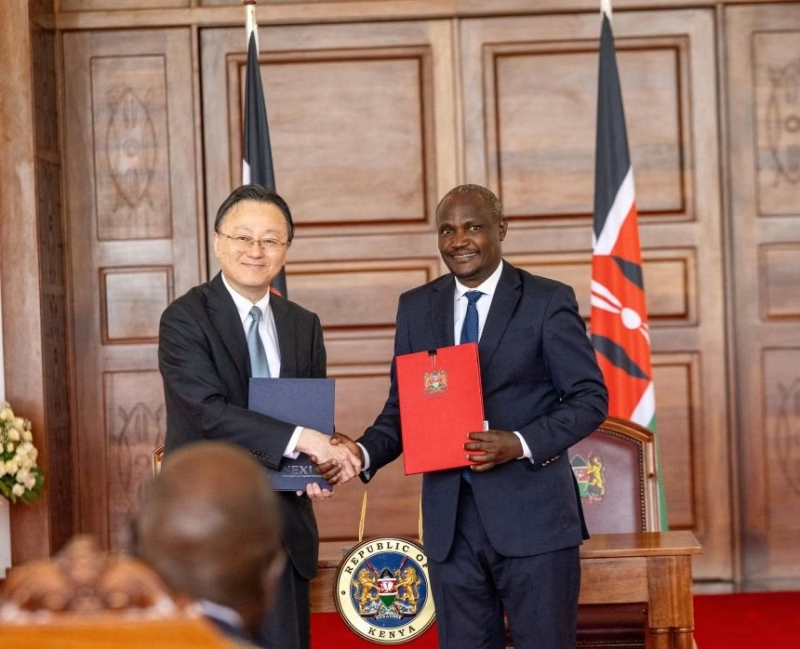
Kenya has secured a KSh22 billion financing package from Japan. This funding is expected to strengthen the country’s automotive manufacturing ambitions and improve energy infrastructure. In addition, it will support broader economic reforms.
The funding agreement, signed between the Government of Kenya and Japan’s Nippon Export and Investment Insurance (NEXI), represents a significant milestone in Kenya’s strategy to expand domestic vehicle assembly and reduce reliance on imported fully built vehicles.
Support for the National Automotive Policy
A substantial portion of the package, approximately KSh13.1 billion, will support the implementation of Kenya’s National Automotive Policy. This policy seeks to increase local manufacturing and promote value addition. It will also stimulate industrial growth through vehicle assembly.
Speaking during the signing ceremony at State House, Nairobi, President William Ruto said the initiative marks an important step towards building a stronger manufacturing economy.
“For many years, Africa has imported products that could be manufactured locally while exporting valuable employment opportunities,” the President said. “Our goal is to assemble more vehicles in Kenya using Kenyan talent, creating jobs, strengthening technical skills, and retaining greater economic value within the country.”
The agreement was signed by Treasury Cabinet Secretary John Mbadi on behalf of the Kenyan Government. NEXI Chairman and Chief Executive Officer Atsuo Kuroda also signed. According to President Ruto, expanding local vehicle assembly will help develop technical expertise and strengthen Kenya’s industrial base. In addition, it will improve the country’s trade balance by reducing dependence on imported vehicles.
He noted that the financing package builds on discussions initiated during his official visit to Japan in 2024 and further engagements held at the Tokyo International Conference on African Development (TICAD) in 2025.
Japanese Partnership and Industrialisation Goals
NEXI Chairman Atsuo Kuroda said the financing arrangement stems from a Memorandum of Understanding signed with Kenya’s National Treasury during President Ruto’s visit to Japan. Eventually, this agreement culminated in the financial agreement concluded in March 2026.
He added that the initiative is expected to support Kenya’s industrialisation agenda by introducing advanced Japanese technologies while contributing to environmental sustainability through improved energy efficiency and lower carbon emissions.
Energy Infrastructure and Economic Reform Support
Beyond the automotive sector, the financing package also allocates KSh5 billion to Kenya’s Reduction of Energy Losses Programme, which aims to modernise the country’s electricity network, minimise transmission losses, and lower the cost of electricity for industries and consumers.
President Ruto described reliable and affordable electricity as a critical foundation for industrial expansion and economic competitiveness. Moreover, the remaining KSh4 billion will support Kenya’s wider economic reform programme. This includes strengthening public service delivery and safeguarding key social development initiatives.
The President said the agreement reflects growing international confidence in Kenya’s economic management and reinforces the country’s efforts to diversify its sources of development financing.
Access to Japan’s Capital Markets
A notable aspect of the partnership is Kenya’s planned access to Japan’s capital markets through a Samurai bond. This marks the country’s first such financing arrangement. President Ruto said expanding financing options is essential to achieving Kenya’s long-term development objectives. Moreover, he noted that conventional funding sources alone cannot adequately support the country’s transformation agenda.
Treasury Cabinet Secretary John Mbadi echoed these sentiments. He stated that the government continues to prioritise concessional financing with significantly lower interest rates. He also emphasized that this is preferred over more expensive commercial borrowing.
Trade Cabinet Secretary Lee Kinyanjui welcomed the agreement. He described it as an important step towards overcoming longstanding barriers to establishing a competitive domestic automotive manufacturing industry.
The signing ceremony was attended by Prime Cabinet Secretary Musalia Mudavadi, Japanese Embassy Chargé d’Affaires Tomonobu Hori, senior government officials, principal secretaries, and representatives from both Kenya and Japan.
Also Read:
President William Ruto opens Japanese Car Auction Firm in Naivasha
Why Electric Mobility Should Top President Ruto’s Economic Agenda
China’s Linglong Tire to Invest $800 Million in Kenya’s First Tyre Manufacturing Plant
Driving Safety Tips Every Driver Should Know

