

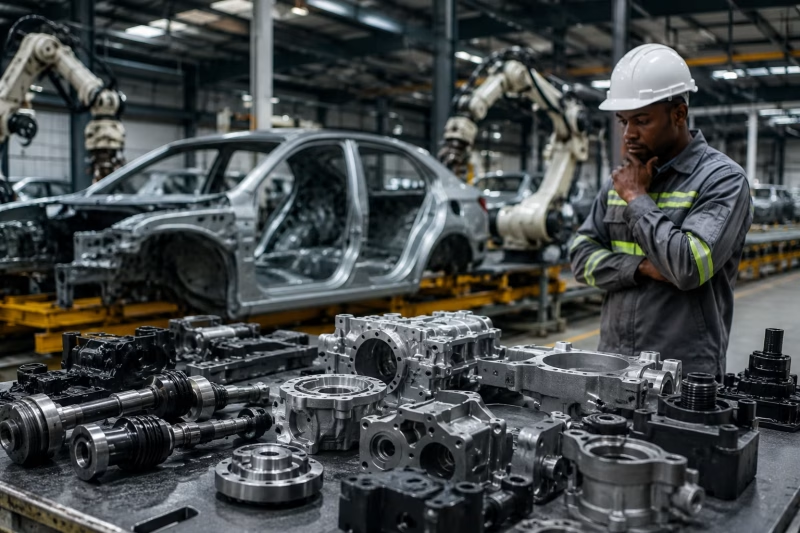
Nearly seven years after launching an ambitious strategy to develop its automotive industry, Ghana faces a critical challenge. While the country has successfully attracted global vehicle assemblers, industry experts warn that weak local component manufacturing and recent tax policy changes could undermine years of progress.
The Ghana Automotive Development Policy, introduced in 2019, positioned the country as an emerging automotive hub by offering incentives to global automakers. The policy attracted investments from Toyota, Volkswagen, Nissan, and other original equipment manufacturers (OEMs), supported by the prospect of serving both the 400-million-consumer ECOWAS market and the wider African Continental Free Trade Area (AfCFTA).
Although vehicle assembly activities have expanded, Ghana has yet to achieve one of the policy’s most important objectives: building a strong domestic supplier network capable of producing automotive components locally.
The Missing Link in Ghana’s Automotive Ecosystem
According to Samuel Adjei, Head of the Automobile Department at the Opportunity Industrialization Technical Institute (OTI), the disconnect between vehicle assembly and component production remains the industry’s greatest challenge.
Without local manufacturers producing essential components such as seats, batteries, wiring harnesses, glass, and metal parts, Ghana risks remaining dependent on imported vehicle kits rather than developing into a fully integrated automotive manufacturing hub. Adjei believes that local assembly alone cannot deliver the full economic benefits envisioned under the policy. Instead, the sector requires a vibrant supplier ecosystem that can support production, create jobs, and retain more value within the country.
Tax Policy Raises New Concerns
Industry concerns have intensified following the government’s decision to remove a 20 percent Value Added Tax (VAT) exemption on applicable duties for locally assembled vehicles in the 2026 national budget.
The Automobile Assemblers Association of Ghana (AAAG) has warned that the move could have severe consequences for the industry. According to the association, the policy change could force seven assembly plants to shut down and threaten more than 400 skilled engineering jobs.
AAAG members have already invested close to $80 million in assembly facilities, equipment, workforce training, and related infrastructure. Industry stakeholders fear that the tax change could weaken investor confidence at a crucial stage of the sector’s development.
Localisation Gains Importance Across Africa
The timing of the policy shift presents an additional challenge. The Association of African Automotive Manufacturers (AAAM) has identified localisation and component manufacturing as major priorities for Africa’s automotive sector in 2026.
The organization aims to facilitate at least five new component manufacturing investments across the continent and continues to monitor policy implementation in strategic markets, including Ghana. At the same time, the AfCFTA Secretariat is finalizing automotive rules of origin that are expected to require vehicles produced in Africa to contain at least 40 percent local content.
For Ghana to fully benefit from these emerging continental frameworks, it must strengthen its domestic supplier base. At present, local component production remains insufficient to meet such requirements at scale.
Structural Barriers Continue to Limit Growth
Adjei points to several structural challenges that continue to hinder the growth of component manufacturing. Access to affordable financing remains limited, making it difficult for small and medium-sized manufacturers to invest in advanced machinery, modern production technologies, and quality assurance systems.
Manufacturers also face high energy and logistics costs, which often make locally produced components less competitive than imported alternatives. In addition, Ghana still faces a shortage of highly specialized technical skills in areas such as precision engineering, industrial design, and quality management, despite ongoing contributions from technical and vocational training institutions.
Growth Potential Remains Strong
Despite these challenges, Ghana’s automotive market continues to show significant growth potential. Industry projections indicate that the market could expand from $2.02 billion in 2025 to $3.41 billion by 2031, representing a compound annual growth rate of 9.1 percent.
However, industry experts caution that long-term success will depend on more than increasing vehicle demand. Ghana must develop the industrial infrastructure necessary to capture greater value locally instead of relying heavily on imported components.
Lessons from Established Automotive Markets
Countries often cited as automotive success stories in Africa, including South Africa and Morocco, built their industries through long-term commitments to supplier development, local content requirements, and coordinated industrial policies. While Ghana has established many of the necessary policy frameworks, experts argue that implementation must become more deliberate and consistent if the country hopes to achieve similar outcomes.
A Narrowing Window of Opportunity
Ghana still has an opportunity to strengthen its automotive ambitions, but industry stakeholders believe the window is narrowing. If policymakers do not restore the VAT exemption and introduce targeted support measures for component manufacturers, the country risks weakening the very assembly investments it worked hard to attract. Without stronger support for localisation, the broader vision of creating a competitive and integrated automotive manufacturing industry may struggle to materialize.
As Ghana seeks to position itself within Africa’s evolving automotive landscape, the next policy decisions could determine whether the country becomes a true manufacturing hub or remains largely an assembly destination.
Also Read:
Côte d’Ivoire’s automotive ambitions in West Africa
Driving Demand for Paints and Coatings in Ghana
Government to Set up a National Automotive Council, Says President Kenyatta

