

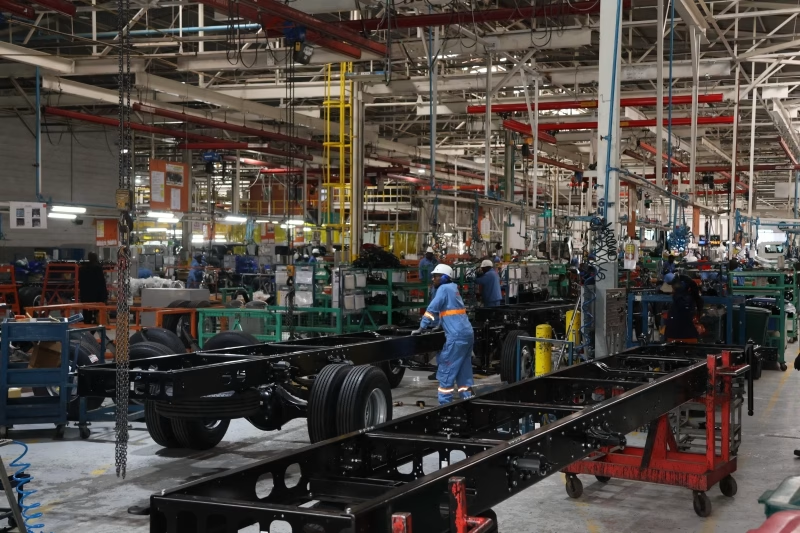
The Kenyan government’s efforts to settle outstanding contractor payments and resume road infrastructure projects are helping support demand for new vehicles, with sales recording strong growth in the first eight months of 2026.
Industry data from the Kenya Motor Industry Association (KMIA) for August 2026 shows that new vehicle sales increased by 27.3% year-on-year, rising by 2,435 units to reach 11,349 vehicles between January and August.
This compares with 8,914 units sold during the corresponding period in 2025 by the 11 major new-vehicle dealers operating showrooms across Kenya, some of which also serve regional export markets.
The growth follows significant government intervention to settle pending road contractor bills and revive infrastructure development. In February 2026, the government cleared KSh177 billion in outstanding payments to road contractors. In August, it announced the mobilisation of a further KSh139 billion to settle certified works, with payments made between August 21 and 28.
The additional funding was mobilised through the Trade and Development Bank and the securitisation of the Road Maintenance Levy Fund, as the government sought to address outstanding bills dating back to 2020.
Heavy Commercial Vehicles Lead Market Growth
Kenya’s automotive market recorded 1,592 new vehicle sales in August 2026, following its strongest monthly performance in July, when dealers sold 1,912 units.
According to KMIA, government spending on contractor payments and the resumption of road projects played a significant role in driving demand, particularly for heavy commercial vehicles.
“Industry performance was primarily propelled by government fiscal intervention, specifically the mobilisation of KSh139 billion to clear contractor bills and restart road projects, which spurred heavy commercial vehicle demand,” KMIA stated in its monthly report.
Heavy commercial vehicles, which support long-haul freight, construction and logistics operations, accounted for a substantial share of the market, with 4,836 units sold during the eight-month period. Isuzu East Africa led the segment with 3,301 units.
Prime movers, which are heavy-duty tractor units used to haul trailers and transport large loads, recorded 844 sales. CFAO was the leading dealer in this category.
Beyond infrastructure spending, sustained activity in transport, including public transport, agriculture, manufacturing, retail and other key economic sectors, also supported new vehicle demand.
Pick-up trucks remained an important part of the market, with single-cab models recording 1,934 units and double-cab models reaching 1,119 units. Minibuses with seating capacities of 21 to 40 passengers recorded 644 sales, while large buses with more than 40 seats accounted for 223 units.
Isuzu Maintains Market Leadership
Isuzu East Africa retained its position as Kenya’s leading new-vehicle dealer, capturing a 47.6% market share with 5,405 units sold between January and August 2026.
The company also recorded strong growth in the SUV-D segment, where its year-to-date sales increased from 20 to 90 units, representing a 350% rise and a 61.2% share of the segment.
Isuzu attributed the performance of its mu-X seven-seater SUV to competitive pricing supported by local assembly, increased public-sector procurement under the Buy Kenya Build Kenya policy and a retail strategy targeting customers considering alternatives to imported used vehicles.
CFAO Mobility Kenya ranked second, selling 3,942 units and securing 34.7% of the market. Simba Corporation recorded 865 sales, while Tata Africa sold 533 units during the same period.
Local Assembly and Policy Remain Key to Growth
The industry continues to look to supportive government policies and a gradual reduction in used-vehicle imports to strengthen domestic vehicle assembly and manufacturing.
Despite the increase in new-vehicle sales, Kenya’s installed automotive assembly and production capacity remains significantly underutilised. Isuzu East Africa Chairperson and Managing Director Rita Kavashe has indicated that capacity utilisation stands at approximately 34%, leaving substantial room to increase local production.
Improving capacity utilisation will depend on sustained vehicle demand, a competitive local manufacturing environment, supportive policies and continued investment in assembly operations. As infrastructure spending and economic activity support market growth, the industry will be looking to convert rising vehicle sales into stronger domestic production, employment and a more competitive automotive sector.
Also Read:
Isuzu East Africa Considers Opening Assembly Plant in Tanzania

