

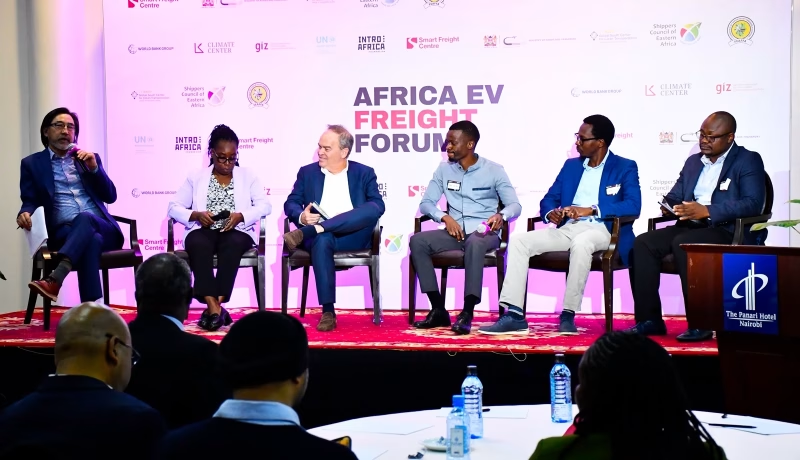
Kenya is stepping up efforts to accelerate zero-emission freight across East Africa, bringing governments, freight operators, financiers and technology providers together in Nairobi to address the practical challenges of electric trucking.
The push took centre stage at the inaugural Africa EV Freight Forum, where stakeholders examined how charging infrastructure, investment, policy, vehicle technology and cross-sector partnerships can move electric freight from pilot projects and demonstrations towards commercially viable operations.
The two-day forum, co-organised by Smart Freight Centre and Intro Africa in partnership with the Ministry of Roads and Transport through the State Department for Transport, comes as Kenya strengthens its policy, legal and institutional framework for electric mobility.
The discussions also highlighted the growing need to develop electric freight solutions around real African operating conditions, including long-distance routes, border crossings, charging availability and the commercial requirements of freight operators.
Kenya Strengthens Electric Mobility Agenda
The opening session featured remarks from the Principal Secretary, State Department for Transport, Mr Mohamed Daghar, CBS, delivered on his behalf by the Director, Road and Rail Transport, Mr Paul Kingori.
In his remarks, Daghar underscored the importance of collaboration between government, the private sector and development partners in developing cleaner and more efficient transport systems.
He also noted that the engagement supports ongoing efforts to strengthen Kenya’s policy, legal and institutional framework for electric mobility, creating a more coordinated foundation for the country’s transition towards cleaner transport.
Moving Electric Freight Towards Commercial Deployment
Discussions on the first day focused on the need to move electric freight beyond demonstrations and towards commercially viable deployment.
Participants examined the conditions required to make electric freight practical at scale, including charging infrastructure, investment, supportive policy frameworks, vehicle technology and partnerships between public and private-sector stakeholders.
A presentation titled “On the Road” showcased electric vehicle expeditions along African trade corridors. The journeys demonstrated the potential for electric buses, pickups and trucks to undertake long-distance operations when supported by appropriate route planning, charging infrastructure and coordination among stakeholders.
The discussions also highlighted practical challenges that could slow adoption, including limited charging infrastructure and delays at border crossings. These issues remain particularly important for regional freight operators whose vehicles must operate across multiple jurisdictions and travel long distances between major logistics hubs.
Integrated Planning for Electric Freight Corridors
During a panel discussion on corridor development and climate competitiveness, Kingori highlighted the importance of integrated national transport planning in supporting electric mobility, alternative fuels and emerging technologies such as hydrogen.
Such an approach can help policymakers consider different technologies alongside the wider requirements of freight transport, including infrastructure availability, energy supply, vehicle suitability, operational efficiency and regional connectivity.
For freight operators, the development of viable electric corridors will ultimately depend on whether charging and energy infrastructure can support real-world duty cycles rather than isolated demonstration projects.
Building Policy to Deliver Benefits
Ms Susan Kamau, Road and Rail Transport Officer in the State Department for Transport, outlined government efforts to coordinate Kenya’s electric mobility agenda during a session titled “Policy to Deliver Benefits.”
She explained that government efforts are structured around five thematic areas: policy and regulation, energy, innovation, skills and financing.
These areas reflect the broader requirements of developing an electric mobility ecosystem. Beyond vehicle availability, successful adoption requires appropriate regulations, reliable energy infrastructure, technical expertise, access to investment and continued innovation.
Kamau also highlighted the review of the legal framework governing road transport to address emerging developments in the sector, including electric mobility and intelligent transport systems.
From Demonstrations to a Scalable Freight Future
The Africa EV Freight Forum provides an important platform for examining what is required to move electric freight from individual demonstrations to commercially sustainable operations.
For Kenya and the wider East African region, the transition will require coordinated action across government, vehicle manufacturers, freight operators, energy providers, financiers, technology companies and development partners.
As freight demand continues to grow, the ability to deploy cleaner technologies while maintaining operational efficiency and commercial viability will become increasingly important.
The discussions in Nairobi therefore point to a broader shift in Africa’s mobility transition: electric freight is moving beyond the question of whether the technology can work and towards the more practical question of how it can be deployed at scale.
Also Read:
Hydrogen vs Electric Trucks: Which Technology Fits Africa Best?
Why Battery Technology Matters for Modern Vehicles in Africa
NEXUS Automotive International held its Business Forum for the first time in North America

