Sunday, May 31, 2026
Home Blog Page 69

Toyota Kenya, Total Kenya partner to promote Jua- Kali Sector

0

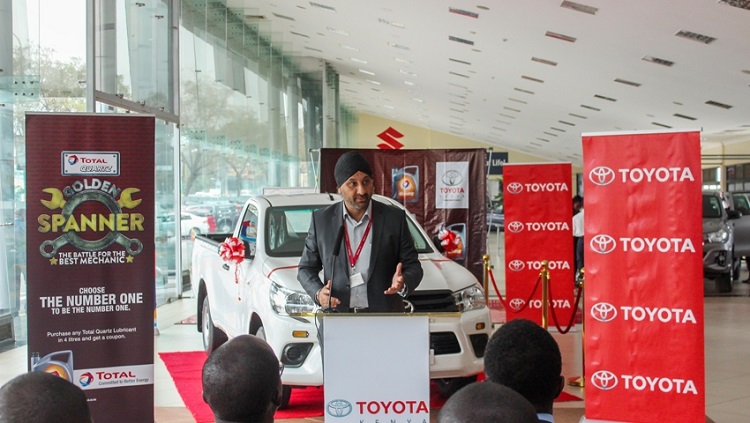
Toyota Kenya Limited and Total Kenya have announced a three-month skill-based competition targeting the Jua-Kali mechanics. The competition dubbed, Total Quartz Golden Spanner Competition scheduled to run from mid-August to November 2019, will see mechanics from across the country battle it out for the grand prize of a brand-new Toyota Hilux single cab pickup valued at Sh3 million.

The first and second runners up will obtain Sh.500, 000 and Sh.250, 000 respectively to help further grow their businesses. According to Toyota Kenya Managing Director (MD), Arvinder  Reel, the competition aims to equip the entrants with skills in a number of vehicle diagnostic and service areas.

He further added that the entrants in the first round of the competition will take part in four elimination challenges namely tool challenge, spark plug challenge, oil filter challenge and quick fire challenge.

“Successful participants in the first round will proceed to the second round of the competition to be held in 14 regions across the country,” said Mr. Reel.

He further noted that the competition will feature three stages taking place at selected Toyota Service centres outlets nationwide and the grand finale at the Toyota Kenya Academy (TKA) in Nairobi.

Speaking during the launch of the competition on Tuesday, the MD said that the second round will be rolled out at Toyota Kenya dealer workshops, in regions where the mechanics will be tested on theory and practical evaluations that will be facilitated by the TKA training instructors.

“Three  candidates will then be shortlisted to attend the finals in Nairobi at TKA which will run for 5 days, where the contestants will go through various elimination challenges that will see 10 compete for the grand prize” he said.

He added that the competition aims to build self-reliant young people who embrace blue-collar jobs and create opportunities for them and secure bright futures and maximize through maximizing their potential.

The  Total Kenya Managing Director, Olagoke  Aluko said that mechanics buying any Total Quartz Engine Oil brands will obtain a scratch coupon with a short code that will be required to send to 40740, upon which the contestants will be sent two sets of questions which they will be required to respond to.

He further added that the contestants will be awarded points based on the number of correct answers given, with those having the highest score getting a ticket into the competition.

“In addition to getting a chance to win the grand prize, the competitors will further hone their mechanic skills and knowledge in automotive servicing and repairs which will help grow their individual start-ups or businesses,” added Aluko.

How software will dominate the Automotive Industry

0

Once a concept confined to science fiction novels and futuristic movies, autonomous vehicles are well on their way to becoming a reality―and 2016 was a landmark year for the sector. Tech companies grabbed the lion’s share of the headlines, with a string of announcements that showed the extent to which they are betting on the space. In August, Uber announced the $680m acquisition of Otto, the self-driving trucking company, on the same day that it also unveiled a $300m partnership with Volvo focused on vehicle development and production. In October, Tesla revealed that all of its new vehicles would be equipped with hardware to enable fully-autonomous functionality, and in December, Google disclosed that it was spinning out its self-driving unit into a separate company called Waymo.

But automakers have not been sitting idle. In March, General Motors completed the acquisition of Cruise Automation, a startup developing self-driving technology, for a whopping $1 billion―only a few months after it disclosed that it would partner with Lyft to test self-driving taxis. In August, Ford proclaimed that it would mass produce fully-autonomous self-driving vehicles by 2021, and in the same month auto-components giant Delphi announced that it would be providing the Singapore Land Transport Authority with a fleet of self-driving vehicles as well as software for a mobility-on-demand program.

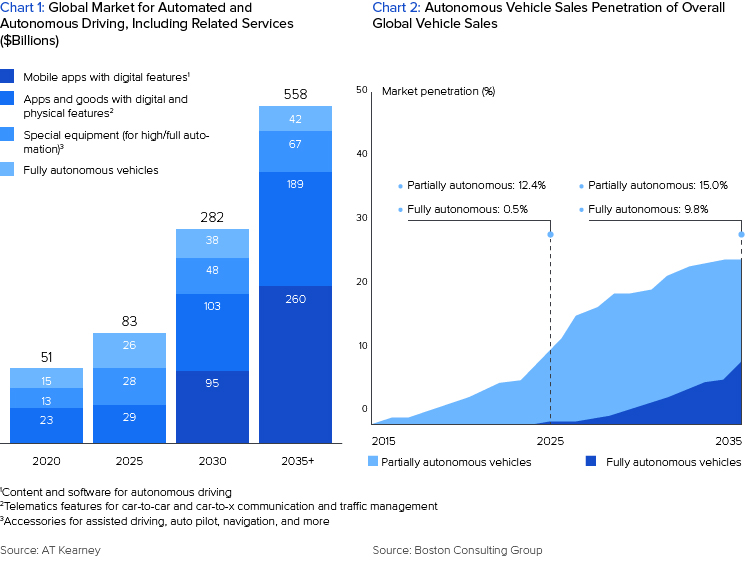
The above is just a selection of the multitude of deals, partnerships, and development programs that are continuously springing up related to autonomous vehicles. Driving all this is a recognition that a profound shift is under way in the automotive industry. As illustrated by Charts 1 and 2 below, AT Kearney estimates that the market value of the connected mobility marketplace will skyrocket to over $550bn by 2035, while BCG estimates that autonomous or semi-autonomous vehicle sales penetration could reach 25% by the same year.
In this rapidly evolving market, how can incumbents react? Existing industry players are well aware that autonomous cars will have a tremendous impact on the mobility market. But how will they change consumer behavior, exactly, and at what pace? What strategies will allow the constituents of the automobile value chain to remain relevant in the long-term? In this article, we analyze how the auto industry will evolve into a software-first sector as autonomous technology progresses, and what considerations can be pursued to reposition for the future.

A Radical Shift in Consumer Behaviour

As autonomous technology advances, a profound shift in consumer behaviour will alter the revenue model and value chain of the industry. While the nature of these changes will be multifaceted, at a high level we can categorize them into two principal buckets.

More Time Spent in Vehicles, Without Having to Concentrate on Driving

The first major change relates to the time spent in vehicles. We already spend an enormous amount of time in our cars: the AAA Foundation estimates that US drivers spend more than 290 hours each year behind the wheel, equating to roughly 6-7 hours per week per licensed driver. But with the advent of autonomous vehicles, this number is likely to increase. As responsibility for control of the car moves to computers, significant demographics that have historically had limited or no engagement with driving―the elderly, people with disabilities, children―will no longer be faced with this constraint. Moreover, as the travel experience becomes more pleasant, consumers will be willing to spend greater amounts of time in their vehicles. Two separate academic studies concluded that autonomous vehicles could lead to increases in vehicle miles travelled (VMT) of up to 20%.

Coupled with the above would be an increased amount of idle time spent in vehicles. The logic is straightforward: as cars evolve into self-driving entities, humans will have more time to do other things while travelling. The pace at which this will occur will depend on advances in technology, but as shown in Chart 3, AT Kearney estimates that self-driving technology could free up 1.9 trillion minutes of idle time for passengers by 2030.

The Rise of Mobility-as-a-service

The other fundamental change in consumer behaviour that will be catalyzed by autonomous vehicles is the rise of mobility-as-a-service (or transportation-as-a-service). Loosely defined, mobility-as-a-service (MAAS) refers to a shift away from personally owned vehicles towards the use of mobility solutions on an on-demand basis.

Underlying this trend will be two factors. On the one hand, the last decade has already seen a shift in consumer perception of car ownership away from status symbol and towards utility. As illustrated in Chart 4 and Exhibit 1 below, car ownership has been waning for several years, likely driven by changing sentiments among younger demographics. In fact, data shows that the percentage of US citizens aged 16-24 holding a driving license declined from 76% in 2000 to 71% in 2013. So autonomous vehicles notwithstanding, advanced economies are witnessing a secular decline in car ownership figures. Self-driving cars will accelerate this trend.

Augmenting this trend has been the rapid growth of on-demand ride services (e.g. Uber) as well as car-sharing services (e.g. Zipcar). Membership in car clubs, for instance, is growing at more than 30% per year, and should hit 26m globally by 2020. Recognizing the trend, traditional OEMs like Daimler and BMW have already pushed into this space (with Car2Go and Drive Now). And with the explosive growth of car-hailing applications like Uber, Lyft, and Didi Chuxing, the lines dividing these services are starting to blur. Once drivers are removed from the picture, Uber and Zipcar will essentially become the same service.

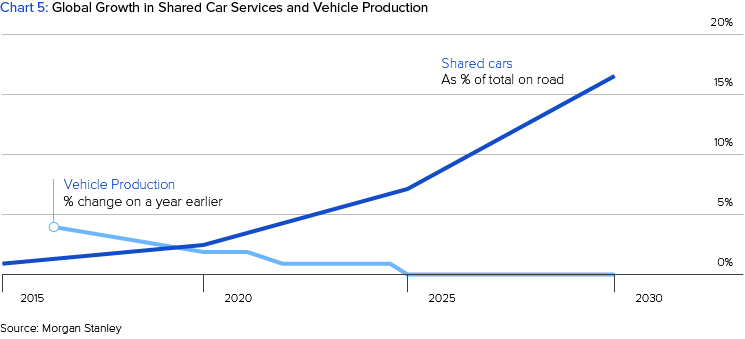
The confluence of all these factors will continue to drive the MAAS trend going forward. Morgan Stanley estimates that by 2030, growth in vehicle production will have stagnated, while Chart 5 indicates that shared car services will pass 15% of total cars on the road.
A New Value Chain

The result of the above is that a profound shift in the value chain will take place. We are likely to see the industry evolve from an OEM dominated value chain towards a “technology stack” that in many ways resembles what we have seen occur in the PC industry.

As Figure 1 shows, the industry is likely to be divided into three principal categories. At the bottom of the stack will be the hardware companies: those actually producing the vehicles and their components and accessories. Sitting on top of these will be the software layer which provides the intelligence that runs the cars, as well as the software enabling connectivity of the vehicles and fleet management functionality. At the top will be the application layer which will leverage the two lower parts of the stack to provide consumers with services and content related to their transportation needs and experience.

Accompanying this change in the stack will be a shift in where the value lies. Today, the overwhelming majority (c. 90%) of the value of a car relates to the hardware―the chassis, the powertrain, interior seating and lighting―but the new paradigm described above means that differentiation and profits will migrate towards the higher parts of the stack. In Chart 6 above, Morgan Stanley estimates that the software and applications layers will collectively account for 60% of the value of a future self-driving car.

More significant is the fact that these software and application focused layers are also higher margin businesses. A study by Strategy& found that while revenue share for hardware suppliers will decline, their share of industry profits will decline far more substantially (Chart 7).

The implications of these developments are clear: for industry incumbents to stay relevant, they must not only recognize the unfolding shift, but act accordingly to position themselves in the evolving landscape.

How To Pivot for the Future

Faced with the prospect of long term decline, OEMs who enter new layers of the value chain (software and/or applications) will continue to be relevant in the industry of tomorrow. But how can they do this? Below we dive into a few important considerations to keep in mind.

Software Or Applications?

The first key consideration relates to which other layers in the stack traditional players can participate in. On the one hand, it goes without saying that whichever of the two one chooses, fundamental reconsiderations of corporate structure and priorities will need to occur. Moving from being a supplier and producer of automobiles and auto-components to being a software company is a tectonic shift to say the least. But assuming this can be done, where does it make most sense for OEMs to angle into?

Our view is that much like the PC and smartphone industry, the car of tomorrow’s operating system will be dominated by one or two providers. Network effects ensure that these layers in the stack tend to be a winner-takes-all market. And frankly speaking, it feels difficult to envision a car company winning out in this race. More likely, one of the traditional technology companies will emerge as the principal operating system.

With this in mind, our recommendation would be to work closely with all the technology companies developing on operating systems solutions to ensure that the hardware/software integration is as smooth as possible. This will in turn drive sales of the hardware, which will remain the core competency for many years to come. In the meantime, we would encourage current industry incumbents to think ahead on what types of applications consumers will find most useful and to position themselves and start developing these accordingly.

Integrate Or Partner?

The other key consideration relates to how these strategies should be executed. Borrowing from the technology industry’s playbook, should OEMs aim to be Apple―a company that owns the entire chain from hardware, to software, through to the point-of-sale―or should they be an Android/Microsoft which focus on the operating system and integrate into hardware and retail distribution provided by other companies?

The two strategies are fundamentally different and have massive implications. And the problem is that the evidence from the PC and smartphone industries doesn’t help solve the dilemma. On the one hand, in the PC industry, Apple led the way, but more open systems quickly caught up and eventually took the lead (Chart 8). In the smartphone industry we’ve seen a different set of events unfold. Open systems like Android dominate in terms of volume, but Apple continues to lead the way in profits (Chart 9).

Our gut tells us that open systems are probably the safer bet. Building a fully integrated car will most likely revolve around the operating system, which current technology giants are best positioned to produce. Aside from M&A, we don’t envision current OEMs being able to effectively transform themselves into technology-first companies. Rather, our suggestion would be to embrace the more open-ended approach and follow a dual strategy of hardware optimization on the one hand, and application development on the other.

Sourcing The Right Talent

Whichever strategy one chooses, the critical component for success is effective talent sourcing and management. The players who attract the best talent and structure their organizations to maximize innovation will be the winners in this space. But competition for talent has already heated up, and reports of defections and lavish compensation packages are not uncommon.

One suggestion is to establish numerous partnerships with exciting startups as a way to achieve the twin goals of investing in promising technology and developing insights into the quality of the teams in question. As these partnerships evolve and the winning teams start to pull ahead, organizations can employ M&A to bring these teams in-house. Incumbents can use this tactic and others to attract self-driving talent―but the first step for stakeholders is understanding the changes in the automotive landscape that we have outlined above, and committing to a strategic realignment that will help them stay relevant well into the next phase of vehicular transportation.

DENSO to mass-produce automotive alternators equipped with newly developed high-efficiency diodes

0

DENSO, the world’s second largest mobility supplier announced that it has developed a high-efficiency diode for alternators for gasoline and diesel engine vehicles with the semi-conductor supplier, Hitachi Power Semiconductor Device, Ltd. Production of alternators equipped with newly developed diodes will start for vehicles to be sold in Europe in FY2019, and will be rolled out to manufacturing group companies around the world.

Overview:

  • Revolutionary spec improvement drastically reduces CO2 emissions
  • Overall alternator efficiency and fuel-economy is improved

The diode is a component of alternators. Diodes flow current in a certain direction and rectify generated alternating current to direct current. The new jointly developed diode significantly reduces the power conversion loss by increasing the efficiency of the function. The new diode improves the power generation efficiency by about 6% compared to conventional products and helps to improve fuel consumption. DENSO manufactures 25 million alternators in annual total in more than 10 countries. If all the diodes were replaced with the new high-efficiency diodes, carbon dioxide emissions would be reduced by 30 tons annually.

The new diode is developed as a component that fits the conventional alternator. DENSO and Hitachi remained the conventional shape of the diode and increased the efficiency of rectifying function by simplifying IC control function and applying 3D design located IC tip sterically.

Although vehicles are being increasingly electrified, the internal combustion engine (ICE) with an alternator still accounts for 80% globally. DENSO markets and distributes products for swiftly improving the environmental performance of ICE vehicles to help create a sustainable society.

About alternators

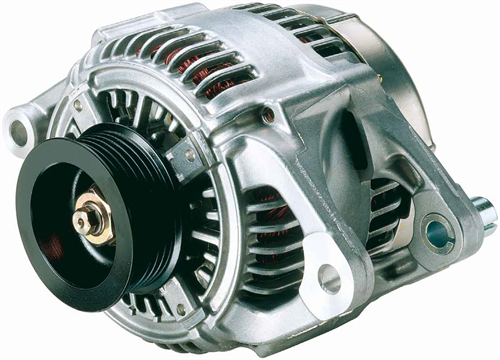
An alternator is an important component that generates electricity using the power of the engine and supplies electricity to all the electrical components in a vehicle. The electricity remaining after consumption by electrical components is sent to a battery for storage.

An alternator is connected to the crankshaft of the engine via a pulley and belt, and generates electricity using engine torque. Improving the power generation efficiency of the alternator reduces the engine torque load and increases the fuel efficiency of the vehicle.

About DENSO’s Electrification Development

DENSO has been developing electrification technologies as a priority to create the future of mobility. The company has also been developing key components for electrified vehicles such as motor generators (MGs) and elements of Silicon Carbide (SiC) for inverters.

About DENSO

DENSO is a $48.3 billion global mobility supplier that develops advanced technology and components for nearly every vehicle make and model on the road today. With manufacturing at its core, DENSO invests in its 221 facilities in 35 countries to produce thermal, powertrain, mobility, electrification, & electronic systems, to create jobs that directly change how the world moves. The company’s 170,000+ employees are paving the way to a mobility future that improves lives, eliminates traffic accidents, and preserves the environment. Globally headquartered in Kariya, Japan, DENSO spent 9.3 percent of its global consolidated sales on research and development in the fiscal year ending March 31, 2019. For more information about global DENSO, visit https://www.denso.com/global.

2020 Toyota 4Runner gets modest price increase


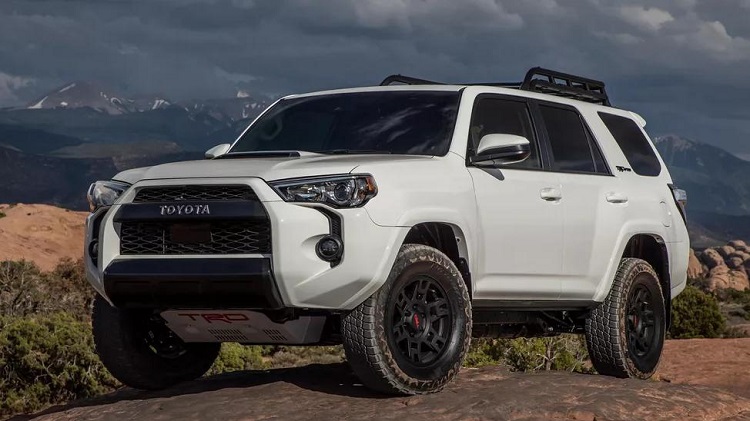
The Toyota 4Runner is one of the oldest new cars you can buy today. Still, we have a soft spot for the rugged charm of Toyota’s go-anywhere midsize SUV, and happily, the 4Runner receives a number of tech and safety upgrades for the 2020 model year. But depending on trim level, those new features don’t come cheap.

According to pricing documents uncovered by CarsDirect this week, the 2020 Toyota 4Runner will have a base MSRP of $37,140, including destination. That only represents an increase of $735 compared to a base 2019 4Runner, but things get a lot more expensive from there.

The 4Runner SR5 Premium will reportedly come in at $40,355, which is $2,100 more than before. Moving up, the TRD Off-Road and Off-Road Premium trims cost an extra $1,280 and $2,100, respectively, over their 2019 model year counterparts.

If it’s the range-topping 4Runner TRD Pro you desire, be prepared to pay at least $50,885 — an increase of $2,975 over the 2019 model. CarsDirect points out the 4Runner TRD Pro got a similar price hike for the 2019, when it received a number of off-road upgrades including new shocks, wheels and skid plates. For 2020, the Pro gets a TRD exhaust in addition to revised infotainment software and Toyota’s full Safety Sense-P suite of advanced driving aids.

The 2020 4Runner TRD Pro is no slouch off road, able to tackle big rocks and tough trails alike. Of course, at $50,000, it’s priced higher than a base Jeep WranglerRubicon ($43,040, including destination), though the 4Runner comes with more standard equipment right out of the box.

Kia counts on electric-car push to meet CO2 target in Europe


Kia will leverage full-electric vehicles to reach European CO2 emissions reduction targets in 2020 and 2021 but the brand has developed contingency plans in case sales are insufficient.

“Failing to make the targets is not an option. Our Korean headquarters would not accept it,” said Kia Europe Chief Operating Officer Emilio Herrera.

Among the contingency plans that Herrera revealed:

  • Kia could make its car-sharing business in Spain all-electric
  • It could introduce low-emissions tires on every vehicle
  • Company cars for staff would be EVs
  • All the dealers’ demo cars would be EVs
  • All the company’s service cars would be EVs.

Kia is likely to miss its European Union-mandated target to cut new-car fleet emissions to 91.7 grams per kilometer by 3.2 grams, according to a study by PA Consulting. This means the automaker would face fines from the EU.

Overall electrification will be crucial. Without battery-electric and plug-in hybrid vehicles, it will be almost impossible for Kia to meet the targets, Herrera said. Kia Europe has to secure as many EVs as possible to be able to increase sales or at least maintain them, he said.

The alternative would be to reduce the volumes, like some other brands. But Kia doesn’t want to do that, Herrera said. And paying fines would be deemed a major failure in Korean culture, he said.

Kia needs to sell 40,000 full-electric cars in Europe in 2020 to reach the CO2 target, Herrera said. EVs are expected to account for 15 percent of Kia’s total sales in 2019 — about 75,000 vehicles out of 500,000 total.

Both “are going so well that we don’t have enough supply,” Herrera said. “In most of the countries, we have already sold the quantities allocated for the whole of 2019, so these countries are already selling the 2020 production.”

Luckily, Herrera said, battery production will rise in the second half of this year and will help Kia sell the cars in 2020.

An accelerated electrification of the model range should help sales. In November, Kia’s plant in Zilina, Slovakia, will start producing plug-in hybrid versions of the Ceed station wagon and recently launched XCeed. Both models will reach the market in January 2020.

Next year the new Sorento midsize SUV will add hybrid and plug-in hybrid versions to the current powertrain portfolio, which already inlcudes a diesel. The Imagine by Kia concept unveiled at this year’s Geneva auto show will be the base of a battery-electric car that Herrera said will launch in 2021. All together, Kia plans to offer 19 electrified vehicles by 2022.

Mild hybrids will also help, although they are not entitled to supercredits. In November, a mild hybrid version of the Ceed hatchback will launch. Mild hybridization will probably be extended to the full range later, Herrera said, adding that the mild hybridization could be quicker if Kia realizes it needs lower-CO2 vehicles.

Is their CO2 advantage worth the cost? The target is so stringent, Herrera said, that Kia needs everything — every little bit counts.

Increasing Demand for Automotive Air Filters

0

Air filters are essential component of an automotive which serves basically two purposes based on its type. There are two types of automotive air filters namely intake air filters and cabin air filters. Where the former acts as a barrier against foreign particles such as dust to enter engine’s combustion chamber, the latter restricts the entry of dust in the cabin of the vehicle through the vent of HVAC system. Non-performance of intake air filters may lead to inefficiency of engine and increase in its emission levels. Therefore, it becomes necessary for the vehicle user to clean it at regular intervals and replace it with new once it completes its lifetime.

Automotive air filters have both OEM as well as replacement markets wherein the latter dominates the global sales. The automotive air filter market is driven by increasing demand for automobiles, strict emission norms and changing lifestyles. The increasing number of vehicles with air-conditioned cabins is boosting the market for cabin air filters. The increasing health consciousness of people wherein they require resistance from dust, pollution, harmful exhaust gases and other contaminants while driving is attracting the car users for the cars with cabin air filter. According to The World Health Organization (WHO), the urban outdoor air pollution causes about 1.3 million deaths every year worldwide. Apart from the developed countries, the developing countries are also becoming conscious about their safety from outdoor pollution which is a positive sign for the growth of cabin air filters market in the long term.

Based on vehicle type, automotive air filter market can be segmented under passenger cars, light commercial vehicles and heavy commercial vehicles. However, there exist certain restraints for automotive air filters market including large interval of their replacement in the developing countries and increasing market for duplicate automotive air filters.

Growing per capita income in other Asian countries such as India is propelling the demand for passenger cars. On the other hand, the increasing industrialization and commerce in Asian countries are boosting the market for commercial vehicles which is driving the automotive air filters market in the region. Commercial vehicles in the developing countries need more care and maintenance as the quality of parts used in them is low as compared to the commercial vehicles manufactured in the developed countries. Moreover, due to less developed infrastructure the chances of entry of dust and dirt in the combustion compartment are high. Due to these factors, the replacement market in the developing markets including Asia Pacific is high as compared the developed countries. However, cabin air filters finds very less usage in commercial vehicles as the requirement for cabin convenience is very less in their case.

Among the regions, Asia Pacific dominated the global sales of automotive air filters followed by North America. China surpassed U.S. in 2010 to become the country with largest automotive population. Some of the key companies operating in automotive air filter market include AC Delco Inc., Affinia Group, Denso Corporation, Hengst GmbH and Company KG, Cummins Inc, Toyota Boshoku Corporation and Hollingsworth & Vose Company Inc.

Automotive sector can make Kenya an industrial hub


The Government ban on importation of used vehicle spare parts has caused uproar as expected, especially from dealers who claim the move will deny them a livelihood.

We established that the use of second-hand spare parts was mainly due to non-availability of new parts locally and rampant use of counterfeit and substandard spare parts.Apart from the technical difficulties of setting up industries for the ever-rising number of models, the task force observed challenges relating to taxation which made local products not to compete favourably with the imported ones.

Set up capacity 

Nonetheless, the team observed that the country has capacity to produce tyres, tubes, batteries, windscreens, oil filters, gaskets, bushes, suspension springs, seats, seat belts, oil seals, air cleaner element, shocks and spark plugs. However, other products required local industries to set up the necessary capacities, especially for popular models.We therefore recommended that incentives be given to local manufacturers and the ban on the importation be gradual as local capacity was developed.The discussion on the harmonisation of age limit for the importation of used vehicles in EAC region has also been on for more than a decade and agreement is yet to be reached. Although Kenya is currently implementing an eight-year rule with a view of cutting the age further, the rest of the member sates are either implementing a 10-year rule or no age limit at all.The impasse led to the recommendation by the stakeholders for a study on the impact of imported used motor vehicles on the EAC economy.

East African Business Council (EABC) commissioned the study.I was privileged too in 2014 to lead a team that visited all the five member states of EAC to engage with the stakeholders who included revenue and environmental authorities, government ministries, hospitals, traffic police, insurance companies and other organisations in the private sector.One of our findings was that over 85% of the vehicles imported to the region were used within an average age of about 15 years and annual importation cost of $2.01 billion (Sh200 billion) compared to total taxes collected over the same period of about $596 million (Sh59.6 billion).The impact on safety, health and environment was evident as economic losses due to road accidents was estimated at average of four per cent of GDP while increased poor air quality in most of the urban centres was a major contributor to acute respiratory diseases and greenhouse gases. This is in addition to declined vehicle efficiency due to old age.

Increased productivity

Limiting the age of imported used vehicles will result in reduced numbers and lead to higher average price. In short term, this will affect small businesses and low-income earners, and reduce government revenues. However, in long term this is likely to reduce traffic congestion, leading to a substantial increase in productivity in the economy, reduced fuel consumption, improved air quality and road safety.  Used motor vehicle business makes the region more of a trading economy rather than an industrial and technological hub. The use of second-hand goods slows down a country’s industrial development.

On the flip side, a systematic phased out implementation of the vehicle age limit together with increasing capacity of local manufacturers to take care of deficit created will spur local demand, thus encouraging and accelerating technology and industrial development.This will be done through installation of efficient assembly lines, support in the whole value chain system and human resource development. The industry will require raw materials and auto parts from various industries and this will spur growth in other economic sectors.To have this strategy succeed and to mitigate on the impact of age limit, several policies need to be put in place. These include transport planning and land use to promote the use of public transport and non-motorised means as an alternative to the use of private vehicles.This will also guarantee road safety and security.

Total Strengthens its Presence in the Industrial Lubricants Market


Total Lubrifiants, a leading player in the global lubricants market, announces the acquisition from Houghton International of its aluminum hot rolling oil (AHRO), steel cold rolling oil (SCRO) and tinplate rolling oil (TPRO) activities in the North American and European Economic Area markets. The transaction includes the associated technical support services in both regions.

“We believe that this acquisition will create value both for Total and our customers from these industries. Philippe Charleux, Senior Vice President of Lubricants & Specialties at Total’s Marketing & Services Division, said, “We will strengthen our position in the industrial lubricants market, which plays an important role in our strategic vision for the future.” He adds, “Geographically we are strengthening our strong presence in Europe and expanding our activities and market penetration in North America, especially the U.S.A.”

Also Read: TOTAL and CITROËN celebrate a 50-Year partnership

With this specially formulated range of hot and cold rolling oils, cleaners and accompanying fluid management services, Total is broadening its product portfolio to offer customers a fully integrated solution.

Total has a long-standing history of providing value-added lubricants and maintenance solutions to the industry while meeting the highest safety and environmental standards.

Also Read: Total Launches New Lubricant for Automotive Air Conditioning Compressors

About Total Lubrifiants

Total Lubrifiants is a leading global manufacturer and marketer of engine oils and lubricants. It has 41 production plants worldwide and more than 5,800 employees in 150 countries. Total Lubrifiants offers innovative, efficient and environmentally responsible products and services developed by more than 130 researchers at its R&D center. Total Lubrifiants is a partner of choice for the automotive, industrial and marine markets.

About Total

Total is a major energy player that produces and markets fuels, natural gas and low-carbon electricity. Our 100,000 employees are committed to better energy that is safer, more affordable, cleaner and accessible to as many people as possible. Active in more than 130 countries, our ambition is to become the responsible energy major.

Auto Safety Innovations in Advanced Driver-Assistance

0

The automotive industry is rapidly deploying advanced driver-assistance systems (ADAS), such as automatic emergency braking and adaptive cruise control, aiming for a market exceeding $67 billion by 2025. Government regulations and the promise of higher profit margins are driving this expansion, with automakers like GM pledging widespread adoption. Suppliers like Aptiv are experiencing booming demand, projecting over $4 billion in new ADAS business this year. Kevin Clark, Aptiv’s CEO, highlights the relatively low cost of implementation ($500-$1000 per vehicle) and consumer willingness to pay for these features.

However, the insurance industry remains cautious about offering discounts based on ADAS. While studies indicate ADAS could reduce accident frequency by up to 25% and save insurers $20 billion annually, insurers like Allstate and State Farm cite several challenges:

  • Insufficient Data

    A lack of standardized data on ADAS features across different makes and models hinders accurate risk assessment. Car manufacturers are reluctant to share detailed information.

  • Inconsistent Performance

    The performance of ADAS varies significantly between manufacturers and even within the same manufacturer’s models, making it difficult to establish a reliable correlation between features and accident rates.

  • Unpredictable Driver Behavior

    The effectiveness of ADAS depends heavily on driver behavior, adding another layer of complexity to risk assessment.

  • Higher Repair Costs

    ADAS components, often located in vulnerable areas like bumpers, lead to significantly higher repair costs in even minor collisions.

These concerns are echoed by other insurers, including Westfield and Hanover, who highlight the lack of consistent data and the substantial increase in repair costs associated with damaged ADAS sensors. The absence of comprehensive data creates a “murky in-between,” preventing insurers from confidently offering discounts. They prefer to maintain rates reflective of the current risk profile, gradually adjusting them as more data emerges.

The industry is attempting to address this data gap. GM is actively working on bridging the communication gap between automakers and insurers. Swiss Re, the world’s largest auto reinsurer, is leading the initiative to develop a global ADAS risk score, facilitating data sharing between manufacturers and insurers. This collaborative approach aims to provide a more robust basis for evaluating ADAS benefits and establishing fair insurance pricing. While Swiss Re anticipates that reduced accident frequency and severity will eventually outweigh increased repair costs, they also acknowledge the potential for short-term liquidity issues within the insurance sector as premiums adjust. The ultimate resolution hinges on improved data sharing and standardization, allowing insurers to accurately assess the true impact of ADAS on risk and adjust premiums accordingly.

DT Dobie sells 45 VW Comfortline units in Kenya

0

Car dealer DT Dobie, the franchise holder of German carmaker Volkswagen, says it has sold 45 units of the new locally assembled Polo Vivo Comfortline as the firm ramps up efforts to expand its portfolio of Kenya-produced motor vehicles.

The auto dealer started producing the new 1600cc Comfortline model in April. It is priced at Sh1.69 million after its predecessor 1400cc Polo Vivo, which has so far sold about 280 units since start of its assembly in 2016.

“In the beginning we sold about five Polo Vivo in a week but the demand has grown steadily since then and we are getting orders of about 25 of this model in a week. This goes to show that locals are willing to spend on new cars when they understand the benefits of the new over the mitumba (second-hand),” said DT Dobie Director of Sales and Marketing Alexander Helfritz. Last week it unveiled its locally assembled van, Caddy Combi.

- Advertisement -