

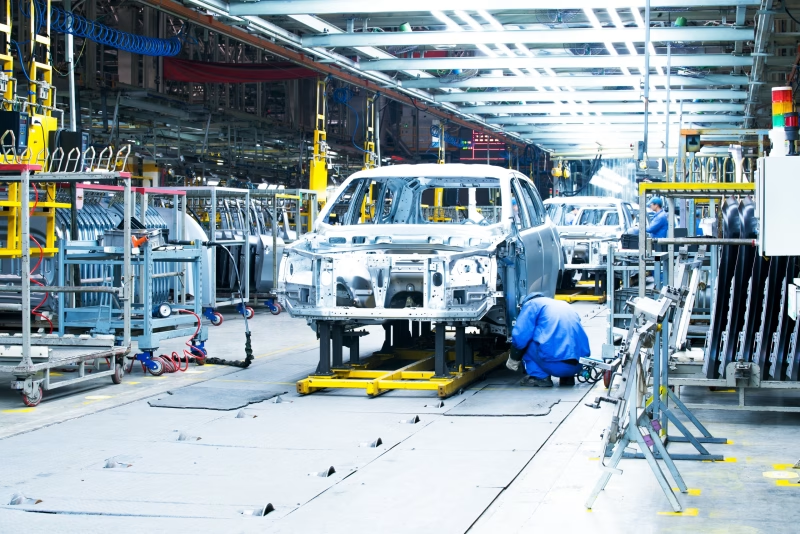
Automotive assembly plants are operational in South Africa, Morocco, Egypt, Nigeria, Kenya, and Ghana. Governments continue to advance industrialization agendas, investors are signaling confidence, policymakers speak confidently about value addition and economic transformation. Yet many African consumers remain cautious.
They still equate imported vehicles with higher quality and often view locally assembled vehicles as inferior. This perception continues to influence purchasing decisions across private buyers, fleet operators, and even government procurement.
The question remains, why does this distrust persist?
The Legacy of “Assembly” Without Manufacturing
For decades, many African automotive plants concentrated on semi-knocked-down (SKD) and completely knocked-down (CKD) assembly models. Manufacturers imported component kits, and local teams assembled them into finished vehicles. However, local content levels often remained modest, and consumers took note.
They did not always see evidence of deep manufacturing capability. Instead, some perceived basic assembly operations and questioned the overall value proposition. If critical components are sourced from abroad, they asked, what truly defined the vehicle as local?
This perception carries weight. Today’s consumers understand global supply chains. They expect transparency and tangible proof of industrial depth. Without visible progress in localization and value addition, assembly can appear superficial rather than transformative.
Inconsistent Quality Experiences
Quality consistency builds trust. Inconsistency destroys it. In several African markets, early assembly initiatives faced challenges with parts availability, after-sales support, and technical capacity. Even minor defects attracted disproportionate attention, and negative experiences circulated quickly within tight-knit consumer networks.
A single disappointing ownership experience can shape perceptions of an entire segment. At the same time, imported used vehicles often arrive backed by established global brand reputations. Consumers make direct comparisons. Even with high mileage, a familiar badge continues to command confidence.
As a result, local assemblers must compete not only on pricing and specifications, but on perception and credibility. Winning that battle requires far more than competitive numbers, it demands consistent performance and proven reliability.
The Used Vehicle Culture
Africa imports millions of used vehicles every year, with major ports in Mombasa, Lagos, and Durban handling steady flows of second-hand cars. Consumers often trust these cars because they have proven themselves over time. Spare parts are widely available, mechanics know how to service them, and informal networks provide additional support.
By contrast, local assembly programs, particularly from newer manufacturers, lack this well-established advantage. Trust is built on familiarity, and imported used vehicles benefit from decades of proven reliability that locally assembled models are still striving to match.
Pricing Paradox
Consumers often expect locally assembled vehicles to be noticeably cheaper than imported models. When prices appear similar, doubts naturally arise. Buyers start asking hard questions. If local labor costs less, why isn’t the vehicle significantly cheaper? If government incentives exist, why aren’t savings reflected at the showroom?
The reality is more complicated. Many assembly plants still depend heavily on imported components. Currency fluctuations drive costs up. Low production volumes limit economies of scale, keeping prices relatively high.
Yet consumers rarely consider these complexities. They see only the price tag. When a locally assembled vehicle is priced similarly to an import without visible advantages in quality, weakens trust.
Limited Brand Communication
Many local assembly initiatives emphasize production targets. They highlight jobs created and investments secured. They communicate primarily with policymakers. But they speak far less to the consumers, the very people who buy the vehicles.
Today’s buyers expect transparency. They seek factory tours, quality certifications, crash-test results, and performance data. They want tangible proof of reliability and safety. Global automotive brands understand this. They invest heavily in storytelling, showing robotic production lines, state-of-the-art testing facilities, and adherence to global standards.
African assembly plants must adopt the same approach. Without clear communication and visible evidence of quality, doubt fills the silence.
After-Sales Service Gaps
Trust is built after the purchase, not before it. Consumers closely examine how warranties are honored. They assess the availability of spare parts. They consider the impact on resale value.
When dealerships lack properly trained technicians or modern diagnostic tools, confidence declines rapidly. In today’s digital environment, social media amplifies dissatisfaction, and negative experiences travel fast. One unresolved warranty dispute can shape the perception of thousands of potential buyers.
Ultimately, a reliable and responsive after-sales network carries far greater weight than any marketing promise.
Historical Policy Instability
Policy consistency strengthens both investor and consumer confidence. Frequent reversals weaken it.
In several African markets, automotive policies have been introduced with ambition, only to be revised, delayed, or suspended. Tariff structures shift. Import regulations change. Incentive frameworks evolve.
Consumers notice this instability. They question the reliability of long-term parts supply. They wonder whether assembly plants will sustain operations over time. When the policy environment appears uncertain, purchasing decisions slows down. Confidence declines. Hesitation takes its place.
Perception Versus Reality
It is essential to distinguish perception from reality. South Africa for instance, has developed a mature and globally competitive automotive industry. It exports vehicles to international markets and adheres to stringent global standards. Likewise, Moroccan manufacturing plants supply European markets that demand rigorous compliance and quality benchmarks.
These milestones clearly demonstrate Africa’s manufacturing capability. However, perception has not kept pace with this progress. Many consumers across the continent do not differentiate between well-established production hubs and newer assembly initiatives. Instead, they tend to view them as one and the same.
Industry stakeholders must close this gap by communicating achievements more effectively and reinforcing the credibility of Africa’s evolving automotive market.
National Pride Alone Is Not Enough
Governments frequently champion “buy local” campaigns, and national pride certainly resonates with parts of the market. It can influence sentiment and spark conversation. However, sentiment alone does not secure a sale. Today’s consumers focus on fundamentals. They evaluate reliability, fuel efficiency, safety performance, and resale value. They calculate total cost of ownership and compare financing structures before committing.
For local assembly programs to succeed, they must compete on these measurable advantages. Patriotic messaging can support the narrative, but sustainable demand will ultimately depend on proven quality, value, and performance.
What Will Rebuild Trust?
The way forward is both practical and achievable. First, increase local content progressively and make that progress visible. Publish measurable data. Demonstrate milestones clearly. Transparency strengthens credibility and builds confidence.
Second, enforce quality standards without compromise. Align operations with recognized global certifications and make testing results accessible. Evident compliance reassures even the most cautious buyers.
Third, invest strategically in technical skills development. Partner with universities, technical institutes, and industry bodies to cultivate a strong pipeline of highly trained automotive professionals.
Fourth, reinforce after-sales support systems. Ensure consistent parts availability. Honor warranties promptly and professionally to protect brand integrity. Strong post-purchase support converts buyers into long-term advocates.
Fifth, communicate with purpose and consistency. Invite media and publications like Africa Automotive Magazine, dealers, and fleet managers into production facilities. Showcase manufacturing processes. Clarify supply chains. Let transparency replace speculation.
Finally, maintain policy stability. Investors depend on it. Consumers draw confidence from it. Long-term clarity attracts investment and reassures consumers that local manufacturing is not a short-term experiment, but a sustained national commitment.
The Role of Consumers
Consumers play a critical role in shaping the automotive landscape. When they support credible local initiatives, they stimulate demand. Increased demand drives higher production volumes. Greater volumes lower unit costs. Lower costs enhance competitiveness. It is a reinforcing cycle.
However, the responsibility to initiate that cycle rests with industry leaders and policymakers. They must first build confidence, demonstrate consistent quality, and earn consumer trust.
The Bigger Picture
Africa cannot industrialize without consumer confidence in manufacturing. Automotive production is a catalyst. It drives growth across steel, plastics, electronics, logistics, and finance among other sectors. When consumers doubt locally assembled vehicles, the ripple effect weakens the entire industrial sector.
Trust is not built on emotion, it is earned through consistent and measurable performance. African assembly plants must treat trust as a strategic asset. They must track it, manage it, and protect it diligently. The opportunity is vast. Africa’s population is young, urbanizing, and increasingly mobile. Demand for vehicles will rise steadily. Infrastructure investments continue to expand.
If local manufacturers consistently deliver quality, skepticism will fade. Markets respond to proven performance. African consumers are not inherently resistant to local products, they resist uncertainty. Deliver certainty, reliability, value and trust will follow.
Read More:
Africa: The New Hub for Automotive Manufacturing

