

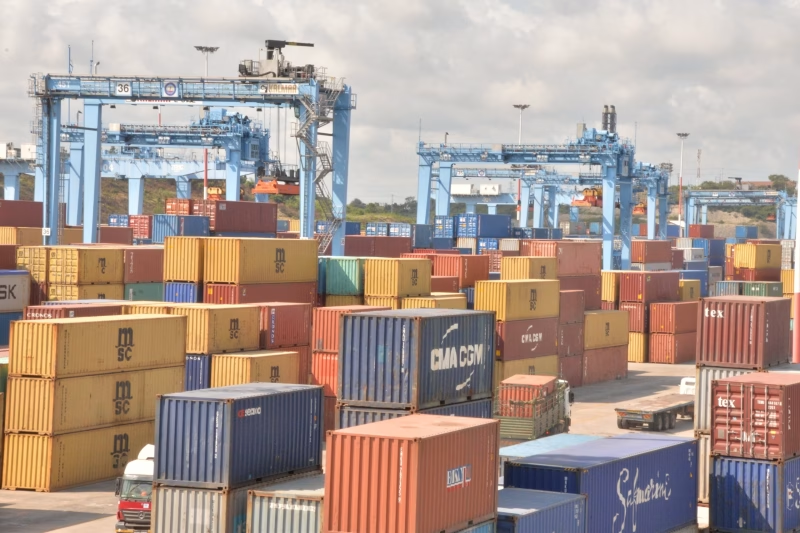
The Kenya Revenue Authority (KRA) has defended new documentation requirements for importers, saying it is enforcing legislation passed by Parliament rather than introducing a measure it can simply suspend following industry complaints.
The dispute has intensified as freight forwarders, clearing agents and motor vehicle dealers warn that the additional requirements could slow cargo clearance and increase import-related costs. Importers say the extra compliance obligations are placing further pressure on an already expensive process for bringing goods into Kenya.
New Documentation Rules Take Effect
The latest requirement took effect on 1 September 2026 under the Finance Act 2026. Importers must now obtain and retain an export declaration, export entry, customs export certificate or an equivalent document issued in the country of export.
The documentation must provide key information about the transaction, including the exporter and importer, description and value of the goods, tariff classification and country of export.
KRA says Section 23B of the Tax Procedures Act provides the legal basis for the requirement. According to the authority, the measure will strengthen its ability to verify imported goods and confirm the accuracy of declared values. The requirement also forms part of a wider push to improve advance customs information.
KRA launched its Advance Cargo Declaration system for containerised cargo in August, requiring information such as commercial invoices, freight invoices, bills of lading and export declarations before shipments arrive in Kenya.
Industry Warns of Higher Clearance Costs
Industry concerns extend beyond the additional paperwork. Freight forwarders and other port users have repeatedly warned that delays in cargo processing can generate demurrage, detention and other charges, ultimately increasing the cost of moving goods through the supply chain.
The Kenya International Freight and Warehousing Association (KIFWA) previously led protests over demurrage charges on empty containers. The association argued that congestion and limited depot capacity could create delays outside the control of clearing agents and freight forwarders.
Pressure has also increased as cargo volumes through the Port of Mombasa continue to grow. The port handled 45.45 million tonnes of cargo in 2025, compared with 40.99 million tonnes in 2024. Higher volumes have placed additional demands on cargo-handling and clearance infrastructure.
KRA has also faced pressure over the operation and maintenance of its Integrated Customs Management System. The authority previously deferred planned maintenance after traders and clearing agents warned that system downtime could compound disruption at the port.
Vehicle Valuation Remains Contentious
The latest disagreement also brings Kenya’s long-running motor vehicle valuation debate back into focus. KRA uses its Current Retail Selling Price (CRSP) system to establish customs values for used vehicles after applying depreciation. The authority has maintained that the system provides greater predictability and has historically involved industry stakeholders in its development.
Importers, however, have challenged valuations they regard as excessive or insufficiently supported. Kenya’s courts have previously questioned KRA’s valuation methodology where the authority could not adequately explain how it reached a particular figure. In one case involving a Mercedes-Benz, the Tax Appeals Tribunal found that KRA had not sufficiently demonstrated how it arrived at the vehicle’s valuation.
The valuation framework has subsequently faced prolonged litigation, prompting KRA to undertake further consultations with industry stakeholders. The authority’s 2025 CRSP review included participation from organisations such as the Car Importers Association of Kenya, Kenya Auto Bazaar Association and KIFWA. KRA has said it will not comment on the substance of the latest motor vehicle valuation dispute because the matter remains before the courts.
Enforcement Versus Consultation
The current disagreement highlights the tension between customs enforcement and industry consultation. KRA has argued that stronger documentation and valuation controls are necessary to tackle under-declaration and undervaluation, practices it says disadvantage compliant businesses and local manufacturers.
A separate dispute over customs valuation benchmarks recently demonstrated the sensitivity of the issue. The government retained the customs benchmark for general consolidated cargo at Sh2.5 million and indicated that it would reduce the figure further to Sh2 million. The decision followed protests by small importers after the benchmark increased to Sh3.2 million, prompting intervention by President William Ruto.
KRA had defended the higher benchmark as a tool for addressing under-declaration and undervaluation. However, the authority also clarified that the benchmark serves as a reference point for valuation rather than a fixed price applied to every consignment.
For vehicle importers, dealers, logistics operators and clearing agents, the challenge now lies in meeting the strengthened documentation requirements while avoiding further delays and costs across Kenya’s already busy import and distribution system.
Also Read:
Kenya Opposes One-Year Delay to EAC Vehicle Assembly Rules
KRA Clarifies: The New Used Car Prices in Kenya
Taxes on used cars to fall after KRA duty ruled illegal
KRA now demands Sh677 million tax from Car & General
Common headlight driver module with low EMI

