

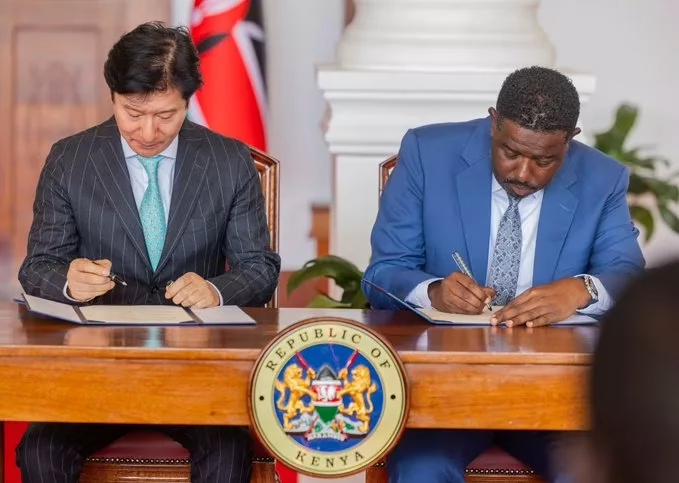
President William Ruto has witnessed the signing of a memorandum of understanding (MoU) between the Kenyan government and Endelevu Enterprise Corporation for a proposed $3 billion (approximately KSh390 billion) investment in electric vehicle manufacturing and green mobility.
Under the agreement, signed in Nairobi, the parties plan to establish an integrated green mobility ecosystem covering vehicle assembly, charging infrastructure and supporting value chains.
According to Ruto, the proposed investment would help Kenya reduce its reliance on imported vehicles and fuel, strengthen domestic manufacturing and create employment opportunities for Kenyans.
“For decades, Kenya has imported the fuel that runs our vehicles, and the vehicles that burn that fuel. We have paid for both in hard currency. And with every shipment, we have exported jobs that should have been created here. We are determined to change that equation,” Ruto said.
Through this initiative, the government aims to retain more economic value locally by expanding manufacturing capacity and creating opportunities for Kenyan businesses
Proposed EV Plants to Target 150,000 Vehicles Annually
The project plans to establish an electric vehicle assembly plant with an annual production capacity of 50,000 four-wheel vehicles. A separate facility would manufacture up to 100,000 two-wheelers and light-mobility vehicles annually.
The investment also includes plans for 1,000 solar-powered charging hubs and a digital platform designed to support up to 100,000 green vehicles.
These proposed facilities could strengthen Kenya’s electric mobility infrastructure while creating opportunities for local manufacturers, component suppliers, technology providers and service businesses.
Investment Expected to Create Thousands of Jobs
Ruto said the project could generate approximately 2,000 direct jobs and more than 20,000 indirect opportunities across supply chains, logistics and related services.
He added that fleet management, vehicle operations and other services could create up to 80,000 additional opportunities.
The government expects the partnership to support small and medium-sized enterprises (SMEs) through supply contracts while encouraging technology and skills transfer.
“So, what does Kenya expect from this partnership? Kenya expect investment and industrial capacity. We expect jobs for our young people and contracts for our SMEs. We expect technology and skills to be transferred, not just traded,” Ruto said.
For Kenya’s automotive industry, the proposed investment could create opportunities beyond vehicle assembly, including charging equipment, maintenance, spare parts, fleet services and technical training. However, the scale of these benefits will depend on project implementation and the extent to which local businesses participate in the supply chain.
Kenya Eyes the Wider African EV Market
The government intends to position Kenya as a manufacturing base serving both domestic buyers and regional markets.
“To our partners from Endelevu and Geely, our ambition goes beyond Kenya. We do not want to assemble for one market. We want to manufacture for East Africa and for Africa,” Ruto said.
He noted that vehicles manufactured in Kenya and meeting the East African Community’s Rules of Origin requirements could qualify for access to the regional market.
This ambition could create opportunities for manufacturers and suppliers seeking to serve a broader African customer base. However, manufacturers would need to meet applicable regional trade requirements and establish commercially viable production and distribution networks.
Government Pledges Support for Project Implementation
Ruto directed the Ministry of Investments, Trade and Industry, working through Invest Kenya, to coordinate government support for the proposed project. Specifically, this includes facilitating approvals and addressing requirements relating to land and infrastructure.
Emphasising the need for effective implementation, the President said: “A signature does not build a factory.” Accordingly, he instructed the ministry to provide end-to-end facilitation to help move the project from an agreement towards implementation.
Meanwhile, the MoU comes as Kenya advances its National Electric Mobility Policy, which seeks to promote local vehicle assembly, expand charging infrastructure, develop technical skills and encourage wider electric vehicle adoption.
If the parties translate the proposed investment into operational facilities, the project could support Kenya’s manufacturing ambitions and expand opportunities across the electric mobility value chain. Its eventual impact will depend on investment delivery, infrastructure development, local supplier participation and sustained demand for electric vehicles.
Also Read:
Why Electric Mobility Should Top President Ruto’s Economic Agenda
President William Ruto opens Japanese Car Auction Firm in Naivasha
What More Can Kenya Do to Attract Global Automotive Investment?
Morocco Launches First Car Battery Industrial Zone

