

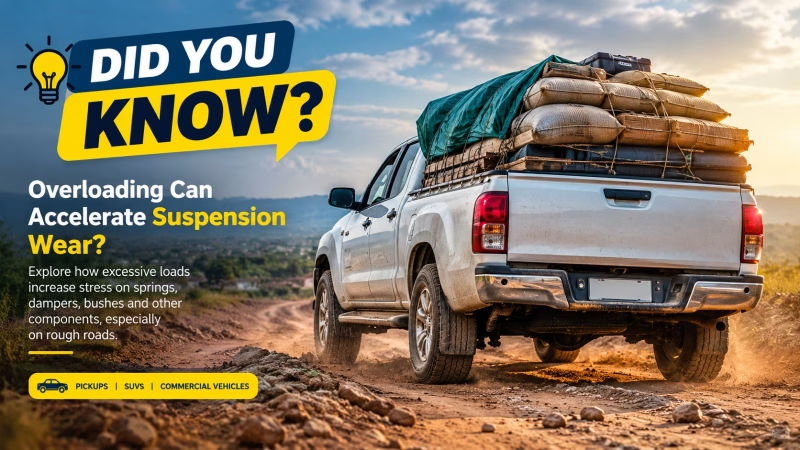
Your pickup carries construction materials, your SUV transports your family and their luggage, and your commercial vehicle delivers goods to customers. But have you considered the additional demands these loads place on your suspension?
Overloading can accelerate suspension wear by placing additional stress on springs, shock absorbers, bushes, mounts and other components. These effects can become more pronounced when excessive weight combines with potholes, corrugated roads, uneven surfaces and frequent journeys.
Across Africa, vehicles support construction, agriculture, distribution, passenger transport and long-distance logistics. Carrying heavy loads is therefore part of daily operations for many drivers and businesses. However, exceeding your vehicle’s specified load capacity can increase maintenance costs, affect handling and accelerate component wear.
How Does Overloading Affect Your Suspension?
Your suspension does more than absorb bumps. It helps control vehicle movement, maintain tyre contact with the road and support stability during braking, acceleration and cornering.
Engineers design suspension systems around specific vehicle weights, load distributions and operating conditions. Exceeding these limits places additional demands on components, particularly when the vehicle encounters rough surfaces.
The consequences depend on the amount and distribution of the excess weight, road conditions, driving style, vehicle design and the condition of existing components. Repeated overloading can accelerate wear and increase the risk of damage.
-
Springs Carry More Than Their Intended Share
Coil springs and leaf springs support vehicle weight and help maintain the correct ride height. When you overload a pickup, SUV or commercial vehicle, the springs must support additional mass.
Excessive loading can compress the suspension further, reducing the available suspension travel and increasing the likelihood of the suspension reaching its bump stops when the vehicle encounters uneven surfaces. Repeated heavy impacts can contribute to spring fatigue, sagging or damage, particularly when the vehicle already has worn or weakened components.
For pickups carrying building materials or agricultural produce, the problem can develop gradually. A vehicle that sits noticeably lower at the rear may indicate excessive loading, worn springs or another suspension fault.
The practical lesson: Check your vehicle’s payload rating and inspect its springs regularly. Never assume that a vehicle can safely carry additional weight simply because the load fits inside.
-
Shock Absorbers Work Under Greater Demands
Springs support the vehicle, but shock absorbers control the springs’ movement. Without effective damping, the vehicle can continue bouncing after hitting a bump, affecting ride comfort and stability.
Overloading can reduce available suspension travel and increase the forces generated when the vehicle encounters potholes, speed humps or rough tracks. Shock absorbers may then have to manage more demanding movements, especially during repeated impacts.
Excessive heat and sustained hard use can also challenge damper performance. Worn or damaged shock absorbers may struggle to control body movement effectively, increasing the risk of reduced stability and inconsistent tyre contact with the road.
For SUVs travelling on rough rural routes and commercial vehicles operating across mixed road surfaces, the combination of excess weight and repeated impacts deserves particular attention.
Inspect for oil leaks, damaged mounting points and changes in ride behaviour. However, remember that not every worn shock absorber leaks visibly; a proper inspection should assess its performance and the condition of related components.
-
Bushes, Mounts and Joints Also Suffer
Suspension systems rely on bushes, ball joints, links and mounting points to manage movement while keeping components correctly positioned.
Additional weight can increase the forces acting on these parts, particularly when a loaded vehicle crosses deep potholes or travels over corrugated roads. Worn bushes may develop excessive movement, while damaged joints or mounts can affect steering precision, produce unusual noises and compromise suspension control.
These symptoms do not automatically prove that overloading caused the damage. Poor road conditions, age, corrosion, inadequate maintenance and normal wear can also contribute.
For fleet operators, the important step is to investigate recurring suspension problems rather than repeatedly replacing individual parts without identifying the underlying cause.
Why This Matters on African Roads
Vehicle loading is a wider transport challenge in African markets, particularly where commercial vehicles carry goods over long distances and variable road conditions.
A 2022 study presented at the Southern African Transport Conference estimated that axle overloading cost Kenya approximately US$43 million annually in pavement damage. This figure concerns road infrastructure rather than suspension repair costs, but it illustrates the broader financial consequences associated with excessive vehicle loading. Read the study.
The same operating realities matter for vehicle maintenance. Excessive loads combined with repeated impacts can place greater demands on suspension components, while repairs and vehicle downtime can disrupt delivery schedules and increase fleet operating costs.
For businesses working on tight margins, avoiding preventable damage is more practical than treating suspension failures as an unavoidable cost of doing business.
How Can You Reduce Suspension Wear?
Whether you drive a pickup, an SUV or a commercial vehicle, a few consistent practices can help protect your suspension.
-
Respect payload limits.
Check the manufacturer’s specifications, including gross vehicle weight and axle-load limits. Distribute cargo according to the vehicle’s loading instructions.
-
Adjust driving to road conditions.
Slow down before potholes, avoid sudden manoeuvres and reduce speed on corrugated or uneven surfaces.
-
Inspect suspension components.
Look for sagging springs, leaking dampers, damaged bushes, loose mounts and uneven tyre wear. Arrange a professional inspection when symptoms appear.
-
Maintain the correct tyre pressures.
Follow the manufacturer’s recommendations for the vehicle’s load and operating conditions. Correct pressures support handling but do not compensate for overloading.
-
Use suitable replacement parts.
Select springs, shock absorbers and other components that match the vehicle specification and intended application. Heavier-duty parts are not automatically suitable for every vehicle.
-
Train drivers and monitor fleet loads.
Establish loading procedures, investigate repeated failures and keep maintenance records to identify patterns before they lead to costly downtime.
Protect Your Suspension Before Problems Develop
Overloading does not always cause immediate suspension failure. However, repeated excess weight, combined with harsh road conditions, can accelerate wear and increase the likelihood of costly repairs.
Whether you drive a pickup, an SUV or a commercial vehicle, prevention starts with understanding your vehicle’s load limits, distributing cargo correctly and maintaining its suspension.
Your suspension is engineered to operate within specified load limits—not to carry unlimited weight. Respecting those limits helps preserve component life, support vehicle control and reduce avoidable maintenance costs, particularly on demanding African roads.
More Insight:
Did You Know Body Roll Is a Suspension Control Issue, Not Just Speed?
KYB Aftermarket Parts: Why Mechanics Prefer Premium Suspension
Did You Know Poor Suspension Reduces Tyre Lifespan?
Automotive Suspensions – Understanding the basics of Automotive Suspension
Backed by KYB Engineering: Why Suspension Quality Determines Vehicle Safety on Africa’s Tough Roads

