

Africa’s transport industry has changed. Today’s fleets operate across longer distances, harsher environments, and increasingly demanding supply chains. Fuel prices continue to rise, delivery timelines are tighter, and competition leaves little room for costly downtime. Under these conditions, old maintenance built on assumptions and routine schedules is no longer enough.
Every unexpected breakdown now carries a ripple effect, delayed deliveries, lost revenue, damaged customer trust, and expensive repair bills. What was once considered a normal operational setback has become a serious financial liability. That is why a quiet revolution is beginning to reshape fleet operations across Africa.
The Rise of Intelligent Fleet Maintenance
Instead of relying on guesswork, operators are turning to telematics, predictive analytics, and advanced oil analysis to understand what is happening inside their engines before failure occurs. Maintenance is no longer based only on mileage; it is increasingly guided by real-time performance data and engine health insights. The result is a shift from reactive maintenance to predictive decision-making, where fleets can prevent problems instead of simply responding to them. And for an industry where every kilometre matters, this shift could redefine the future of transport across Africa, and that is why a quiet revolution is taking hold.
From routine servicing to intelligent lubrication
Across transport corridors, from the long-haul trucking routes of Nairobi to the freight networks of Lagos and the industrial highways of Johannesburg, a quiet transformation is unfolding inside fleet operations. Fleet managers are beginning to re-examine one of the most underestimated yet essential pillars of vehicle performance: lubrication.
For years, trucks were serviced after a fixed number of kilometers, whether the engine truly needed attention or not. But today’s operating environment is far less predictable. Harsh road conditions, heavy payloads, rising fuel costs, extreme temperatures, and longer delivery schedules are placing unprecedented pressure on engines. In this new reality, traditional maintenance schedules are no longer enough.
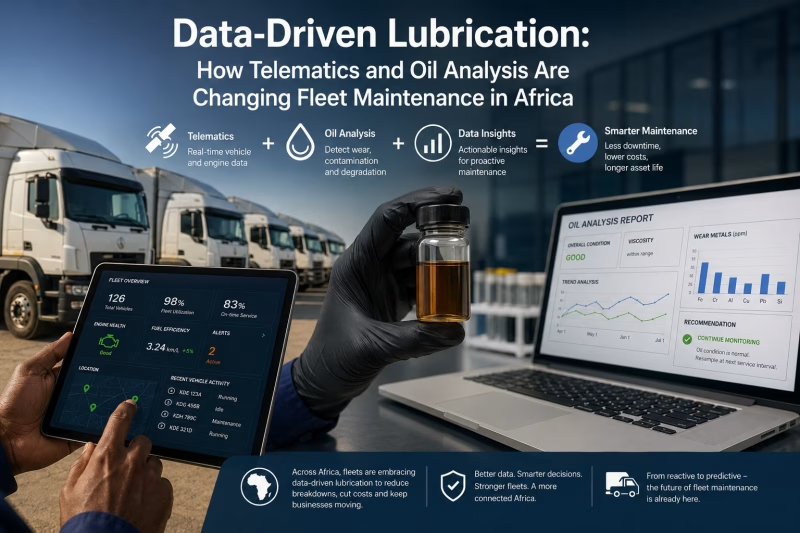
Instead of relying only on fixed oil-change intervals, companies are now combining telematics systems with advanced oil analysis to understand what is actually happening inside engines in real time. The connected telematics systems are now acting like digital nervous systems. Sensors installed in trucks continuously monitor engine temperature, load levels, fuel efficiency, mileage, idle time, driving behavior, and overall performance patterns. Every journey generates valuable operational intelligence.
At the same time, lubricant laboratories are telling another side of the story. Oil samples collected from engines are carefully analyzed for contaminants, microscopic metal particles, fuel dilution, soot accumulation, and chemical degradation—silent warning signs that often appear long before mechanical failure becomes visible. When these two streams of intelligence come together, fleet operators gain something they never truly had before; visibility into the real condition of the engine in real time.
The shift from guesswork to precision
In many fleets maintenance routine, every 10,000 kilometers, the oil comes out and fresh lubricant goes in. It is a system built on habit, not necessarily on how a truck actually performs on the road. Yet across Africa’s demanding transport corridors, no two journeys place the same strain on an engine.
For instance, a truck hauling heavy cargo through the steep escarpments of East Africa, crawling through traffic in Lagos, or battling heat and dust on remote mining routes experiences far greater stress than one travelling steadily along a well-maintained highway. Still, under old maintenance models, both vehicles are often treated exactly the same. That is where data-driven lubrication is changing the story.
By analysing real-time engine data alongside oil condition reports, fleet managers can now detect early warning signs such as overheating patterns, abnormal friction levels, or contamination from fuel or dust. According to industry research, predictive systems using telematics can detect failures before they occur, improving reliability and reducing downtime significantly. The result is simple but powerful: oil is changed when it is actually needed, not just when the calendar says so.
Why Africa’s fleets are paying attention
Across Africa, transport rarely follows easy terrain. Trucks travel for days across scorching highways, dusty mining corridors, congested border points, and rough rural roads that test both machines and drivers. From the ports of Mombasa and Durban to inland trade routes stretching deep into the continent, long-distance haulage remains the backbone of commerce. But these demanding conditions place enormous pressure on engines, lubricants, and every moving part inside a fleet vehicle.
Africa’s transport system is unique. Roads vary widely in quality, climate conditions are extreme in many regions, and long-distance haulage is essential for trade. These realities place heavy stress on engines and lubricants. At the same time, operational costs are rising. Fuel remains one of the largest expenses, while unexpected breakdowns can disrupt entire supply chains. In this environment, every hour of uptime matters.
However, fleet operators are increasingly adopting smart systems that combine IoT sensors and analytics to improve efficiency. Platforms inspired by global trends in fleet intelligence, such as those tracking thousands of data points per vehicle daily, are proving that visibility leads to savings and better planning. Even in African markets, emerging solutions are showing measurable results. Studies and deployments in fleet intelligence platforms indicate reductions in breakdowns, fuel waste, and maintenance costs when predictive systems are used effectively.
The science behind oil intelligence
Oil may look simple, but inside an engine it behaves like a living system. It carries heat, reduces friction, cleans internal parts, and protects metal surfaces. Over time, it degrades.
Oil analysis reveals what the eye cannot see. It can detect:
- Metal particles that signal engine wear
- Fuel contamination from incomplete combustion
- Water ingress from seals or environmental exposure
- Chemical breakdown indicating overheating or extended use
When this information is combined with telematics data, such as engine load patterns or driving conditions, maintenance teams can predict when an engine is moving toward failure. This approach turns lubrication from a routine task into a diagnostic tool.
A real shift in fleet decision-making
In the past, maintenance decisions were often reactive. A truck breaks down, and repairs follows. Today, data is pushing decisions earlier in the cycle. A fleet manager no longer asks, “When was the last oil change?” Instead, the question becomes, “What does the engine data say about its condition right now?”
This shift is already visible in advanced fleet systems that use sensor data and predictive models to optimise maintenance scheduling and reduce operational disruptions. It also changes how drivers, mechanics, and managers interact with vehicles. Drivers become data contributors, mechanics become analysts, and managers become strategists.
Challenges on the road to adoption
Despite its enormous potential, the transition toward data-driven lubrication is not without obstacles. Across many parts of Africa and other developing markets, inconsistent connectivity in remote transport corridors can disrupt the seamless flow of real-time data. Some fleet operators still depend on aging trucks and machinery that were never designed with integrated sensors or digital monitoring systems in mind.
There is also a growing need for technical expertise. Collecting lubricant and telematics data is only part of the equation. The real value lies in interpretation. Maintenance teams must learn how to read oil analysis reports, identify abnormal wear patterns, and translate data into practical maintenance decisions. Without the right skills, even the most advanced monitoring systems risk becoming underutilized.
At the same time, IoT technology is becoming more accessible and affordable, while digital infrastructure across transport and logistics networks continues to improve. What once seemed like a futuristic concept is steadily becoming part of everyday fleet operations. The industry is moving from reactive maintenance to predictive intelligence, and that shift is not a distant possibility, but an emerging reality shaping the future of commercial transport.
The bigger picture: efficiency and sustainability
Beyond the immediate financial savings, the transformation reaches much deeper into the future of fleet operations. Fleet operators no longer treat lubrication as a routine workshop task. They now recognize it as a strategic tool that drives performance, improves reliability, and supports sustainability goals. By optimizing lubrication through data and predictive analysis, operators reduce internal engine friction, slow component wear, and improve fuel efficiency. This smarter approach helps fleets maximize engine performance while lowering maintenance costs and operational downtime.
The result is not only longer engine life, but also fewer roadside breakdowns, reduced downtime, and lower operating costs across the entire fleet. The environmental impact is equally significant. Longer oil life means less waste oil disposal, while healthier engines produce fewer emissions and consume less fuel.
Additionally, what makes this shift remarkable is how dramatically it is changing decision-making itself. Fleets that once relied heavily on experience, instinct, and fixed service intervals are evolving into connected, data-driven ecosystems. Maintenance managers are no longer reacting to failures after they happen; they are using real-time insights to predict problems before they disrupt operations. In many ways, the modern fleet is beginning to think ahead of the road it travels.
Fleet Reliability in Written Data
Data-driven lubrication represents a fundamental shift in how fleets think, operate, and compete. It replaces guesswork with measurable insight, routine servicing with precision-driven maintenance, and costly reactions with intelligent prediction.
For Africa’s transport and logistics industry, where uptime can determine profitability and survival, this evolution is rapidly moving from innovation to necessity. Rising fuel costs, demanding operating conditions, and the pressure to maximize vehicle availability are forcing fleet operators to rethink traditional maintenance models.
Moreover, fleets that embrace this transition early are gaining more and lower operating costs. They are building stronger reliability, longer asset life, greater operational confidence, and a sharper competitive edge. In the years ahead, the definition of a high-performing fleet on African roads may no longer depend solely on the number of trucks it owns, but on how intelligently it keeps them moving. The road ahead belongs to fleets that understand one simple truth: better data leads to better decisions, and better decisions drive better business.
You can explore further, this comprehensive guide on Machinery Lubrication explains how oil analysis supports predictive maintenance in detail.
More Insights:
Oil Analysis: How can it benefit your Bus fleet operations?
Key Indicators It’s Time for an Oil Analysis for your Heavy Trucks
Telematics Redefining Automotive Industry
Oil Maintenance and Monitoring of Commercial Bus Fleet
How Data and Telematics Are Powering Smarter Fleet Management Across Africa
Why Proper Greasing Is Important for Vehicle Components
Heritage Insurance Kenya launches first telematics motor insurance in Kenya

