
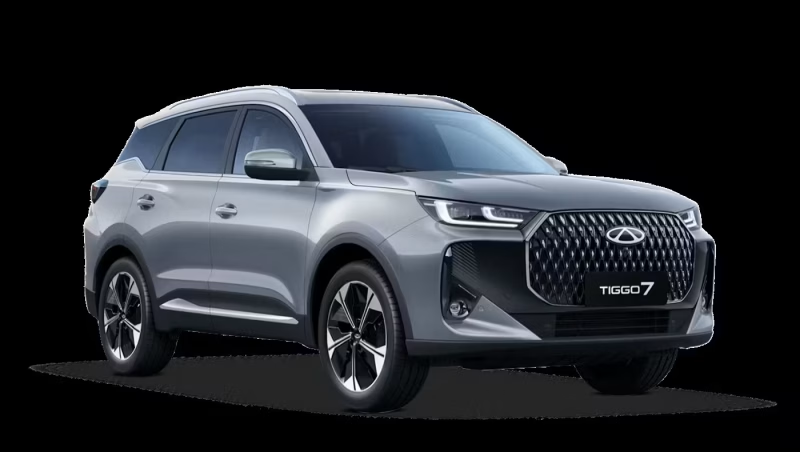
Chery has officially confirmed plans to establish a local vehicle manufacturing facility in South Africa, marking a significant milestone in the company’s expansion strategy across the continent.
The announcement came during the 6th annual South Africa Investment Conference (SAIC 2026) held in Sandton, where the Chinese automaker attributed its decision to the strong support it has received from South African customers and dealers over the past four years.
“This investment is a vote of confidence in South Africa and a direct result of the unwavering support from our customers and dealer network over the past four years,” said Mr. Charlie Zhang, Vice President of Chery Auto and Executive Vice President of Chery International.
The move represents a major shift for Chery as it transitions from a vehicle importer to a long-term manufacturing investor in South Africa’s automotive sector.
Rosslyn Facility to Undergo Major Upgrades
Chery confirmed that it has secured a production site in Rosslyn, Pretoria, which will undergo extensive refurbishment before operations begin.
“The site which has been secured in Rosslyn, Pretoria will be re-commissioned and retrofitted over the next 12 to 18 months,” said Chery.
While the company did not identify the facility in its official statement, previous reports indicate that Chery will take over Nissan’s vehicle assembly plant in Rosslyn. The facility currently produces the Nissan Navara and forms part of Nissan’s broader restructuring efforts as the Japanese automaker scales back operations globally.
The acquisition provides a positive outcome for the local industry by preserving manufacturing capacity and safeguarding employment opportunities. Both companies have indicated that most existing employees will retain positions similar to their current roles.
Supporting Employment and Economic Growth
Chery expects the project to generate significant economic benefits for South Africa through job creation, skills development, and supplier growth.
“This transition to local production is set to deliver significant positive impact for South Africa,” said Chery.
“This includes the creation of more employment, as well as retaining most of the current employees at the existing plant, previously operated by another manufacturer, to ensure continuity and a smooth project transition.”
The automaker expects the first locally assembled vehicles to leave the production line by mid-2027.
According to the company, the investment will create additional employment opportunities while providing training and upskilling programmes for existing workers to support a seamless transition into the new manufacturing operation.
“Chery’s investment in South Africa is not only an important step in the company’s globalization development, but also our long-term commitment to the economic and industrial development of South Africa,” said Zhang.
“The project will directly and indirectly create nearly 3,000 jobs, covering multiple sectors including manufacturing, supply chain, and services.”
Building a Stronger Local Supply Chain
Beyond vehicle assembly, Chery plans to strengthen South Africa’s automotive supply ecosystem by developing a network of local component suppliers.
Zhang explained that the company intends to work closely with domestic suppliers to improve local sourcing capabilities and support industry competitiveness.
“We believe this will make the overall automotive industry more competitive.”
Local manufacturing will also help Chery improve vehicle availability, reduce lead times, and strengthen its competitive position within the South African market.
In addition, the Rosslyn facility will serve as an export hub, supplying vehicles to other African markets and reinforcing South Africa’s role as a regional automotive manufacturing center.
“Moving from an importer to a manufacturer deepens our roots in this country,” said Zhang.
“It allows us to better serve the South African and broader African market, enhances consumer confidence through local presence, and aligns our future growth directly with the growth of the local automotive industry.”
Which Vehicles Could Be Produced Locally?
Chery has not yet revealed which models it intends to manufacture at the new facility. However, industry observers expect the highly successful Tiggo 4 Pro and the related Tiggo Cross to be strong candidates.
As Chery’s most affordable crossover, the Tiggo 4 Pro has gained significant popularity among South African buyers, consistently achieving strong monthly sales. Local production could further improve affordability while enhancing parts availability and aftersales support.
The Tiggo Cross, which serves as the updated version of the Tiggo 4, could also become part of the production lineup as Chery expands its local operations.
Could the Himla Join the Production Line?
Another model that could benefit from local manufacturing is the upcoming Himla pickup. Chery plans to enter the competitive bakkie segment later this year with the midsize double-cab model, powered by a 2.0-litre turbo-diesel engine.
The Himla will compete against established market leaders such as the Toyota Hilux, Ford Ranger, and Isuzu D-Max, all of which already benefit from local production.
If Chery eventually manufactures the Himla in South Africa, the company could strengthen the vehicle’s competitiveness through localized production, improved supply chains, and reduced delivery times.
As preparations begin at the Rosslyn facility, Chery’s investment signals growing confidence in South Africa’s manufacturing capabilities and highlights the country’s continued importance as a strategic automotive production hub for the African market.
Also Read:
Chery to Invest Sh2.62 Billion in Kenya for Electric Vehicle Production
Zonda Tec Ghana Expands the Chery Vehicle Line-Up in Ghana
Carloha Nigeria Opens New Chery Showroom in Lagos
Africa’s car industry needs more investment

