

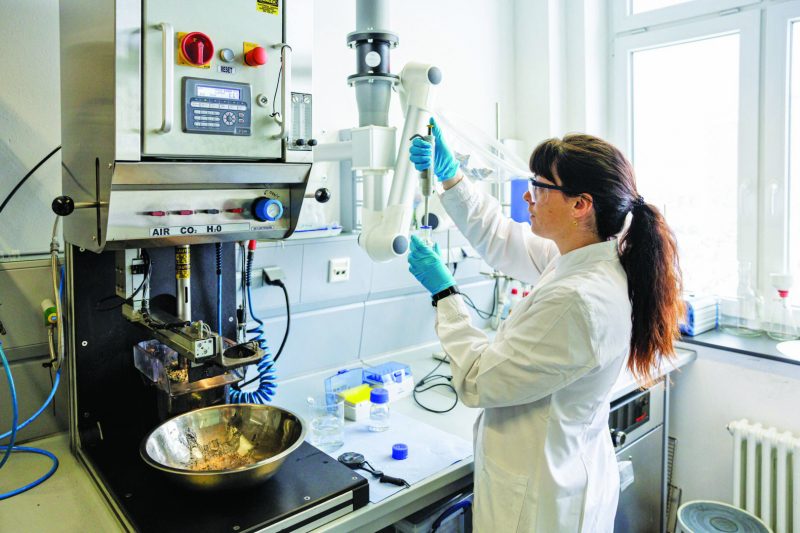
Researcher Anna Vanderbruggen peers into a vat of dark bubbling liquid. This is the result of a process she has developed to recover graphite from old lithium-ion batteries. Although graphite represents up to a quarter of the weight of the batteries, no one has yet come up with a viable plan to recycle it. This challenge is a part of the broader efforts in battery recycling, according to Vanderbruggen.
The 29-year-old researcher is still fine-tuning her battery recycling method but has already received an award from the European Institute of Innovation and Technology (EIT) for her efforts.
Her method, developed at the Helmholtz Research Institute in Freiberg, Germany, involves extracting graphite from “black mass”, a powder that also contains cobalt, nickel, lithium and manganese.
“The graphite attaches itself to the bubbles, whereas the metals are hydrophilic and therefore remain in the water.”
Vanderbruggen also works as a consultant for businesses exploring the opportunities that arise from recycling electric car batteries in the future.
But that looks set to change with 350 million electric cars expected to be on the road worldwide by 2030. This is a significant increase. The number is up from 16.5 million in 2021, according to the International Energy Agency (IEA).
Barboux said that in 10 years, manufacturers will produce so many batteries. They will have to incorporate battery recycling to handle lithium reuse, which is necessary to avoid shortages.
In theory, the technology now exists to recycle almost all the materials that make up lithium-ion batteries. This is according to the experts interviewed by AFP.
German group Aurubis, one of Europe’s largest suppliers of non-ferrous metals, claims to be able to recycle at least 95 percent of the metals. This recycling process applies to “black mass” at a pilot plant it has set up in Hamburg. French mining group Eramet, Belgium’s Umicore, and German carmaker Mercedes have also launched similar ventures. The majority of such projects are still in their pilot stages.
Also Read: Tesla inks deal to get key battery component outside China
‘Huge growing market’
“It’s a huge growing market and we want to play a role in it,” said Ken Nagayama, head of business development for battery materials at Aurubis, who is currently working on a graphite recycling process.
He believes there will be “sufficient market supply to develop a plant for battery recycling on an industrial scale during the second half of the decade.”
Since the batteries tend to last seven or eight years, there are not yet “enough batteries at the end of their life” to feed the recycling market, said Serge Pelissier, director of research at the Gustave Eiffel University in Lyon.
There are also many different models of car batteries. This situation makes it difficult to set up a standardised recycling system. It is unlike those available for mobile phones and laptops. The market for recycling car batteries will probably not reach its full potential until the “early 2030s”. This is according to Alex Keynes of the Transport and Environment NGO.
Also Read: China Looks to Africa in Race for Lithium
Swedish and Norwegian joint venture Northvolt-Hydro, a pioneer in the field, is aiming to recycle the equivalent of 500,000 batteries by 2030. This would represent around half of the batteries likely to be available for recycling by that time, according to estimates from consultancies.
The European Union wants new batteries to incorporate 16 percent recycled cobalt and six percent recycled lithium and nickel by 2031. The company aims to meet this by promoting high rates of battery recycling, targeting at least 70 percent of old battery weight by 2031.
“If they recover new components like graphite, they will be able to meet these requirements,” Vanderbruggen said.

