

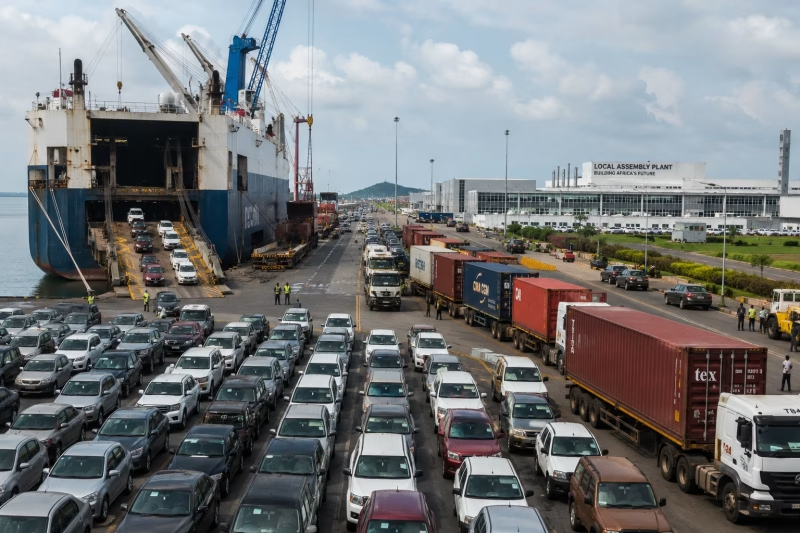
Across Africa, governments have unveiled bold visions to establish local manufacturing hubs, generate employment, and reduce reliance on imported vehicles. The intent is clear and commendable. However, beneath these ambitions lies a persistent structural weakness that continues to erode progress: policy inconsistency compounded by import loopholes.
The reality is stark. While policy frameworks often promise protection and growth for local industries, inconsistent implementation and regulatory fragmentation dilute their impact. At the same time, porous import controls allow an influx of used and underpriced vehicles, undermining domestic production and distorting market dynamics. The result is a disconnect between policy intent and real economic outcomes.
In my opinion, if Africa is truly committed to building a resilient and competitive automotive industry, it must confront this challenge with urgency and resolve. Without harmonized regulations, firm enforcement, and a unified strategic direction, even the most ambitious plans risk falling short. Sustainable growth will not be driven by policy declarations alone, but by the discipline to implement, enforce, and protect the frameworks designed to nurture the industry.
The Policy Promise vs. Operational Reality
Why ambition alone is not enough to build Africa’s automotive future
Across Africa, governments have rolled out automotive policies aimed at catalyzing local assembly and, ultimately, full-scale manufacturing. These frameworks typically offer tax incentives for locally assembled vehicles, impose restrictions on used imports, and provide investment support to attract global and regional manufacturers.
In principle, the strategy is sound. It reflects a clear ambition; to replicate the success of established automotive hubs by building domestic industrial capacity, creating jobs, and reducing import dependency. But the reality on the ground tells a more complicated story.
Execution has been uneven. Frequent policy reversals, ambiguous regulatory frameworks, and inconsistent enforcement have introduced a level of uncertainty that undermines confidence. Investors, who depend on stability and predictability, remain cautious. Manufacturers face difficulty committing to long-term capital investments without clear, sustained policy direction. Meanwhile, consumers are left navigating a difficult trade-off between affordability and quality, often with limited viable options.
The result? A growing disconnect between policy intent and real-world outcomes. What is designed as a pathway to industrial transformation risks becoming a cycle of stalled progress, where ambition is high, but impact remains constrained. Bridging this gap requires more than well-crafted policy documents. It demands consistency, transparency, and a long-term commitment to execution that builds trust across the entire automotive value chain.
Import Loopholes: The Silent Disruptor
Weak enforcement and policy gaps continue to erode the competitiveness of local vehicle assembly.
Even as governments champion local manufacturing, persistent import loopholes are quietly diluting these efforts. These loopholes manifest in several critical ways. Vehicles are often misclassified to attract lower duty rates, while under-declaration of value reduces the tax burden significantly. Transit and re-export arrangements originally designed to facilitate regional trade, are frequently exploited, allowing vehicles to leak into domestic markets. At the same time, exemptions and special permits, intended for specific use cases, are too often weakly monitored and easily abused.
The cumulative impact is profound. Markets become saturated with low-cost imports, many of them used and falling short of established safety and environmental standards. Price distortions emerge, creating a structural imbalance across the industry.
Meanwhile, for local assemblers, the consequences are severe. These firms operate within formal regulatory frameworks, investing heavily in infrastructure, compliance systems, workforce development, and quality assurance. However, they are forced to compete against cheaper imports entering through informal or semi-regulated channels, where the true cost of compliance is largely bypassed. In effect, this creates an uneven competitive landscape that weakens the growth and sustainability of local manufacturing.
If left unaddressed, these loopholes risk undermining not only industrial policy objectives but also long-term economic resilience. Closing them is not simply a matter of regulation, it is a strategic imperative for building a fair, competitive, and sustainable automotive sector.
The Used Car Dilemma: Balancing Access with Industrial Ambition
Affordable mobility must coexist with policies that stimulate local manufacturing and long-term economic resilience.
The debate over used car imports lies at the heart of Africa’s mobility and industrialization challenge. On one side, pre-owned vehicles remain a critical lifeline, delivering affordable transport solutions to millions of households and small enterprises that would otherwise be locked out of vehicle ownership. They enable commerce, support livelihoods, and sustain everyday mobility across both urban and rural economies.
However, this accessibility comes with a structural trade-off. Heavy dependence on used imports suppresses demand for new vehicles, weakening the business case for local assembly and manufacturing. This has consistently, discouraged investment, stifles job creation, and slows the development of a competitive automotive industry on the continent.
The real challenge is not choosing one over the other, it is designing a system where both can coexist strategically. Without coherent, forward-looking policies, the market naturally gravitates toward cheaper imports, often undermining long-term industrial growth. A balanced approach, one that preserves affordability while gradually strengthening local production capacity. This is essential for building a sustainable and self-reliant automotive market.
The Price of Policy Inconsistency
Unpredictable regulatory environments erode investor confidence, weaken industrial growth, and compromise sustainability outcomes.
Policy inconsistency does far more than create confusion, it imposes tangible economic, industrial, and social costs that ripple across the entire automotive sector.
-
Investor Uncertainty
Automotive manufacturing is inherently long-term, capital-intensive, and highly sensitive to regulatory stability. Investors require clear, predictable policy frameworks to justify commitments such as establishing assembly plants, localizing production, and building integrated supply chains. When policies shift abruptly or enforcement remains uneven, confidence erodes, and investors default to a cautious, wait-and-see stance, delaying or redirecting critical capital flows.
-
Fragile Local Value Chains
Inconsistent policy signals undermine the development of robust local supply ecosystems. Component manufacturers depend on stable demand and policy continuity to scale operations and invest in capacity. Without this foundation, supplier networks remain fragmented, limiting industrial depth and preventing the emergence of a competitive, self-sustaining automotive value chain.
-
Erosion of Public Revenue
Regulatory gaps and import loopholes create opportunities for tax avoidance and revenue leakage. This not only distorts market competition but also deprives governments of vital resources needed to fund infrastructure, workforce development, and sectoral growth initiatives, further constraining long-term economic progress.
-
Environmental and Safety Setbacks
Weak enforcement frameworks often allow the influx of older, less efficient vehicles into the market. The result is a higher environmental burden through increased emissions and fuel consumption, alongside elevated road safety risks. With time, this undermines national sustainability goals and places additional strain on public health systems.
In Perspective
Policy consistency is not merely a regulatory ideal, it is a strategic imperative. Stable, transparent, and enforceable frameworks create the conditions for investment, industrialization, fiscal strength, and environmental responsibility. Without it, the true cost is measured not only in lost opportunities, but in, stalled progress.
Lessons from Emerging Markets
Experiences from countries that have successfully built competitive automotive industries point to one defining factor: policy consistency.
Sustained progress has come where governments established clear industrial frameworks, enforced regulations consistently, and aligned incentives with long-term development priorities. This stability gives investors the confidence to commit capital, strengthen supply chains, and localize production for long-term growth.
Africa’s challenge is not a deficit of vision. The continent is rich in strategies, roadmaps, and industrial ambitions. The real gap lies in sustained execution, where policies shift too frequently, enforcement remains uneven, and long-term commitments are often disrupted by short-term priorities.
Industry stakeholders, including the African Association of Automotive Manufacturers, continue to emphasize the importance of harmonized continental standards. Their argument is straightforward but critical; without policy alignment and consistent enforcement, Africa risks entrenching itself as a consumption hub for imported vehicles rather than an active player in global automotive production.
A coordinated approach would not only strengthen local manufacturing capacity but also unlock regional value chains, skills development, and technology transfer at scale.
The Case for Policy Harmonization
Africa’s automotive future cannot be built on fragmented policies and disconnected markets. When neighboring countries apply different import rules, tax structures, standards, and enforcement measures, the result is a system full of loopholes that traders exploit by shifting vehicles across borders. This weakens regulation, distorts competition, and undermines long-term industrial growth.
The cost of this fragmentation is significant. Investors face uncertainty, manufacturers struggle to scale operations across multiple markets, and local industries remain vulnerable to inconsistent enforcement. Instead of creating a unified automotive ecosystem, Africa risks operating as a collection of isolated markets with conflicting priorities.
A harmonized regional approach offers a far stronger path forward. Regional economic blocs such as Economic Community of West African States (ECOWAS), East African Community (EAC), and Southern African Development Community (SADC) have a critical opportunity to align automotive policies, standardize regulations, and close cross-border loopholes that continue to undermine the sector.
A coordinated framework would deliver multiple benefits:</h6>
- Stronger and more consistent enforcement across borders
- Greater market predictability for manufacturers and investors
- Expansion of regional automotive value chains
- Increased investor confidence in long-term industrial projects
- Improved competitiveness for locally assembled vehicles
Most importantly, harmonization would help transform Africa from a fragmented consumer market into an integrated automotive production hub capable of competing globally. Furthermore, as the continent advances under the African Continental Free Trade Area (AfCFTA), policy alignment is no longer merely a diplomatic ambition; rather, it has become an economic necessity. In the absence of harmonized regulations, the vision of a competitive continental automotive industry will remain difficult to achieve. Conversely, with coordinated and consistent frameworks in place, Africa has the opportunity to unlock scale, accelerate industrialization, and build a more sustainable automotive future.
What Governments Must Do Next
Africa’s next phase requires more than promises. It demands decisive, coordinated action, that can transform the automotive sector into engines of industrial growth, employment, and innovation. Policy ambition alone is not enough. Execution, consistency, and long-term vision will determine whether Africa builds globally competitive automotive industries or remains dependent on imports.
-
Enforce Existing Policies with Discipline
Africa does not suffer from a shortage of policy frameworks; rather, the real challenge lies in implementation. In many cases, weak enforcement creates loopholes that undermine legitimate investors, distort markets, and weaken public trust. Therefore, governments must strengthen customs oversight, eliminate illegal import practices, and ensure regulations are applied consistently across all players. Ultimately, without credible enforcement, even the most well-designed policies lose their value.
-
Commit to Long-Term Policy Stability
Automotive manufacturing is inherently a long-term investment business. As such, investors commit billions to assembly plants, supplier development, logistics, and workforce training based on predictable policy environments. However, frequent regulatory reversals, abrupt tax changes, and inconsistent incentives create uncertainty that discourages industrial investment. Consequently, manufacturers become hesitant to expand operations or localize production. To address this challenge, governments must provide clear, stable, and long-term frameworks that allow manufacturers and suppliers to plan, invest, and grow with confidence.
-
Accelerate Customs and Import Digitization
Modern customs and import management systems can significantly reduce fraud, improve transparency, enhance revenue collection, and strengthen compliance. By digitizing vehicle tracking, valuation, and clearance processes, governments can curb under-declaration, limit corruption, and create a more efficient automotive trade system. Technology-driven systems also provide policymakers with accurate data for smarter planning and regulation.
-
Strike a Practical Balance Between Affordability and Industrial Growth
The reality is that millions of Africans still rely on affordable used vehicles for mobility and business. However, unchecked dependence on second-hand imports can suppress local manufacturing growth and delay industrial development. Governments must adopt balanced transition strategies, gradually managing used vehicle imports while simultaneously expanding financing options, tax incentives, and credit access for new locally assembled vehicles. Sustainable growth depends on balancing consumer affordability with industrial expansion.
-
Invest Aggressively in Local Automotive Ecosystems
A successful automotive industry cannot thrive in isolation. It depends on strong supplier networks, skilled labor, reliable infrastructure, and competitive manufacturing capacity. Governments must invest in technical education, industrial parks, logistics systems, energy reliability, and SME supplier development. Building a resilient local value chain will not only reduce import dependence but also create jobs, stimulate innovation, and strengthen regional industrial competitiveness.
Changing the Narrative
Africa’s automotive future will not be secured by restricting imports alone. Real progress depends on building a fair, stable, and competitive ecosystem that inspires investment, supports local industry, and earns consumer confidence. Consumers will always prioritize affordability and value, while businesses will naturally pursue efficiency and profitability. The role of policy, therefore, is not to fight these realities, but to align them with long-term industrial transformation.
Investors need certainty. Manufacturers need clear direction. Supply chains need predictable regulations to grow sustainably. Without coherent and reliable policies, even the most ambitious automotive strategies risk collapsing under uncertainty. But with consistency, Africa can move beyond short-term protectionism and build a resilient automotive industry capable of competing on a global stage.
Africa Must Choose a Clear Direction
Opportunities in Africa are immense. Rising urbanization, growing consumer markets, and regional trade integration position Africa to become a major automotive hub. However, this potential will remain unrealized if import loopholes continue to flood markets with cheap used vehicles, weaken local assembly, and discourage long-term investment.
Africa must choose a clear industrial direction, and commit to it with consistency and enforcement. Africa’s automotive opportunity is immense, yet weak policy coordination and import loopholes continue to undermine local manufacturing and slow industrial growth. In this sector, consistency is not just a policy principle, it is the foundation of investor confidence and long-term competitiveness. Africa must now decide whether to remain a consumer market for imports or emerge as a true automotive manufacturing powerhouse.
More Insights:
Nigeria approves new Automotive Investment Policies
Fake Parts, Real Accidents: How Counterfeit Auto Parts Are Endangering Lives in Africa

